Reflections: One Year Post-Pitch Wars

Author’s Note: For those who are not aware, Pitch Wars was a well-known, all volunteer-run mentorship program that paired unagented authors with published/agented authors, editors, or industry interns. One mentor (or mentor pair) to one mentee. Over the course of several months, the mentor(s) and mentee pair worked together to prepare the mentee’s manuscript, query letter, and synopsis for querying. At the end of the “revision period” was the infamous agent showcase, a one-week period where the mentee could post a short pitch plus the first page (about) of their book on the Pitch Wars website for agents to review and (hopefully) request. For the entirety of the revision period and the week of the showcase, no mentee was allowed to query the work. During the showcase, no one but Pitch Wars volunteers involved with running the website could see what agents requested whose work. Limited information about requests was conveyed to the mentors, who conveyed it to their mentees. At the end of the showcase, it all went live for everyone to see. Read more here.

One year ago today, me and about 114 other of my peers were officially thrown into the query trenches. The same day, the Pitch Wars Committee announced that after 10 years of mentorship, the program would be shuttering.

I think it goes without saying that was one hell of a day.

As I’ve mentioned, the agent showcase did not go well for me. Still, I grit my teeth and buckled down. Maybe my book was not a one-line pitch type book. Didn’t make a lot of sense considering the amount of people who told me how “high-concept” it was and oh so “hooky” but you know, who knows what those things are, anyway? I would win the agents with my query.

If you’ve read my How I Got My Agent post, you’ll know I didn’t really win the agentS with my query. I did, however, win one. Well, maybe. I’m not sure it was the query that did it. I never asked. Nor do I want to know.

Truly, I never thought I would be writing a one-year reflection blog. If anything, I thought I might be writing a one-year reflection thread on Twitter about how pissed I still am about the showcase and how SO MANY querying authors think the showcase is the real loss of Pitch Wars and how fucked that is because agent exposure is not the reason to seek mentorship, mentorship is the reason seek mentorship thus mentorship is the real loss. And those feelings are all true and real and still very, very raw even one year later.

But since Pitch Wars is gone railing about the showcase seems less applicable. What is applicable is how much I learned from one year of watching 115 separate writers start one place and 365 days later be in so many different places. The following observations are things I hope will help all writers but especially those still querying.

Community

I tried to get into Pitch Wars for 5 years. It wasn’t until 2021 I actually opened up and started engaging with the online community a bit more. Invaluable. I’ve said this before, I will say it again, some of my closest friends and CPs are the ones I met during the waiting period. The ones who didn’t get in and the ones who did. They’re the ones who will understand you best, who will get the highs and the lows, who will never accuse you of being too dramatic or too much to handle. They will be the ones who understand all the random and weird publishing things your family still can’t seem to grasp no matter how many times you’ve tried to explain it to them. And that you don’t have to explain it or yourself will ease some of the exhaustion. Of which there is so much.

Community you need to boost you, but also to check you, to be honest with you, to encourage and support you, to be there in your mopes and your hopes, to be your void to shout into when it’s not appropriate to do it on Twitter. You need them always and should start finding them as soon as you can.

Image of a rainbow bucket with yellow roses, a congrats balloon and a sweet smiles jar of cookies.
Signing day gift from some of the CPs in question. Do you know who didn’t send me a gift? Anyone else. Not family, friends, partner. No one except them. Because they get it.

Mentors

Contrary to popular belief, you do not need a mentor. In fact, some might say trying to achieve one is just adding another gatekeeper in an endless stream of them. Considering the odds of being chosen by my Pitch Wars mentor were something like less than 3% and I spent five years trying to get into Pitch Wars and a couple trying to get into RevPit and at least one trying to get into AMM, I can’t entirely disagree.

They’re cool to have IF you do end up with one, though.

I was really fortunate to end up with the world’s greatest mentor. Not everyone is so lucky. There are arguments about this topic for both sides I could go on about for days, but that isn’t the point of this post.

What was really interesting about Pitch Wars was seeing all the different mentees with their mentors and how they all communicated and what worked and what didn’t and how totally different that could be. And how hard it could be to summarize on a blog, too, which is what the mentors attempted to do, and which I think many of the mentees did not read, because they cared more about getting in with ANYONE than getting in with the RIGHT someone. Sound familiar? Yeah, it happens with agents, too. A thing I will talk about in a future blog already mostly written.

So for me, I really wanted a close relationship with my mentor. I had spent a LONG time being rejected not only in publishing but in, well, life. I desperately needed someone to believe in me. Not only in my stories, but in me, as a human. I needed someone to believe I was capable of doing this. Even if it meant rolling her eyes and smiling through my dramatics while I raged that I could not, in fact, do this. Then waiting until I was finished, asking politely if I was actually finished before telling me that I could do this for the following reasons.

I also really needed someone who understood my neurodiversity and my trauma. That I process things differently. Who understood I’m not going to do Save the Cat or beat sheets and that would have to be okay. Who knew I needed some semblance of rules in the chaos that is publishing, even if the rule was there are no rules. Who would be able to be flexible where I was not. Rochelle was all these things and more. I was very lucky. Did I mention that?

But not everyone needs all this hand holding and cheerleading and ya ya. Some of my peers did very well with a much more business-like, professional relationship with their mentors that did not involve frantic 1 a.m. text messages about doom spiraling. Some fit right in the middle somewhere. Others had communication breakdowns because they could not find a meeting of the minds at all.

This is when you refer back to your community.

Cartoon image of various characters working on cell phones, tablets, digital displays, etc.

Where You Are is Not Who You Are

Let me tell you about how Pitch Wars teaches this lesson to the Not Darlings really fucking fast. This exact time last year I was essentially equal in credentials to my Pitch Wars peers. Of course some of us had heftier resumes than others. Some had won other mentorship contests. Some had been published with indie presses or in short story anthologies. Some (like me) had creative writing degrees, or MFAs. Some (not like me) had a list with 50 requests on it ready to go. But we all had shiny manuscripts polished over a period of the most intense revision months of our lives, a submission packet to make any querying author drool, and we had “2021 Pitch Wars novel/mentee” to tag onto our books (and our names). Out of thousands, we were the 115.

We thought that meant something. And maybe it’s the weirdness of this querying climate, or maybe it’s that Pitch Wars shut down the same day we entered the trenches, or maybe it did mean something but not enough for some of us. But on February 15th that starting gun fired and some of us shot forward and others of us stumbled, fell, startled, pressing our hands to our ears, shell shocked. Some of us barreled forward but quickly ran out of steam. Our paths started to diverge. Fast.

Within hours, LITERAL HOURS, calls were getting announced. From there, the deluge of distancing became frantic. Full requests poured in, some phones seemed to be ringing off the hooks. Question lists were assembled. Drama. Subtweeting. Agents with teeth. Mentees in the spotlight. We rallied for our peers because that’s what you do for your community, even when your own heart is bleeding. Even when your own inbox is empty. It was a good distraction.

Agent announcements. Talks of auctions. Editors with teeth. And still for so many of us, empty inboxes. Full requests from the showcase gone untended while the shinier mentees glowed. It was hard not to wonder what was different. Not to blame ourselves. We were all the same except… we weren’t. Not anymore.

Despair came fast, too. And in that despair sat uncomfortable feelings about our friends. Our peers. Our community. People we’d bonded with so tightly during this experience so few could relate to. Guilt. Blame. Shame. Resentment. Toward ourselves more than anything, really. Many of us started to turn away. And this is where things get a little tricky.

Because this is not uncommon in the entirety of the writing community, not just the Pitch Wars community. You will see if you hang out here enough there is this concept that there exists a hierarchy between authors. A chart is needed. Hold.
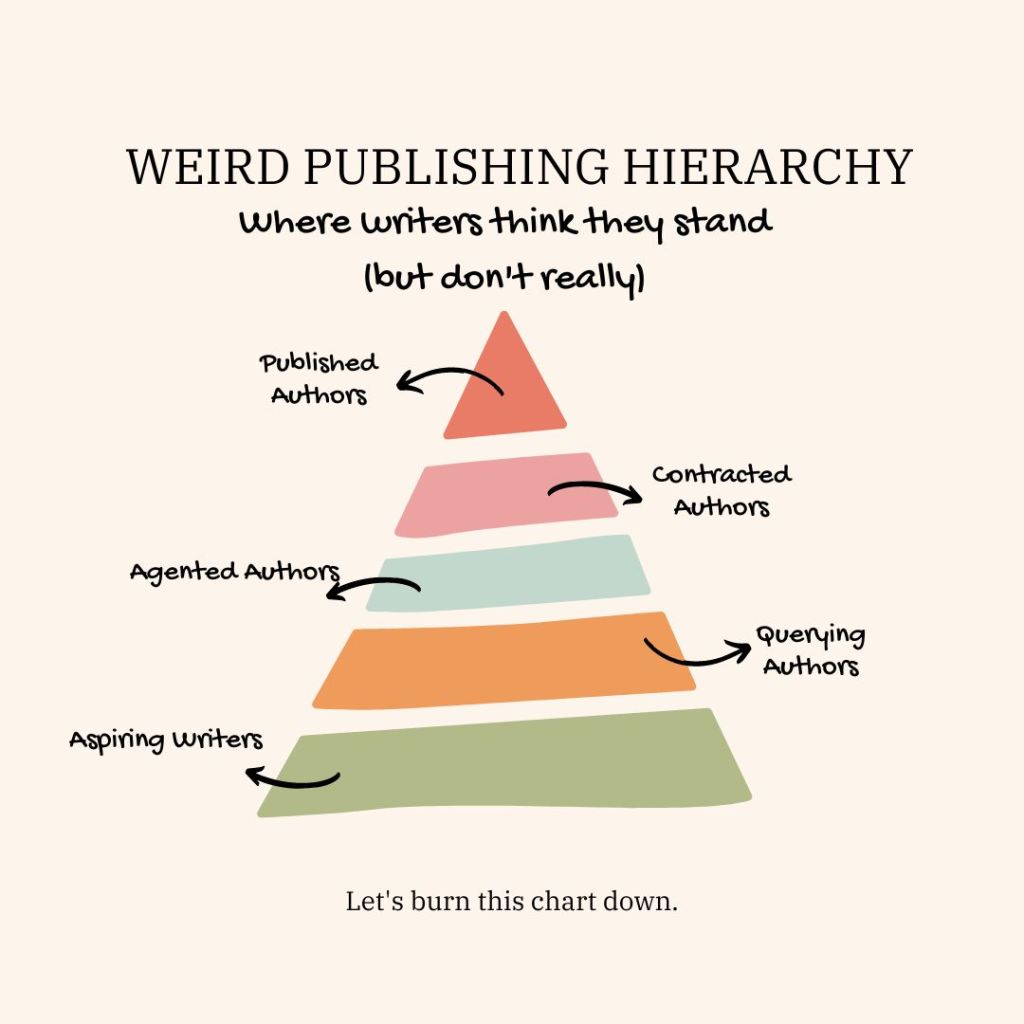
Chart: Title "Weird Publishing Hierarchy" which depicts levels. From bottom to top: Aspiring Writers; Querying Authors; Agented Authors; Contracted Authors; Published Authors. Subtext: Let's burn this chart down.
If this chart makes you uncomfortable, good. Me too. Let’s do something about it.

If you’ve been around long enough, you’ll have had the weird experience of watching your friends level up through this chart. You’ll have also likely seen some drama around people leveling up through this chart and leaving their friends behind. There is nowhere this phenomenon happens faster than in Pitch Wars. And if you’re on the inside of it, you get to watch this weird hierarchy play out in rapid fire fashion as some folks level up and others do not. Right now, at this very moment, my Pitch Wars peers are basically at all levels of this chart. The first book from my class comes out soon. Many book deals have been announced. Even more agent announcements. Still more of my classmates are querying new books, still looking for their agents. Some have veered off the traditional path all together, choosing indie presses or self-publishing. Some, like me almost, stepped back from writing all together.

But the thing I noticed while watching this all happen was that it’s not always as simple as “level up, leave behind.” There is so much more nuance behind it. I, for one, in my grief, tried to leave my core group of Pitch Wars friends… a couple of times. I felt like I was dragging them down, holding them back, being too depressing, dampening their joy. I felt like I was too lame for them with their fancy Big Five book deals and big shot agents. They, thankfully, dragged me back.

Now that I have an agent myself (weird), I also notice there’s a bit of a dynamic put on authors at perceived “higher” levels from those “beneath” that makes this all the stranger. My opinion seems to automatically matter more because I have an agent, which honestly, y’all it shouldn’t. It’s luck. You will never see me giving away a query critique because my query stats are objectively terrible. I still can’t write a synopsis. Don’t misunderstand, I learned a lot from Pitch Wars, and I continue to learn about my craft every day from writers everywhere on this pyramid. I will speak on what I believe I know enough about to speak on, but my advice is no more valuable than anyone else’s and in many cases, my un-agented CPs know just as much if not more than I do about loads of craft things.

All this long winded thing to say: We’re all writers. We all have valuable advice to bring to the table, and none of that is earned by any milestone along the way. It’s earned the way all knowledge is earned: by study. So don’t let where you are on this pyramid thing define who you are as a writer, and don’t let it change the way YOU act around other writers (you can’t change how they act around you, obviously, but one side of this can be controlled at least). If you feel your friends leaving you behind, ask yourself, truly, are they? Or are you?

TL;DR Don’t push your friends away because you think you’re not worthy of them anymore because they got a Fancy Book Deal or a high profile agent. If they’re your real friends, they are not going to give a shit. They’re still going to crack jokes with you about opening pickle jars and ask you for cat pics. Because besides all being writers, you are first and foremost all friends.

Picture of a gray and white cat sitting in front of a bowl of pickles.
Apropos of absolutely nothing, I JUST SO HAPPEN to have a picture of my cat Hope with pickles.

So, to my Pitch Wars 2021 Class, happy one year post-showcase. I am so proud of each and every one of you. And I can’t wait to see what the next year brings.

Xoxo,

Aimee
Opening up the Shelf: Adult SFF

Author’s Note: Today, I am going to talk about my #PitchWars book ALL HER WISHES specifically, but only as a way to address some swirling thoughts I’ve had about adult fantasy in general. For those who don’t know, my 2021 #PitchWars book ALL HER WISHES is a dual-POV, adult fairytale retelling told from the POVs of a selfish fairy godmother who hates her job but is trying to be good at it in order to save her best friend’s Destiny, and the villain (who happens to be the MC’s ex) who is trying to sabotage all that for, well, vengeance, obviously. It is an enemies-to-lovers, second chance love story set within a fractured fairytale world.

When I submitted to Pitch Wars in 2021, I entered All Her Wishes as a Romance (with a capital R). At the time, I had no idea what it actually was. What I did know was I’d never read anything quite like it in Adult Fantasy, though plenty of things like it exist within Young Adult Fantasy. I figured it would never “make it” if I endeavored to set it on a Fantasy shelf beside Tolkien and George R.R. Martin and All the Characters Who Stab. There are no swords, no graphic violence, no wars, no epic quests. There’s no need for a map (I can’t read them and neither can my main character), no invented languages or species, no explanations of geography or the genealogy of my characters going back 700 generations.

I didn’t love the idea of submitting it as a Romance, because somehow, it felt like cheating. But I had sent a few queries prior to Pitch Wars and the only feedback I’d received was “Sounds adorable! I’ve checked with some people, and no one knows who or how to market it.” So, somehow it seemed like because Wishes didn’t have all the above things meant it was “lacking” and therefore not Fantasy and maybe? a? Romance? Which, also felt gross. Because Romance, for the record, is not lacking in shit. Seriously, stop saying, believing, perpetuating any stereotype that Romance is anything but the badass queen of the publishing castle. Facts: Romance is the highest grossing genre in publishing (at $1.44 billion in revenue last year, take that to the bank and suck it). Romance authors are kings and queens of their art, and they deserve so much credit for what they do. The fact they don’t get it is a whole other blog post for another day. Also, Wishes’ love story does not make it less of a Fantasy.

A white woman with auburn hair in a green gown leans back against a tree, pointing her wand downward while a white man with dark hair wearing a dark jacket leans toward her, holding his hand to her foot.
Am I going to take this opportunity to drop this beautiful artwork for the book despite the fact it is everywhere on this website? Absolutely. Image © Jaria Rambaran  

Good news, my mentor also didn’t love that I’d submitted it as a Romance. Primarily because it hit NONE of the Romance beats and to make it do so was going to be a Herculean task that might have destroyed the structure of the actual story. We spoke at great lengths about my feelings on whether it was primarily a Romance or a Fantasy, and though I said to her I didn’t have strong feelings either way and in private said to my friends I would make it whatever the hell she wanted if it got me into Pitch Wars, the more I started to think on it, the more I realized I did have strong feelings about where Wishes ended up on the shelf.

ALL HER WISHES is Fantasy, capital F. It’s a story about magic, about friendship, about villains and heroes and the mistakes they make and the prices they pay. There are princes and princesses, fairy godmothers and evil queens, multiverses, and magic systems. There is world building and palace intrigue, and yes, there’s a whole lot of kissing, and because it’s adult, sex too. There’s love, but when did Fantasy stop becoming Fantasy because there was love?

Would Neil Gaiman’s Stardust find itself on a Romance shelf because it’s primarily the story of a boy out to win the heart of a girl and in so doing falls in love with another? What about one of the most quintessential epic fantasies of all time, the Wheel of Time series where the main character, Rand Al’Thor, is involved in a polyamorous relationship with three women? Do we discount the romance in that series because there’s enough words around it to ignore it? What about a more recent example in Jay Kristoff’s Nevernight? Mia Corvere, that series’ main character is about as ensconced in romance as she is in blood. Or do these authors get a pass because they’re *AHEM* white men? It’s fine, y’all, they’re writing MANLY love stories. Which is totes fine. Manly man’s masculinity is not threatened as long as the love story is also written by a man, am I right? Okay, I should sit down before I refuse to get off this here soap box. WHOOPS.

Drawing of a white girl in a blue dress with a purple bow standing on a soap box washing on a wash board over a large basin of water.
Oh look, it’s me getting back into the time period I’m expected to be in. I kid, I kid.

As I worked on my revisions of Wishes throughout Pitch Wars, these thoughts continued to poke at my brain. Where did my book go on the shelf, and why was I so afraid to say with these others?

Afraid.

Yep. There it was. I was afraid. Because there exists in Adult SFF a sort of elitism not unlike what I remember from my undergraduate days at UNC spent arguing Chekhov and Hemingway and preparing for an MFA at Iowa. Because obviously you go to Iowa. That is the only option for a Serious Writer. In Adult SFF there is a similar feel to this lit fic like discourse that’s more akin to: Obviously you write epic fantasy of a political nature, heavy on the world building, light on the romance, or you are not a Serious Fantasy Writer.

It feels a little… Gamergate to me, truth be told. And after I got done being afraid, I got irritated. If you couldn’t tell.

The thing is, I believe all genres should be for everyone, which means we have to tell lots of different kinds of stories within our genres to welcome lots of different kinds of people into not only our genres, but reading in general. That’s how we cultivate growth, and learning, and a body of literature that expands our experiences beyond what we know which is literally one of the main points of all reading but especially freaking fantasy!

So it’s time to open up the shelf to new stories that go beyond the old elitist thoughts of what Adult Fantasy should look like. Stories that include subgenres like urban fantasy, and contemporary fantasy, and yes, fairytale retellings, and stories from non-western mythos, and romantasy. And stories written from different perspectives than we’re used to seeing. Stories from women, and POC, and LGBTQ folks, and ND people, and disabled people. I want to see stories about Black grandmas riding dragons, 20-somethings in wheelchairs shooting flames from their spokes and owning their sexuality, and stories about brown women trying to juggle being the badass court sorceress while being pregnant and having a baby. It’s time for a new canon of fantasy that is relevant to the readers who fell in love with fantasy during the YA fantasy boom brought on 20 years ago.

Because guess what? We aren’t teenagers anymore, but we still like fantasy. And sure, some of us do like politically epic fantasy with sprawling worlds and all that other stuff (although I can bet you based on my anecdotal research a fair few more of them are reading R.F. Kuang than they are Robert Jordan these days). But loads of us want a fresh array of new stuff. Short stuff. Different stuff. Weird and wacky stuff. Stuff that is relevant to our lives and our world and yes, that’s important even if it’s a fantasy.

Book cover: The Remarkable Retirement of Edna Fisher by E.M. Anderson. A red cover with a dragon flying over a city skyline.
I would be remiss not to mention my agent sib has just such a book coming out soon. Which you can preorder HERE.

So here’s my plea to not only publishing but the readers who love my genre as much as I do: Support new voices in Adult SFF. Writers and readers alike. Don’t push them out because they’re different or you think the books they write or the books they like aren’t “serious” or otherwise “enough” of something for you. If they haven’t read all of the Lord of the Rings books, they can still love Fantasy. If they don’t know with perfect precision the specs of every species from a series they say they love, they can still love that series. If they don’t know which superhero fits into DC or Marvel, they should still be welcome. There should be no criteria to liking fantasy books other than, well, liking fantasy books.

Welcome them! Open up the shelf! You never know, they could be the author who writes your next favorite book!

Xoxo,

Aimee

I Stand with the HarperCollins Union

Authors note: For those reading who might not be aware of what it is currently going on with the strike, please read HarperCollins Union’s press release and other info (including how to donate to the strike fund) at their LinkTree here. For purposes of this post, it should be understood that to “Stand in Solidarity with HarperCollins Union” as an agented author means that you have agreed to withhold submitting your book to any HarperCollins imprint until such a time as the bargaining unit employees have a new contract. For me, this means that if the union is still on strike by the time ALL HER WISHES is ready to go on submission, my agent and I have agreed we will not submit it to HarperCollins or any imprint of HarperCollins to honor our commitments to the strike (my agent has signed a similar pledge in relation to agenting, so we are 100% united in this commitment).

1/26/2023 Update: I started drafting this blog post a few days ago with the plan to publish it on day 56 (week 8) of the strike, which is today. Today, finally, HarperCollins management has agreed to mediation. THE UNION IS STILL ON STRIKE. HOLDING THE LINE IS MORE IMPORTANT THAN EVER.

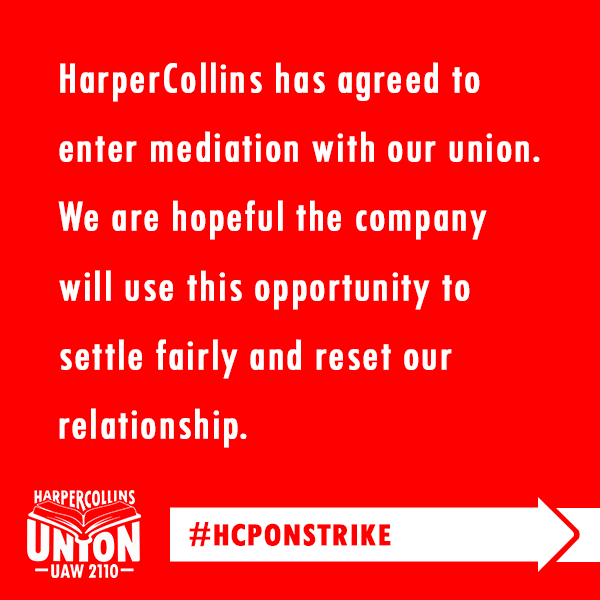
Taken from HarperCollins Union’s Twitter. Text reads: HarperCollins has agreed to enter mediation with our union. We are hopeful the company will use this opportunity to settle fairly and reset our relationship.

In my home, #Unionstrong is not just a hashtag on Twitter. It is a lifestyle. My grandfather was a steelworker from western Pennsylvania. My grandmother was a charge nurse in a nurse’s union during a time when many women weren’t “supposed” to be working at all. Much of the rest of my family has union affiliations running through their blood as deep as the coal dust from the mines they find themselves in. My partner is a shop steward for a local Teamsters Union. I have spent many a night sitting with him at our kitchen table, pouring over their contract and proposals while he texts his crew about whatever is going on in negotiations.

Graphic of white hand holding white pencil with text: I SIGNED The Strike Solidarity Open Letter

Interestingly, as it relates to my union affiliation, I spent over a decade of my career on the other side of the table: the management side. Before you skewer me, let me explain. I was a paralegal and benefits specialist for a law firm that had a unique relationship with labor, because we served as co-counsel to a ton of Taft-Hartley funds (multi-employer benefit funds that must be overseen by an equal number of management and labor trustees). We were not union busters; we were there to cultivate genuine relationships between management and labor.

You know, like how it’s supposed to work.

I have updated this post because today, finally, HarperCollins has agreed to mediate. But that still means that they went 55 days without saying a word. It means that their employees are still on strike for day 56. That’s eight weeks. Eight weeks that these employees have been without pay. Two months. Think about that for a second. Think about what going two months without pay would mean for you and your family.

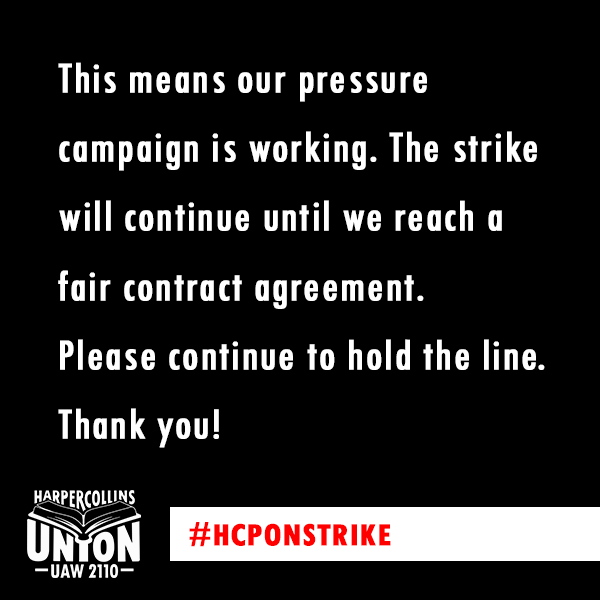
Taken from HarperCollins Union’s Twitter. Text reads: This means our pressure campaign is working. The strike will continue until we reach a fair contract agreement. Please continue to hold the line. Thank you!

Now, think about the fact that this is a bargaining unit consisting of 250+ employees across editorial, sales, marketing, publicity, design, and legal whose average salary is $55,000 a year in New York City. You know, the most expensive city to live in in the United States. The city whose median home price is $850,000 and median rent can be anywhere between $1,900 to $4,500 a month. Source and Source and Source. Doing a little rough math for taxes based on that tax bracket and factoring in New York City taxes, assuming standard deduction, you’re talking about a take home pay of about roughly $1,600 biweekly if you don’t have deductions for things like healthcare, 401(k), a health savings account, or a flexible savings account, etc. So, less than that, really. Or an inability to have insurance. Or save for retirement. Cool options.

Now, think about donating to the strike fund HERE.

That’s all based on that $55,000 average salary that HarperCollins Union talked about in their press release. But the wild thing is that isn’t even the point of contention! While there are a few things at issue*, when talking cold hard cash the thing the union is striking for here is to increase the starting salary from $45,000 a year to $50,000 a year. A measly little $5,000 a year. Listen, I know my day job is in software, so I’m obviously a gluttonous snowflake who doesn’t work and feeds on the wokeness of the masses or something, but I’m telling you $5,000 a year for new employees to a company that reported $487 million in revenue and $39 million in earnings in its last quarter (a BAD quarter) is not a lot of money. Source.

*Union security being one which when I tell you how hard I laughed, like omg please union security clauses are standard and a non-issue, in a decade plus of doing this kind of thing I have NEVER seen a union security clause disputed like what is even happening there? Please explain, HarperCollins.

Oh wow, so I went wandering a bit. Sorry, I fell down a capitalism rabbit hole and couldn’t seem to find my way out. Give me a moment to just reset here…

GIF of Alice from Disney’s Alice in Wonderland falling down the rabbit hole.

Right so that’s all well and good but probably if you’re here you know all that. Well, you might not have known that specific level of detail on the math because that was maybe a little intense, but you probably understood the basics of HarperCollins is a big company that makes a lot of money, New York City is very expensive, and these people are underpaid because LOLZ who isn’t. Thanks, America.

But back to me, because this is my blog, and I’m here to talk about why I personally stand in solidarity with the HarperCollins Union despite the fact that it is scary as shit as a baby author to be like hahahaha no, who needs you, Harper? And your… million imprints. I… definitely… do not. Heh.

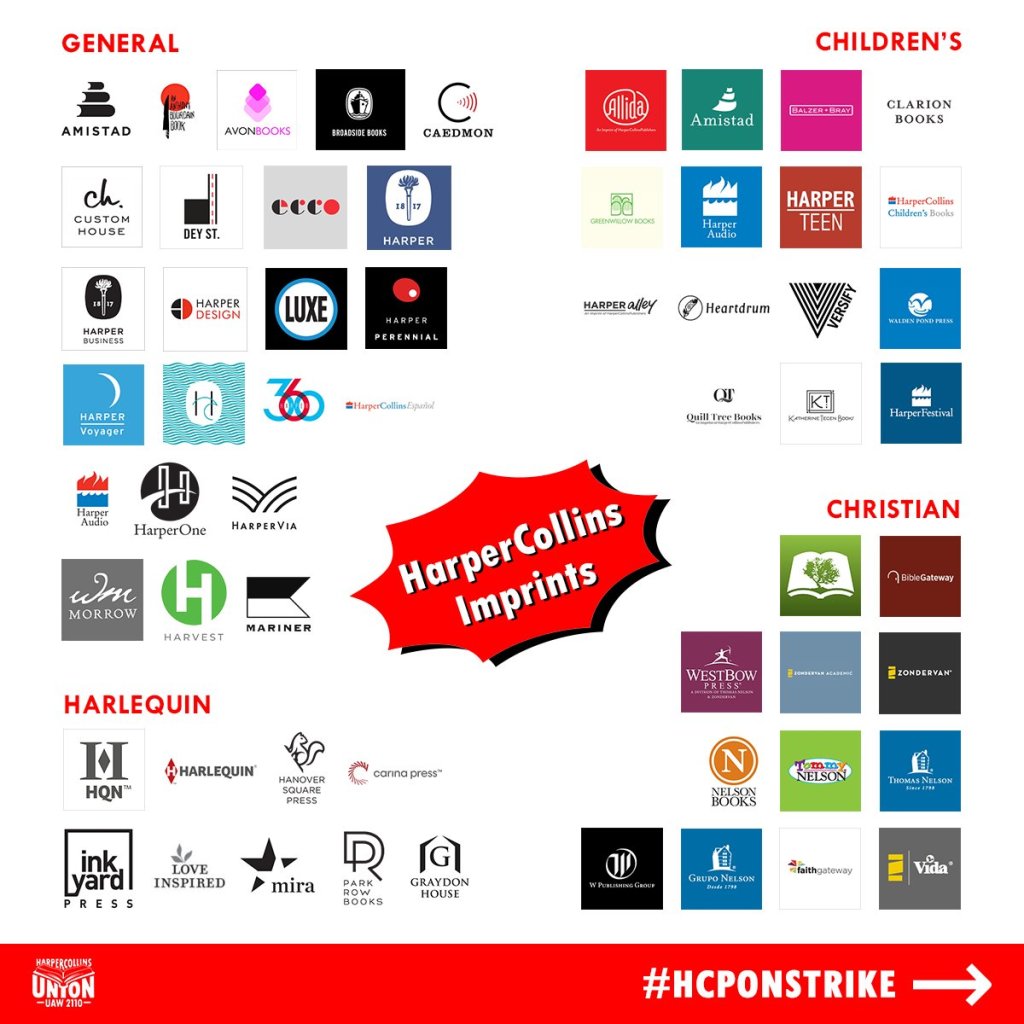
Graphic showing all of HarperCollins imprints. Taken from the HarperCollins Twitter. Original tweet reads: We’ve been getting some asks about this, so we wanted to clarify: we’re requesting that submissions, reviews, & freelance work are withheld from all parts of HarperCollins US, regardless of imprint, until we get a fair contract to minimize union work performed without us.

Wow, they just keep going, huh?

Anyway, I would be lying to say it wasn’t terrifying to have those imprints just POOF off your submission list when you’re a baby author. Still, when I had The Call with my agent, high on my list of priorities was that Keir knew I was with faer in the commitment to not cross the picket line. I knew Keir had signed on to the open letter put out by agents late in 2022 declaring they would withhold submissions from Harper in solidarity, and I wanted faer to know this was also my desire even though it was scary.

Why?

Because I believe in unions, like I said. They are a deep part of my life. I believe in fair wages, even if I don’t believe $50,000 is even pushing it far enough, but hey, it’s a start. I believe in diversity, and I believe it is more than a trend or a marketing tool, but if we want to make it more than that, we will have to work harder and be better and do the right thing even when it is the hard thing. Lord do I know that. I also understand the complexities behind making a profession passion-based and how it disproportionately excludes marginalized groups. I myself almost had to leave my publishing dream behind because of my disabilities. I got to the point with writing and querying and writing and querying and working a high-paced, full-time job to pay the bills that I was so burned out I was throwing up blood. I had migraines so bad I couldn’t get up for days at a time. I almost had to be hospitalized. I found myself at a crossroads: Keep it up or die. Pay the bills or publishing.

Too many of these employees are facing similar choices and publishing is already their full-time job.

We are watching publishing professionals leave the business in droves. Agents, editors, publicists, marketing folks. They’re burned out. They’re working multiple jobs, eighty hour weeks, and they barely have two pennies to rub together in the most expensive city in the world. This trickles down to authors and querying writers. Less opportunities, less people to advocate for us, longer wait times, heavier lift on what kind of work we have to produce but yet smaller advances. The list goes on.

What hurts one of us, hurts us all. That’s the whole point of a union. Stronger together.

So yeah, looking at that list and knowing those are opportunities potentially missed is scary. But what’s scarier is knowing that if I don’t do something in whatever small way I can might mean that in the end, we all lose. And that’s a future I simply want no part of.

#UnionStrong

Aimee

P.s. Have you donated to the Strike Fund yet?