Rejection Sucks: A True Story

Author’s Note: Hard truths time. Before you go in, some disclaimers about where this is going so you can read it in the right headspace. This isn’t a subtweet blog, but it does vaguely track the relevant discussion of the publishing hour (how an agent rejects you) and my vast experience being rejected by pretty much every agent in this business (including my own at one point). It’s for newer writers and is more relevant to 2023 than not. It’s not particularly positive (or I would argue negative, it’s honest). It’s based on my experiences in both self-publishing and traditional publishing over the past decade, though focuses mainly on traditonal publishing. It can thus be reflective of only one person’s point of view, which as I like to remind folks is white and cisgender. It contains minimal advice except some tricks I’ve seen used and to practice mindfulness and self-care. Finally, I think it’s fair to note that I am (finally) agented, so I do have a rose-colored perspective on querying (sort of, lol).

Content Warnings/Trigger Warnings: Discussion of rejection, loads of it.


Welcome to Publishing, Everything Sort of Sucks Here

I’ll be the first to admit that when I (re)entered the querying trenches in 2017, I was not prepared for what I was about to face.

Neither failure nor rejection were particularly new to me. I was querying on the heels of what I considered two failed self-published books. Those books were rejected by what felt like the world. They had also been specifically rejected by hundreds of bloggers, bookstagrammers, and Goodreads reviewers* who I had to pitch to one by one, according to their varying instructions. Those emails were frequently rejected and ignored. Sometimes, they were accepted, only for me to spend dwindling money on printing and shipping to the result of no review. Once (only once, a victory, honestly!), one was read, resulting in my first one-star review.

Not so unlike querying, truth be told. Except querying never cost me hundreds of dollars.

*(No shade to reviewers, by the way, an honest review is an honest review, and your time is your time! You’re as unpaid as the rest of us, I mention this experience only for a close comparison to the traditional publishing world’s rejection to link the two together).

This is what I told myself as I prepared to query (for real, as an adult) my first novel.

I was ready.

The first of many lies I would tell myself over the next five years.

The Rejections

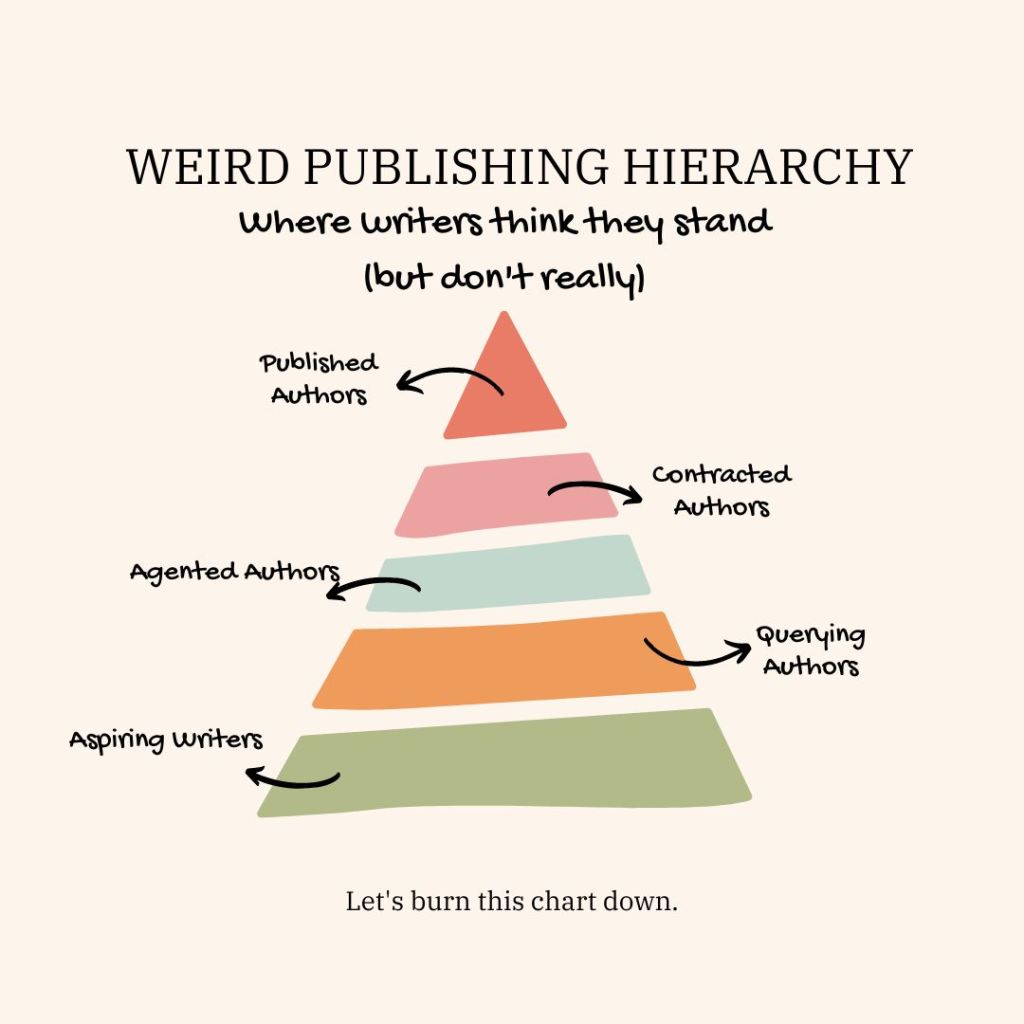
It’s been awhile since I did a nice chart here, so let’s start with one of those then break it down from there.

Chart showing three different types of agent rejections in 2023 which will be broken down in full but are: The Form, Personalized, and Feedback.
Image made using Canva.
Was this a pricing chart before I reformatted it? Maybe. Is it missing Closed No Response? Yes. Did I try to reformat it and give up? Also yes.

The Form Rejection

In 2023, the form rejection is the most common type of rejection to receive (besides potentially Closed No Response, more on that at the end of this section). I hear legends this wasn’t always the case, but for me, it sure as shit has been, so I’ll take people at their word when they say that wasn’t true in 2017. (I also hear that a 20% request rate was a perfectly reasonable thing to aspire to in 2017 but again, rocking that big goose egg for years over here, so I’ll have to believe other people when they say that).

What does the form look like? Well, it depends on the agent. Some agents have forms that say “This is not right for me, but thank you.” Some agents have forms that are so un-formlike I (and others) mistake them for personalized rejections. Some agents have multiple versions of form depending on what (in their mind) went wrong (thanks for submitting this, but I don’t accept this genre versus thanks for submitting, but I didn’t connect the way I’d hoped, for example).

If you’re new to querying and aren’t sure what might be a form, the best way to figure out if you’ve been formed is to go to QueryTracker and read the comments for that agent. Lots of people will record what the form for the agent is or what they believe it to be. If you received the same thing as others, you’ve been formed. Try not to stress, it happens to literally everyone at least ten times (or ten dozen). (If you did not get formed ten times or more, please happy dance elsewhere, this post is not for you).

Screenshot from Querytracker that reads: Same form as others: 'Thank you so much for giving me the chance to consider ______. It's clear that you've devoted a lot of hard work to this project, and your passion comes through in your writing. However, while there is a lot to be commended, I didn't have a clear editorial vision for the project and thus don't think that I would be the most effective champion for your book.'
Sample of someone reporting a form response on Querytracker. I didn’t pick on this agent if you know this form, I literally just signed in and clicked on the first form rejection I saw on my account and scrolled through to find this.

When I started querying, I hated form rejections. I particularly hated form rejections of the “this isn’t for me, bye” variety. I hated them for all the reasons many new (or newly querying) writers hate them. Because they didn’t give me any information about what was “wrong.” And there’s so very much that can be wrong. The query, the pitch, the idea, the pages, the writing, the genre, me.

What. Was. Wrong.

If I knew what was wrong, I could, presumably, fix it.

Hard truth. A lot of the time, you can’t. I’ve said it before, I’ll say it again. If you’re doing The Things (getting beta reads, critiques, improving your craft, putting together a strong query package, listening to fedback and taking it, etc.) you’re probably doing nothing wrong. You are simply having bad luck.

I also hated them because they felt cold. Some didn’t have my name, or the title of the book. I had no indication if the agent had even read the damn thing.

Hard truth. They are cold. I don’t know these people. They don’t know me. I’m a drop in the bucket. It isn’t personal. Therefore, it doesn’t feel personal. That hurts because it is personal. Here I was, putting all this time and effort into something, no not just something, my dream, and on the other side of a screen someone didn’t even take time to read it! It felt unfair. Unjust. Wrong.

Yeah, there’s that word again. Wrong.

I thought if I could prove to an agent I work harder than everyone else I could show I deserved this more.

Wrong. Wrong. Wrong.

I don’t work harder than everyone else. I work hard. There are people who work harder. I know that without a doubt now. I admire these people. Envy them. Sometimes worry about them. There are people who deserve this more. I feel guilty about that. Frequently. There are better writers than me. People who I feel have stories more worthy of being told. My distinguishing factor is I was determined and lucky. I hope loads of others will be too. Some of them already have been, and I cheered for them harder than anyone.

After I got over myself, of course. Some days I still need reminidng, and humbling, yes. That’s normal. Human. Don’t hate yourself for it, but do try to be better in spite of it. Be kind to yourself when you fail to be better, then try again. Forgive when others around you inevitably fail (and with the exception of a few, most everyone will fail at this along the way).

Anyway, back to rejections.

By year four of querying, I started to prefer form rejections. Better than a no-response. Better than a personalized rejection that made me wonder if the agent liked it why not request? Better than feedback that suited one agent but not another. Forms were tidy. An answer to pilot me to QueryTracker to mark this one closed and move to the next. In and out like a wave.

Image of a wave. 
Sourced via Pixabay.
Were they gentle like a lightly lapping wave? Not really, no. Did some of them hit me in the back like a newbie surfer, dragging me off my board into the depths of existential fear? Sure. Was I probably disassociated by year four and rejection many hundred? I mean, yeah. Listen, I said they were like a wave. That can be all kinds of interpreted.

Also by year four I had (sort of) learned that I wasn’t really doing anything wrong and even if I was, agents weren’t here to teach me about it. I had to learn from other writers, from critiques, from doing the work. But more than anything, I needed the right idea at the right time pitched to the right agent in the right way.

Honestly, it’s shocking it only took five years and four books.

The Personalized Form Rejection

According to the Wisdom that Was, personalized form rejections used to be much more common than they are now. Again, I never saw one until Pitch Wars, but I’ll believe people. They’re not common now. At all. If you get one, celebrate. Believe it or not, this rejection is a victory. It’s the partial request of the new querying era. Someone liked your work enough to spare the time to tell you (even if it’s a line, in this overworked, underpaid industry, a line is money not made so you earned that, celebrate it).

If you’re not sure what a personalized form rejection is, usually it’s the form plus something a little extra specific to your book or pages. Maybe it calls out a character or a particular element of your world the agent thought was interesting or unique. Maybe it’s more generic. I received one for my Pitch Wars book that said, “I definitely remember this one from Pitch Wars!” Then go on to praise my writing and premise.

Personalized rejections are (in today’s market) an indicator that your query and sample pages are “working.” They aren’t a reflection of your work.

Hard truth. They still feel that way.

If there’s one thing that’s true in this business, there’s two. Here are two things to know about publishing and personalized rejections:

  1. The goal post will keep moving, so celebrate every win as best you can (this is harder than it seems and doesn’t get much easier). When I was in the query trenches, I always seemed to be doing Worse Than Everyone Else. Friends would bemoan their losses and I would envy them for where they were. Must be nice to be sad about a personalized rejection. I’ve never gotten one. Then, one day I got one. Annnnnd was sad about it. Quickly, my bitterness turned to Must be nice to be sad about a partial rejection, I’ve never had a request. Then, one day I got one. Which wasn’t good enough because it wasn’t a full. Which wasn’t good enough because it wasn’t 10 fulls. You see how this escalates. It’s hard. Keeping your eyes on your own paper isn’t really possible with social media or writing friends and you need at least the latter, I’ll be honest. You’re going to compete against your friends, your peers. You’re going to feel these feelings (probably, or maybe I’m the only asshole, but I like to think not). When you do, acknowledge them for what they are, and keep them on the inside or with an extra trusted friend or two. Better, have a friend to call you on your bullshit, gently and with compassion, but honestly. Megan Davidhizar is mine (ps if you like YA thrillers you should totally Add Silent Sister On Goodreads, it’ll blow your mind I should know I read it FIRST and told her then it would be The One which was of course, correct). Megan parrots my own advice and moving goal posts back to me with the memory of an elephant, and the humor of a patient saint. “Oh, look at that, remember when you said LAST TIME this thing then you moved your own goal post? Funny how it becomes impossible to do things.” Okay sure, fine, she’s right. My sincerest wish is you all find a Megan to annoy the shit out of you with the exact right amount of tough love plus validation you need.
  2. “Near misses” are a thing to seek and destroy from your brain. The concept of a near miss is somehow more haunting than a flat out nope, goodbye. It’s like that partner you break up with not because anyone did anything wrong but something just wasn’t quite “right.” The person you think about every once in awhile, a nagging worm in your brain. You know the one. The one who got away and left you with this whole world of possibility you didn’t explore for reasons that aren’t entirely clear. The one you think about reuniting with on an Oprah episode in some serendipetous act ten years in the future “First Loves Reunited.” After all, it wasn’t bad it just wasn’t right but that could have been fixed, couldn’t it? Nope. That person is not The One. And your book, I’m sorry to say, was not the agent’s The One. There was nothing fixable to make it “right.” Not because it was horribly broken but precisely because it wasn’t. It’s fitting a square peg into a round hole. The square is perfect, the circle is perfect. They just don’t fit. Acknowlege you wrote a great square and you need to find your square hole, and do your best not to let that near miss eat you alive. Easier said than done, I know. Which is why I prefer the form rejection now!

Dog and cat square off. Dog face on left is Jack Russell type. Cat on right is calico. 
Image sourced via Pixabay.
Why this rando image you ask? Well, because the dog on the left looks like Megan’s dog and the calico cat on the right is sassy because calicos always are which is how I feel today. Plus dog and cat, square peg round hole, fits both points. Now you know how my brain works. Welcome to the circus, it’s weird in here sometimes.

Feedback

All right, I’ll be honest here, I don’t know too much about feedback because I’ve literally only received it one time, and it was from my now-agent on a book they passed on prior to offering on another book. The feedback was lovely, in depth, and kind. It made me want to revise the book, which I did. It resonated the way a CP’s feedback resonates, and was in large part the reason I queried my agent with another book immediately thereafter despite having quit writing forever. Because I know feedback like that from anyone, but especially an agent is rare.

Feedback in a rejection (i.e. not a request to revise and resubmit) can be a bit perilous, however. What one agent dislikes or thinks should be revised isn’t always the same and feedback is so rare these days it’s unlikely you’ll get enough of it to see the same thing repeated often enough for you to say okay yes, this is the market saying I need to revise this, or this is objectively a hole in the craft, or whatever. Revising your book for an agent who didn’t offer on it can change something another agent would have liked. Or, it may change absolutely nothing but waste time you could spend working on a new project. Worse, you’ll never know which it was, so there’s a good chance you’ll end up doing that should I should I not have dance forever more. Or, for awhile, anyway.

The best advice I have on feedback is to take it and run with it only if you know in your gut it will make your book better for you. Not anyone else. You.

The book that my now-agent gave me feedback on? I revised it after I’d shelved it. Because I wanted to see if I could make it better. Because the feedback made me excited to write again. I revised that book one final time for me and no one else. It’s a better book for it. I’m a better writer for it. Revise to make the book better in a way you believe in, and your decision will hopefully be easier to swallow regardless of what happens.

CNR (Closed No Response)

Okay so first, CNR means Closed No Response. It took me more years than I’m willing to admit to learn this, so you’re not alone if you’ve been head scratching.

What it means is the agent didn’t respond to your query. That “No response means no” policy you see on many agent websites these days. Next to the form rejection, the CNR is probably the most common form of rejection these days (maybe more common?). It’s the source of much controversy and despair. I hate it. I’ll never learn to accept it. Well, I could, but the only way I could publishing will never be able to accomplish, so I suspect we can both continue to stubbornly ghost and glare.

The way, you ask? Well, as a neurodiverse individual, I could probably be persuaded to grudgingly accept the CNR as I’ve accepted the other forms of query rejections if it followed rules. The hardest thing for me with the CNR has always been how erratic it is. No response means no except not always. No response means no within 6 weeks not in 2023 though, lolz. No response means no for some agents here but not others but good luck figuring out who.

I’m not faulting agents for this. They’re busy. It takes time to send even a form rejection. Time they don’t have because they’re not getting paid unless they’re selling books. Timelines are impossible to keep. Websites are obnoxious to update, so updates are pushed to the neverending to do list of small business life.

It’s a reality, though. CNRs are hard. And sometimes they aren’t actually CNRs. Rejections you closed out in QueryTracker (and your heart) pursuant to a no response means no policy might come again in a form months later. They sneak out of nowhere and knock you right off that surfboard. Shitty, silent waves.

Hard truth. All you can do is brace yourself for them.

I have a CP who marks every single query CNR in her spreadsheet as soon as she sends it. Something about ticking a box from “mystery void” to “known rejection” makes her feel better than taking an empty box and ticking it to “mystery void” after months of waiting (and potentially getting hit again months after with a form). It makes a certain kind of sense to me, really. It’s killing the hope before it gets a chance to breathe. One of those it can only get better from here kind of tactics.

The Conclusion of Care

In my author’s note, I said this blog doesn’t really have advice. I guess it has some, but I don’t profess to know the secrets for everyone. Different things work for different people. I always recommend setting up a separate query email just for that, then turning the notifications off. I know people who have loved ones take control of their query inbox, filtering out rejections for them. Others who only check the inbox when they have the ability to take on the rejections.

Some people try to find meaning in every form, every word. Some people find solace in research, in trying to perfect the query for every agent. Others say fuck it and send queries to everyone (but never in a blind copy or absolutely not carbon copy sort of way). Some people have to space out rejections by querying in batches of 10-20, others prefer the “bandaid method” as I call it of making the query package as strong as possible, then querying every agent on their list all at once.

I’ve done it all. None of it has made the rejection easier.

Image of a fan of cards that all say no. 
image from Pixabay.
Friends have made it easier, though. If there’s one piece of universal advice I could give to everyone it would be that: Make friends. Now. Don’t wait. Don’t do this alone.

At the end of the day, rejection is rejection. Yes, it’s part of the business. Yes, you’re going to face a ton of it. No, I’m not going to preach thick skin because some people can’t do art without access to their skin. Me, for one. My trauma history causes me to disassociate when I’m facing a lot of upset. It helps me work well under pressure when the work I have to do is survive. When the work is logical and practical and decision-centric. It doesn’t help me write. I can’t access the feelings I need to write in that state.

What I need to do in those moments isn’t pull up my bootstraps and keep working. It’s grieve. Sleep. Cry. Scream (in private). Rage. Vent (in private). Then heal. And if and when I’m ready, try again. And again. And again.

Hard truth. Rejection is part of the business. There’s no easy way to do it or receive it. It simply is. Naked, plain, true.

Welcome to publishing, everything sort of sucks here.
Graphic of a pink flower pot with a pink flower growing out of it and a woman with black hair watering it with a green watering can.
Image sourced via Pixabay.
As Jerry Springer (RIP) used to say, “Take care of yourself, and others.”

GMC if you have C-PTSD

Author’s Note: This post is a more practical, craft-based post that relates to my recent post on character agency and trauma. After writing that post, I realized I had some practical application things I wanted to add that might be better as a separate post, so here it is!

Disclaimer: As with my previous post, please note that this is about writing for traditional publishing and any discussion regarding trauma is written from my lens as a white, cis, American writing within that storytelling framework. Please also note this post is about GMC as an author with C-PTSD/trauma not necessarily always about writing characters who have trauma.


During Pitch Wars, while most of my peers were reading Save the Cat! Writes a Novel and Story Genius and working on beat sheets, my mentor had me read a 26 year old craft book by Debra Dixon called GMC: Goal, Motivation, and Conflict: The Building Blocks of Good Fiction.

I loved it. It felt like finally there was a book explaining to me in simple terms the things other people intrinsically seemed to understand about character. For years, I’d tried to revise to advice about goals and agency and active protagonists that was either too complicated or too simple. Now, here was someone to explain what I was doing wrong. The trick is that having an active protagonist with agency isn’t just about having a character with a goal who does stuff. It’s having a character with a goal who does stuff to drive the plot forward. Having a goal of “Get home to eat some soup”* while it’s a goal the character might take action on doesn’t drive the plot forward.

*Actual example from the draft of my Pitch Wars book my mentor saw, by the way. Listen, someone told me the cure to a passive protagonist was to give them goals even if they were small. Turns out, this is not to be literally interpreted. The goal can be small but only if it moves the plot forward.

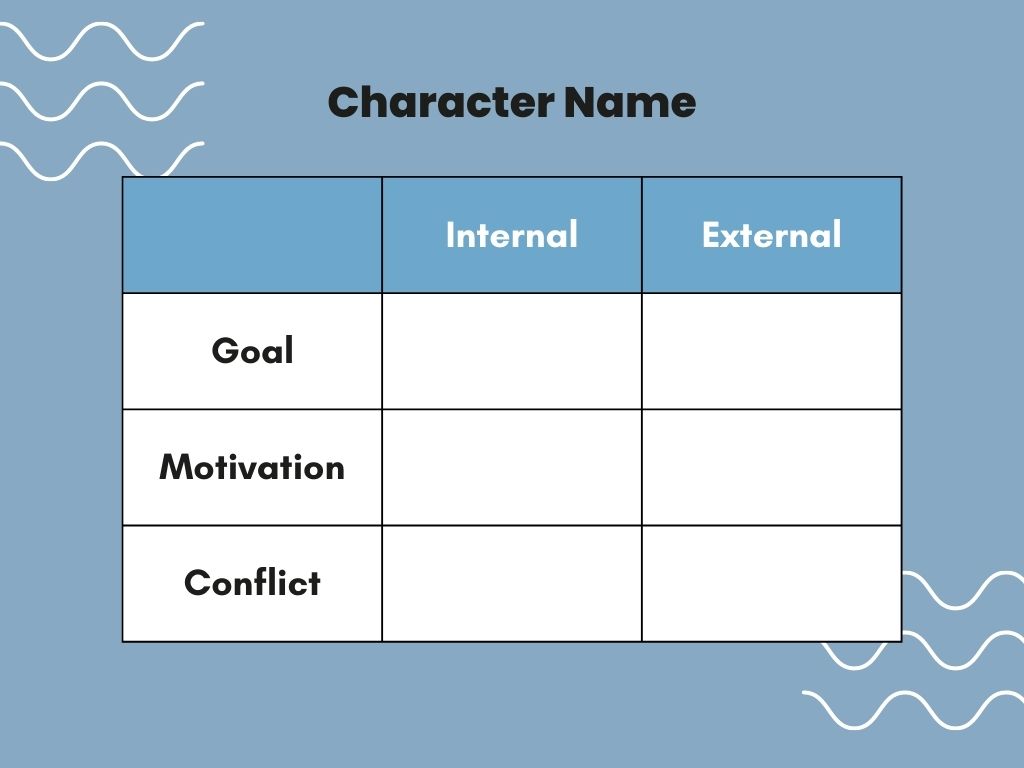
What I loved most about Debra Dixon’s book was it gave me easy GMC charts for stories I knew well. Particularly the ones for Wizard of Oz, one of my favorite movies of all time. I’m pretty sure it would be copyright infringement to share that chart in its entirety here, but the structure is simple:

Simplest form of a GMC chart. These can be wildly more complicated if you want to go there. I do not.

The very first thing my Pitch Wars mentor requested I do before I revised a single word of my book was to create GMC charts for my main character (the protagonist), the second point of view (the villain love interest), the main character’s best friend, the antagonist, and the secondary (tertiary?) villain (listen, unclear, this book has a lot of villains). Why? Because my arcs weren’t clear. Why? Well, I suspect because even after fifteen years of trauma therapy I still don’t really understand how agency works. Which is how I came to write this blog. But first! An announcement!

Write What You Know, Except…

Here’s where this whole write what you know thing gets a little off the tracks. “Write what you know” was another piece of writing advice that made absolutely no sense to me for most of my adult life. Again, because I interpreted it way too literally. All through my college classes I heard write what you know and bobbed my head while internally I screamed what the ever loving fuck does that mean?

If people only write what they know how do they write about dragons? Or even simpler, how do they write about people they aren’t? Not every character is a self-insert, or should be. Wow that would be… something. Clearly, we are constantly writing what we don’t know. This is terrible advice and yet here it is. Everywhere. All the time.

As I got older and started really writing novels and more specifically, focusing on craft for novels, I realized write what you know doesn’t mean that quite so literally. This might be obvious to some, most even, but it wasn’t to me. It took me years to figure out. Write what you know doesn’t apply to the external, surface level stuff. To plot. To dragons. To if your character likes tomato soup when you like broccoli cheddar (yeah, here I am with the soup again). It applies to the deeper seated things. Write about the human experience unique to you. Your pain. Your joy. Your identities. I also learned (something they did not teach in my writing classes, by the way) it means you shouldn’t write from those deep places you don’t know. The ones that belong to someone else. The stories that are not yours.

This started to make the most sense to me when my internal stories started to bleed onto the page without me realizing. Whole novels I thought were about magic and worldbuilding and friendship and questing. Whoop. Trauma. Whoop. Addiction. Whoop. Secret bisexual. Whoop. ADHD.

That secret bleeding is authentic to the unique experience of the writer. It’s writing what you know. But sometimes, it becomes necessary to trick the system a bit. NOT to usurp someone else’s identity, but to attempt to reclaim your own. And that’s when, in my opinion, the intellectual exercise of a GMC chart can really come in handy for someone with trauma. Because sometimes, you don’t actually know what you know well enough to write it, or to write it with intention and consistency. Or, through no fault of your own, you haven’t learned it. Such is the way with the loss of agency and the first two points of that chart: Goal and Motivation. So, you have to trick your own system (your brain) and write a bit of what you do not know to get to what you do (Conflict).

Goal

External Goal

For brevity (ha!) I know right? I’m going to focus on the main character in this post. But as I noted above, most of your major players should have GMC. Definitely your POV characters and your villain at minimum.

In its simplest form, the goal is the thing the main character wants. In fantasy, what I write, the external goal is usually the thing driving the plot forward. Steal the thing (heist), overthrow the government (coup), save the world (hero’s journey), become the next queen (palace intrigue).

For my Pitch Wars book, the external goal for my main character was “Save her best friend.”

External goals for me have always been a bit easier to figure out, because as I mentioned in my earlier post, having C-PTSD doesn’t stop someone from wanting things. For this one, I would say the advice given is pretty standard. Read widely and see what’s popular. Then give it your own spin. Fantasy stakes are often epic, as I cited, but there’s been a recent demand in the market for character-focused stories. Character-focused stories require character-focused goals. I don’t love saying anything is “overdone” or “dead” (especially as someone who writes fairytale retellings), but I will say a character trying to save the world isn’t always as easy to relate to as a character trying to save their best friend. Or their mom. Or their dog. Now, if their best friend just so happens to be the person most likely to fix the future of the world, well… I mean… you do you.

Internal Goal

The internal goal is what drives the character arc. The character is not always immediately aware of this goal, but you as the author should be. Usually, it’s related to the character’s emotional wound and is the thing that will be healed by the end of the book.

Oop, I used the word healed and hackles across the traumaverse raised. To be clear, your internal goal in a trauma narrative does not have to be (nor would I recommend it be) “heal their trauma.” Nor are character’s emotional wounds limited to one. Indeed, we all have scars aplenty, traumatized or not. When we’re talking about The Emotional Wound and The Internal Goal, we’re talking about the one driving the character arc forward for this one book. Good news for writers is that people are pretty fucked up and have many emotional wounds so loads of internal goals to work toward (meaning more books for that character which for us fantasy authors is key).

On a more serious note, for those of us with trauma, especially C-PTSD, you’ll know “healing” is not a linear journey made up of one thing but a patchwork of unraveling one thing only to realize you’ve unspooled seven others. Followed by fifty more. Which is why I say it’s probably not a great goal for a single book even if we wanted to convey the message that trauma can be healed (which is another post entirely, perhaps for my therapist to address). Regardless of whether you think trauma of that magnitude can ever be healed or should ever be healed, it’s simply too big to do in one book.

For my Pitch Wars book, the internal goal for my main character was to “find self acceptance.” This was related to her emotional wound: abandonment.

Here’s where things start to get a little bit trickier for someone with trauma, in my experience. Internal goals are where character arcs come into play. In theory, if you were plotting the points of your character’s emotional progression over the course of your book, it should look something like this:

Needless to say, the character arc for my Pitch Wars book did NOT look like this at first

First, I’m not a plotter, so part of my issue with *gestures vaguely* some of this, is that. However, some of my issues around internal character arcs are, I’ve discovered, related to trauma. My character arcs never look like arcs. They always look like EKGs. You know, this thing:

Image of a red line of an EKG machine. Image sourced from Pixabay.
Bless my Pitch Wars mentor for her fortitude, patience, and wisdom to put up with all this. WHICH! If you love a high heat contemporary romance with a cool ass setting, no toxic masculinity, a grumpy/sunshine trope and “Oh no, we’re snowed in” vibes, plus an arc that doesn’t look like an EKG, please check out her newest book, Abbeydon Attraction available NOW!

This has to do with the difficulty I have as a writer with trauma in understanding a smooth progression of emotion in any situation. The act of healing for me is never linear. It’s always this two steps forward, one step back tango of unraveled mess that doesn’t turn into a nice arc and is also apparently quite frustrating to read to anyone not me. Why? Well, because for most readers it reads as repetitive. “We’ve already done this with this character. Let’s move on.”

Pause. I know this is going to be a long blog. They always are, but it’s because I want to try to address the thousand thousand caveats which I know I can’t do but I can try, damn it.

Is it frustrating to you as a writer with trauma to hear that your authentic story reads as frustrating and repetitive to readers? Absolutely. Does it remain true? Also yes. I again repeat you can ignore every single thing I say in this blog as bogus and do it your own way. You can write the book of your heart about survival with no GMC and an arc that looks like that EKG machine. You can break every single rule in the rulebook. There is no such thing as advice that will lead you to success, nor is there advice you must follow to find it. All that exists is kind of in general information about the current ways stories are told in the United States. There’s information about why some things appear to work and others don’t. There are also examples of people saying fuck off with that, breaking the rules, and everyone loving it. However, for every one of those stories there are ten thousand more who tried the same thing and weren’t lucky. There are also loads of people who follow all the rules and get nowhere. So, I have no magic solutions here, only information.

How does the GMC chart help with the EKG machine effect, then? Well, if you know where you’re headed and what you’re working through, it can be easier to chart a smoother course. Or help you smooth things out in edits, depending on what type of writer you are. Each scene can be approached with an eye for how the emotion is moving forward (and if it could be moving back). Keeping in mind that there are some stutters and one big one (at the Dark Moment) you should have where that emotional wound comes and rears its ugly head, but overall it should be a mostly smooth line toward Aha!

Other craft book recommendations: The Emotional Wound Thesaurus

Motivation

External Motivation

Motivation is all about the why behind the want. Why does your character want the thing? Often, you’ll hear this advice about forming GMC which I quite like: My character wants X [Goal] because Y [motivation] except Z gets in the way [conflict]. Or some variation on this.

Figuring out why your character wants something sounds easy enough, and I guess it can be, but there’s another part of this we don’t talk about often enough and everything about it has to do with agency. If you’re writing a character who’s experienced trauma, the why behind the want has to be stronger than their trauma responses.

The why is what pushes the character forward. In the case of a character with trauma, that means pushing forward through their own trauma, which if you’ve got trauma, you might now be understanding why this is harder for us than other writers, perhaps. Primarily because if you asked me this question, what motivation do you hold now that can make you fight through your own trauma responses? The list is… quite small. And there’s a part of me that is still sitting here saying, “If it’s even possible to do, honestly.” Because some things are just y’know, biological. Burned into my brain and all. I might want to fight through some shit for certain goals, but there are things in my brain that are now wired to not fight. So, it can get murky.

Fortunately, we write fiction, and this is one of those moments where fibbing what you know might be in order. But you probably won’t do it naturally. You will not bleed that experience onto the page like some others. So you have to do it with intention. Via an intellectual exercise like the GMC chart. Why does your character want this thing? And make it big.

For my Pitch Wars book, the external goal of “Save her best friend” was accompanied by the motivation “Because the villain is trying to turn her evil.” Goal worth fighting for and a why big enough to aggressively fight forward.

Keeping that goal in your mind (and your character’s mind) is a good way to keep the plot moving forward. Each scene should be moving either the plot or the character arc (or both) forward. If it’s doing neither, well…

Let me just tell you there are not a lot of freely sourced images of the Grim Reaper on the internet. Dude is not getting a fair shake.

Internal Motivation

Internal motivation is also something I’ll argue is not always known, especially if you’re writing a character who has some trauma. But usually, it relates back to the wound. Why does the character want the internal goal? Well, usually because the wound has left them feeling Some Kind of Way and they’d like to uh… not.

But saying to a trauma survivor “Don’t feel like shit” about something is about as disingenuous as telling them to “Just let it go.” Don’t you hate it? So, once again, we as writers are confronted with the dilemma of needing a why that is strong enough to overcome the trauma to move forward toward the want. With internal motivation, this can all happen sort of under the character’s radar, by the way. They don’t have to seek therapy on the page, though cool if they do.

If you’re writing a romance, or something with a romance subplot, you will likely lean heavily on the love interest for this part, which is helpful. Why does the character want to get over their feel like shit feeling? Well, because it’s affecting this new relationship which could be great. The emotional wound should be something that can be healed with a supportive partner’s love. Another reason it should not be trauma. Because that’s a story no one needs in the world anymore. Trauma cannot be healed by love and if I see another fantasy novel written like… I will stop talking now.

Primarily, however, self-improvement happens inside the self, so your character has to be the one to do the work, with or without a love interest as motivation. Consciously or unconsciously. They might not know exactly what they’re seeking in the beginning, but along the way they should find a reason to keep pushing at the edges of their own capacities, and by the end, they should have found a new status quo.

If they’re fighting trauma, the path is harder. You will likely run into the EKG because creating that smooth arc requires some “letting go.” Sometimes, it might seem unnatural, or “too easy” and that’s because it sort of is. Regardless of whether you have diagnosed, clinical trauma or not, most of us don’t heal anything in a smooth line. Old habits die hard. Old suspicions which are born of old wounds, die harder. It’s almost more natural to write an up and down, back and forth dance than a forward-moving progression. No one ever said writing was easy.

Ultimately, for my Pitch Wars book, my main character’s internal motivation of “find self-acceptance” was accompanied by a motivation of “because she needs it to be free.”

Freedom. What a word.

Conflict

Conflict both external and internal is the “But” that gets in the way. I’m not going to spend a ton of time on it because I think most people writing from a place of trauma are plenty familiar with conflict. In fantasy it’s the villain in the external plot, the things that go wrong, the challenges. In the internal arc it’s those old fears related to the emotional wound creeping back in.

When you’re dealing with trauma, it can often be the thing that stalls the forward motion. The conflict for internal progress of an arc of a traumatized character could actually be the underlying trauma itself. “I want to be more confident because that’s a trait that’s desired in leadership roles but I can’t trust myself because trauma has taught me not to.” That’s pretty much something you could say about me.

The problem with making trauma your conflict is again, that point I made earlier about your motivation needing to be strong enough to overcome it. Am I going to overcome my trauma for work? Doubtful. So two things can be done here. You can revise your goal and motivation to be bigger, or you can revise the conflict to be smaller.

Does that mean you’re writing the trauma out of your narrative? I think that’s a point to be argued. I would say no. Because we do exist in multitudes, and I think you can overcome some internal hurdles without leaping trauma to do so. In my Pitch Wars novel, my main character is not traumatized, at least not in the traditional sense (probably all my characters are traumatized in some way because I write what I know). My villain love interest, however, is.

I didn’t share his GMC chart because some of his goals and motivations are spoilers. But the conflict to his internal motivation is based partly in trauma. Trauma done to him and trauma he’s done to himself. I say partly because it’s only one thread in that spool of so many. By the end of the book, he’s found that one thing he’s been seeking without entirely knowing he was seeking it. What he isn’t is cured or healed of trauma. One piece may be unknotted, but in unknotting that, he’s unraveled more. Arguably, he’s more traumatized. As my therapist says, “With trauma, it gets worse before it gets better.”

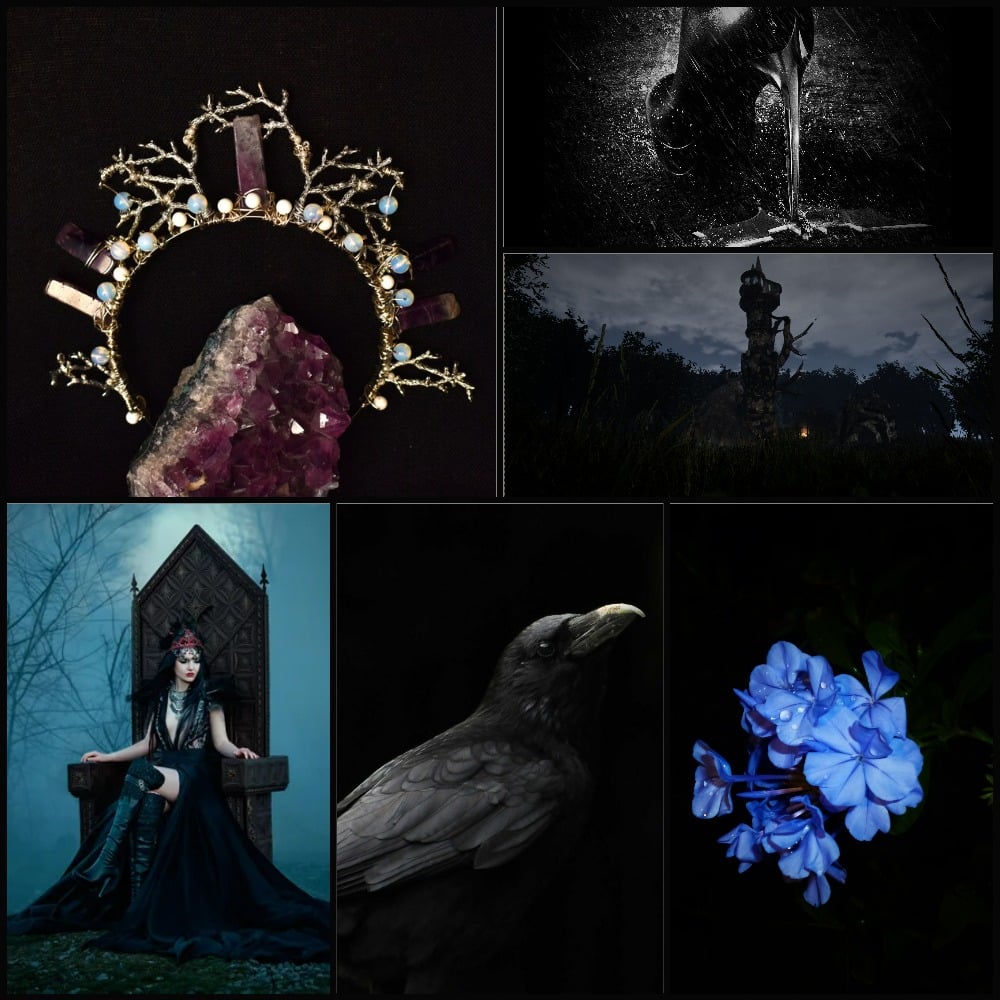
Mood board with pictures of an amethyst crown, a black heel crashing down in the rain, a dark tower in the distance, a queen on a dark throne, a raven, and a blue flower against a black background.
Aesthetic for All Her Wishes from the villain’s POV. Is it a romantasy? Yes. Does it seem kinda cutesy with the fairy godmother who hates her job pitch? Yes. Does it have dark elements? I wrote it so obviously, yes.

Conclusion

When I was studying creative writing, one of my intermediate fiction writing professors put a list of “Rules” on our workshop door. There were 14 of them. Some I remember, some I don’t. Some were standard, some a little more bizarre. We were not to break them in our stories. One was: “Write what you know.” Another: “Use only said and asked.” Another limited us to one exclamation point per ten pages. Yet another said we couldn’t write teenage girls crying in the bathtub. Which never made sense to me, a teenage girl who often cried in the bathtub, trying to write what she knew.

For years, I framed my dorm room and apartment rooms with quotes on writing from the greats. “Don’t tell me the moon is shining; show me the glint of light on broken glass.” ~ Chekhov (who I have a lifelong feud with, doesn’t matter he’s dead). “Your intuition knows what to write, so get out of the way.” ~ Bradbury. “It’s not wise to violate the rules until you know how to observe them.” ~ T.S. Eliot. “Good novels are written by people who are not frightened.” ~ Orwell “Work like hell!” ~ Fitzgerald. “You can make anything by writing.” ~ C.S. Lewis. “A word after a word after a word is power.” ~ Atwood.

I thought these words would inspire me to keep going even when it got hard. What I didn’t realize was I’d surrounded myself with rules I didn’t understand urging me to do things that weren’t achievable for me. My external GMC was this: I want to be a novelist because my voice has been silenced all my life, but I’m too afraid to speak my truth. My internal GMC was this: I want to be courageous because to speak your truth you need to be, but I’m afraid to be punished. Around and around the trauma wheel I went. Wanting to speak to break the cycle. Too afraid to speak because of the damage done by the cycle.

The truth was, I could work like hell, did work like hell, but no amount of working could help me understand. I couldn’t understand the rules to do the things, let alone break them, which meant there were most certainly things I could not create with writing, like a traditional GMC for starters. I sure as shit did not have intuition that knew what it was doing, and as much as I craved power, I was too terrified to seize it were it handed to me on a golden platter which you know, it isn’t.

I’d surrounded myself with words that said I would never be enough. And I believed them.

But here’s the thing: the greats were wrong.

There’s no singular way to write. No rules that can’t be broken, or for that matter, shouldn’t be. Stories aren’t only for the brave or the powerful or the intuitively inclined or the hard workers. Stories are for everyone. But your story, it’s only for you. Which means only you know how best to tell it. If that means self-publishing or going with a small press or popping something up on a blog or never showing a word of your writing to anyone then do it (after the appropriate amount of research and making sure you can afford it and all that comes with it). If it means throwing your heart book about survival that doesn’t follow a single rule at the gates until someone lets you in, then do it (after knowing and accepting if no one lets you in, you are more than your writing). If it means trying a few things to find the right fit, well, you surely wouldn’t be the first of us to wander around for awhile.

The path I ultimately chose was this one. Traditional publishing. Learning the rules no matter how much they confused me so maybe one day I could break them with intention. Telling the greats to fuck off while also remembering they probably did know a thing or two so maybe some of their advice could apply, it just didn’t have to be crushing. Making compromises about how I tell the stories that matter so they’re heard. Hoping one day someone will be able to tell them the way I’d prefer, regardless if that person is me or not. Knowing maybe I’ll be someone who helps pave the way and that can be enough because in so doing, I found my own voice and power, which was the point. This is the path that fits my story and this exact point in my life. I expect it’ll change. I hope it does. Art requires change, in my opinion, and I want to keep producing it.

This post is not to say there’s only One True Way. Because there isn’t. There never was. There never will be. Your story demands your way. No one else’s. This is but a tool and like any other you can choose to use it or find something better or say to hell with all of them and do it your own way. Invent your own tools. Chart your own path.

Whatever you do, though, don’t let anyone tell you they know more about your story than you do.

You are a warrior. A survivor. And you are courageous.

Xoxo,

Aimee

Agency, the Active Protagonist, and Where it All Went Wrong

Author’s note: This post will primarily focus on the concepts of agency and active and passive (or reactive) characters in relation to stories about trauma. I would be remiss not to state clearly this is because I’m focusing on the story I know best: my own. However, I’m white, cis, and American. There are intersectional identities here with their own perspectives that are just as important. For a BIPOC perspective please check out this great post from Vida Cruz. For a more detailed analysis of many of these concepts as they relate to all kinds of storytelling and identities, I highly recommend Matthew Salesses’ Craft in the Real World. (Barnes & Noble).

Content/Trigger Warnings: Detailed definitions/descriptions of C-PTSD including medical symptoms and statistics related thereto.

Disclaimer: As always, I note the views expressed in this blog are mine and mine alone and not representative of a whole identity. Also, when referencing current market and industry trends please note that in this blog post I’m primarily talking about Young Adult Fantasy (traditional publishing).


When I was querying my two YA Fantasies (and pre-PW my Adult Fantasy), the most frequent critique I heard from critique partners, alpha readers, beta readers, editors, agents, and random strangers everywhere was my main character(s) lacked agency. Whether someone had read my entire novel, the first 20 pages, the first 5 pages, a synopsis, query letter, or a 280 character Twitter pitch, the same refrain found itself on repeat in my skull. No agency. Inactive. Passive. Lacks Agency. Reactive. Needs more oomf.

It got to the point every time I saw the word “agency” or “active” whether it was in relation to writing or not, I recoiled. Then, in March 2021, during a regular therapy session, the word agency reared its ugly head, setting the brain worms to squirming.

As it turned out, my characters were not the only ones who lacked agency.

What is Character Agency?

Character agency (aka agency as that word is used in writing) is the character’s ability or power to change things in the direction they want. If you google this you’ll find a million definitions but they all center on this concept. For a character to have agency they must both (1) be able to change things, and (2) want to change things.

What you’ll also find if you google this is about a thousand ways defining agency in this way leads writers with a different story to feel as though their stories don’t matter.

  • “Without agency, characters are little more than leaves, pulled along by the river. They don’t make an effort to change their situation, therefore we don’t care about them.” (emphasis mine)
  • “A character without agency is just a prop. They’re a piece of decoration that doesn’t serve any purpose other than to have the story happen to them.”
  • “Nothing makes a reader put a book down faster than a character who just lets stuff happen to them. These characters feel like shells or puppets, cardboard cutouts that the plot is moving around arbitrarily. Your character should drive the plot, not the other way around.”

I could keep going but honestly, it’s making me sad. Point is, western storytelling circa 2023 is obsessed with agency. If your main character(s) don’t have it, you’ve written a bad book no one will care about.

Photo of a white woman with silver blond hair wearing a red crown, a red and black gown with a long black cape, wielding a sword in front of a fallen tree.
Aka if your fantasy heroine is not this woman, good luck. FTR, I’m not shaming the authors of the cited posts (which is why I left the sources out after a long internal debate, but they can be provided upon request!) They’re not entirely wrong in the sense this is the way the world is. But should it be? I mean, don’t get me wrong, I want to write about this woman (damn!). I just think the entire market already has, and I probably couldn’t anyway. Also – presentation is everything. Do we really want to tell people we don’t care about their stories? That they’re shells? Or not rounded? Because guess what? Writing what you know for me means writing characters with trauma and having C-PTSD often feels like being life’s prop. Or a shell. So what? We don’t want to hear that truth? Because why? It’s not sexy? WELP, I have news. Photo by Dmitry Vechorko on Unsplash

What is Psychological Agency?

Psychological agency or the definition of agency used in behavioral psychology is not dissimilar from character agency. In psychology, agency is roughly defined as a person’s ability to act autonomously to control their own life. Source.

C-PTSD and the Loss of Agency

Complex Post Traumatic Stress Disorder (C-PTSD) is a disorder usually brought on due to sustained, inescapable, relational trauma in early childhood. It is distinct from its singular C-less form of PTSD in that the trauma is ongoing and not a singular incident. This repeated abuse causes a child to suffer a lack of agency during critical times in their brain development. The lack of agency often carries over into adulthood even after the childhood trauma has ceased. Adult survivors of C-PTSD suffer from a wide variety of symptoms including amnesia, alienation, mistrust, chronic physical pain, re-victimization, debilitating flashbacks, nightmares, body memories, anxiety, dissociation, trouble regulating volatile emotions, severe depression, toxic shame, and auto-immune disease. They’re 27% more likely to have COPD, 33% more likely to be smokers, and 24% more likely to be heavy drinkers. Source.

Oh hey, that’s me. More on this in a second.

What is an Active Protagonist?

An Active Protagonist is basically a hero with agency. Usually the main character. Listen, you can quibble with me all you want about well technically agency is more than active because it requires a focused goal, so an active protagonist doesn’t always have agency, and sure. But for the most part, if your main character (1) wants something and (2) actively does stuff to obtain that thing, you have an active protagonist with agency. Trying to keep it simple. I know you’d all appreciate I keep it under 40 pages today.

Where the Active Protagonist Fails and Falls

The Active Protagonist is not the end all be all of storytelling. In fact, to think so is to limit yourself to a very narrow view of the whole of the human experience which is, interestingly enough, one of the reasons people read. To learn and all.

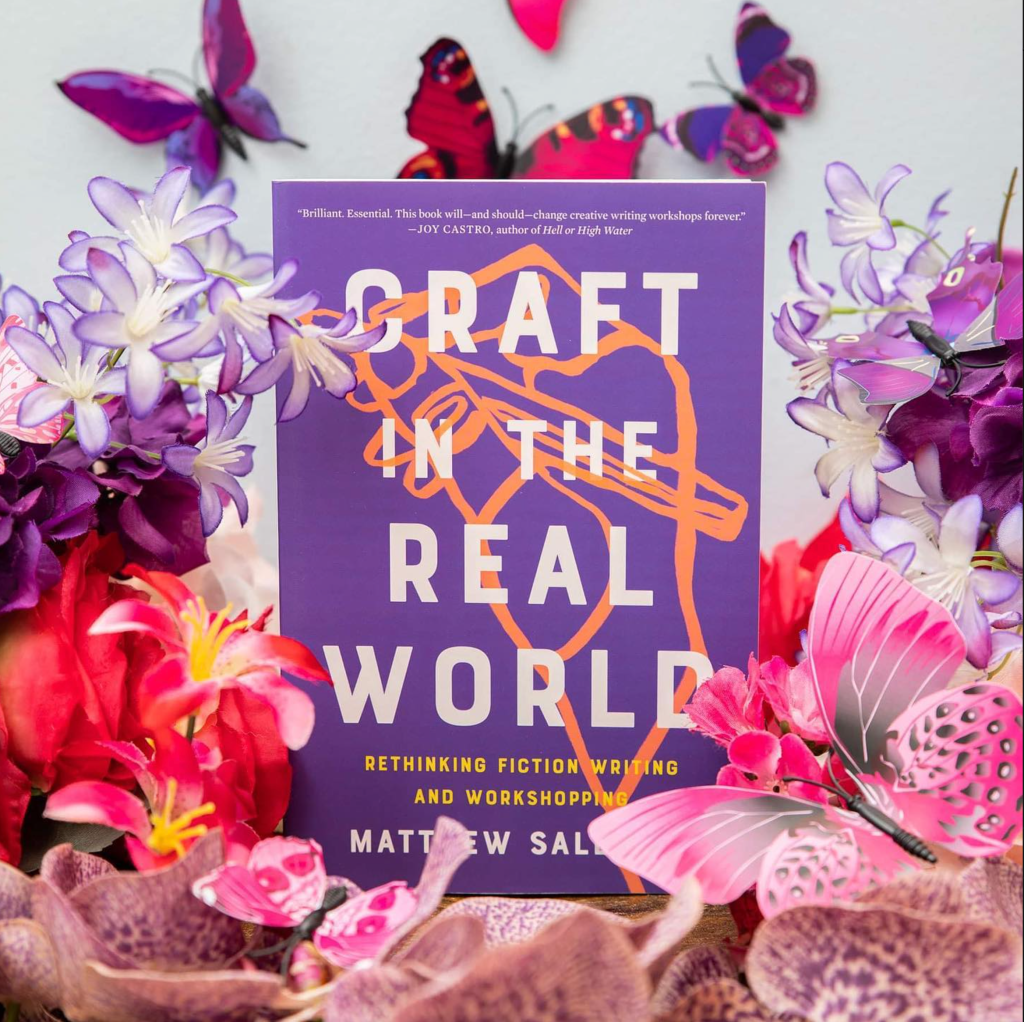
This is where I’m going to plug Mathew Salesses’ book Craft in the Real World again. Oh look! There’s a picture if you click on it, you might be able to buy the book!

Photo of a purple book with an orange sketched hand. Title: Craft in the Real World by Matthew Salesses. Book is surrounded by purple and pink flowers and pink and purple butterflies.
I will never stop talking about this book. Copyright mine (for the photo, not the book. I am definitely not smart enough to write a book this brilliant).

Matthew speaks on experiences outside my own far better than I ever could, but beyond western storytelling’s obsession with agency and the active protagonist is a whole world of literature waiting for us to embrace a style that is… not that. Just saying.

Active Protagonists and Trauma Narratives: Debunking Survival as an Active Want

I write trauma narratives. Even when I don’t mean to. Write what you know, they say. Well, what I know is trauma baked in deep. What I don’t know as well is agency. Despite over a decade (going on two) of therapy, working toward reclaiming agency, that beast is still fuzzy around the edges. Especially when it comes to writing young adult. I find it extremely difficult to write an authentic, traumatized teenager who possesses agency. Probably because the entire concept of a teen with C-PTSD is (in my opinion) their loss of agency.

This is, of course, where that squishy definition of active protagonists could really get squishy. Because I really don’t want to go down the rabbit hole of the focused goal part of this (like I said, aren’t my blogs long enough?) let’s stay with my abbreviated definition of an active protagonist who has agency and try to apply it to a trauma narrative. And yeah, some of you aren’t going to like where this is going, but I hope you’ll stick with me.

Step One: Wants something. Cool. It would be reductive to say traumatized people don’t want things. They do. Obviously. Usually the want at the forefront of their minds, however, is survival. Even after the trauma has ended, the brain of someone with C-PTSD has often developed in such a way as to hyper fixate on survival. And while survival might seem like a big want, it’s not active in the way western storytelling expects. Why? Because of…

Step Two: Actively does stuff to obtain the want. Active is the key word and needs to be delineated from reactive. When you live in a state of survival, you aren’t actually active. You’re reactive. Your central and sympathetic nervous systems have been wired to respond to every stimulus in your environment with a flight, fight, freeze, fawn response. It’s nearly impossible to make forward actions when all your energy is spent reacting to perceived threats because your body and brain are fried by trauma.

Wanting to survive is therefore reactive. Not active. A character whose primary desire is survival is therefore very likely not active but passive. They do not do unto the world and the world responds. The world does unto them and they respond.

Are there other things that a traumatized character can want besides survival? Absolutely! As I said, it would be reductive to say traumatized people don’t want things. In fact, I might go so far as to argue they possibly want things more because they can’t pursue them. But that’s the problem. They often can’t pursue them. Because they’ve lost their agency, aka their ability to actively chase things they want. So even if your character does want something besides survival, if they’re still in that mode, and they haven’t found agency because they’re living in trauma, then they likely can’t pursue it. I know because that’s how I’ve lived most of my life. Wanting desperately. Unable to chase. It’s a sad story I’d love to tell but can’t because it isn’t wanted. Apparently, characters like me are not particularly interesting. Perhaps because they’re too true.

Photo of a white woman with reddish hair in a white gown floating under a blue water.
Sometimes the wanting feels like drowning. You’re trying to swim to a surface but it’s so far, and you’re too heavy. You’ll never get there. So you just… drift. To the viewer, it seems passive, gentle, maybe even beautiful. But inside, it’s violent and terrible with teeth and claws. Like a beast that will never let go. But the beast is your brain come to eat you alive. Photo by Alice Alinari on Unsplash

Trauma Narratives and Seeking Agency as the Arc

One of the main arguments for why you, the writer, should write an active protagonist is because people like to see character growth. The argument goes that “people” want the arc. The hero’s journey. The descent into darkness. They want the emotional journey that goes with a character starting off at point A and ending at point B. First, let me just again mention this is a very western view of storytelling that focuses on the individual. Not all cultures require, desire, or demand an emotional, individual journey. Some cultures prefer a moral. Or a history. Some prefer a story that centers the growth of the group, not the individual. Others like stories that are sweeping with no human focus at all. And over the years tastes and wants and societal demands change and change again.

But that isn’t my story to tell, and others can and have made their own arguments better as to why western audiences should pay more attention to non-western storytelling.

If I speak to the story that is mine then, I find myself asking: within the framework of western storytelling and arcs and the active protagonist, is there a place for a trauma narrative? And if so, where?

Let’s try again.

Step One: Want something. In my opinion, survival is always at the core of the trauma narrative. But if we dig a bit deeper into the stage that might come after survival, we turn toward a new want for the trauma survivor. It can take many forms: a friend; an education; a place to live; a pet; a job; a hobby. But often, when you boil these wants down, you find at the center a quest for agency. Through connection, or eduction, or financial independence, or the stability of a place all your own, or simply doing something just for oneself a trauma survivor is cautiously asserting (or learning to assert) agency.

Step Two: Actively does stuff to obtain the want. It seems deceptively simple to write a story about actively seeking agency. Want something. Go after it. Except you need agency to go after something. And around and around our active protagonist seeking agency goes. How do you chase something if you need that same something to know how to chase?

I can tell you one thing: it isn’t something I’ve ever managed to convey in a five or ten page writing sample. Which is probably why the most common feedback I’ve heard from queries and samples is silence. Or form rejections.

Personal experiences aside, I do believe it’s possible to tell this story within the western storytelling framework. In YA Fantasy, where I’ve had least success telling it but where I believe it’s most sorely needed, I think it’s a quieter, slower story than the current market demands. The two books that spring immediately to mind are The Light Between Worlds by Laura E. Weymouth and Ever Cursed by Corey Ann Haydu (please be mindful of huge trigger and content warnings on both these books). Both left me with deeply complicated feelings regarding their content and their endings but as I sit here writing this, I know my own YA Fantasy, Deathbringer, were it to ever find its way to shelves, would be critiqued similarly. Perhaps that’s what it is to tell a trauma narrative. It isn’t pretty or quippy or vibey. It is, in fact, quite ugly, and messy with an arc that doesn’t always lead you to a happily ever after.

But it does lead you somewhere different than the start. And that’s all that’s required of an arc.

Digital painting of a white girl with short dark hair in a bob, wearing a purple, sequined dress and long purple gloves holds a turkey vulture aloft.
Always and forever will drop commissioned art when I have half a reason to. This is Violet, the main character of my YA Fantasy, Deathbringer, a 1920s-inspired second-world fantasy about a religion that has rotted an entire society, ruined a family, pushed magic into the underground, and the traumatized girl at the center of it all who–in the quest to find friends–finds her agency. And a cost far higher than she imagined. Image © Jaria Rambaran   

Tell the Story but Remember the Audience

I wrote this heading about ten different ways before I settled on this. I started with “Tell the Story Anyway.” I wanted to say bold advice like that didn’t come from a place of privilege but was instead a recommendation to the traumatized soul to help with healing. To say that even if the book of your heart doesn’t get you an agent or dies on sub, you’ll have the cathartic experience of pouring your trauma onto the page, and it isn’t a privilege to give yourself space to heal.

That would have been a lie.

Sadly, getting to the point where you’re safe enough to heal is a privilege. Which is why western storytelling has failed so many people, because right now the only maybe sellable trauma narrative (as I see it, in YA Fantasy anyway) is one related to healing. Survival still isn’t sellable. There’s one notable exception, yes. I’m not forgetting The Hunger Games. That’s a whole separate rant for another day. Also, that was 15 years ago. One story every 15 years when we have the amount of early childhood trauma we have in this country is… oop, starting the rant. Gonna stop.

Instead, I offer to you this, take it or leave it, advice is only advice. I don’t believe in hard or fast rules, and only you can know your heart and what you need. But if you find yourself writing a traumatized protagonist who’s getting critiqued for lacking agency, and you’re lost on what to do to change that (and you want to), please know this is the arena you’re playing in, these are the rules you’re expected to follow. I know they’re confusing.

Often, writers are given the advice to put things in the way of their protagonists. To create conflict. Talk of messy middles seems to be based on this concept. Personally, I never have trouble with middles. Or conflict. I’m actually laughing to think of having trouble with conflict. Where I struggle is beginnings. The place where we’re supposed to define the want. The goal. The motivation. If you’re in this position, and you have a trauma history, I might suggest you need a new brand of advice specifically for you. So you can write in a system not made for you even though you shouldn’t have to.

Here’s the advice: If you lived in one of your books (or one of your favorite books) outside the chaos of your life, where the possibilities were bigger (not boundless), what would you want? If no one (including you) was holding you back, what would you do? Where would you go? Who would you dream to be? To learn? To love? To chase?

Picture it. Now, unshackle your characters even if you can’t unshackle yourself.

And run.

Xoxo,

Aimee

Let’s Talk: Trigger Warnings

Author’s Note: If you’ve been around here awhile you’ll know this is standard fare from me at this point, but I repeat it for new folks: anything in this post is my opinion as one person not as a monolith. Nothing in this post can or should be used against other people in the same communities I describe.

Trigger/Content Warnings: This post talks about trigger/content warning discourse. Also describes in detail what a triggering event can be like. Brief description of child abuse and related triggering event thereafter; flashbacks; disassociation. References to childhood abuse and trauma.


Let me put this right up front for the TL;DR crowd. I am pro using trigger and content warnings. I am anti policing how people ascribe these things to their personal experiences. I am pro self-exploration about using these words more carefully. I also think we need to do a better job explaining what they are, how they’re different, and why we use them. I also believe failure to do so has caused harm to the communities who need them most.

Trigger; Triggering; To be Triggered

To be perfectly frank, because that’s what I do here, I have a very complicated relationship with the way the term “trigger” has evolved. For me, a person who has C-PTSD (and other mental health issues I don’t need or want to list out today), “trigger” has a very specific meaning. That meaning is the one used by most psychiatrists and psychologists and goes something like this: a trigger is a stimulus that causes a painful memory to resurface (usually the definition used in the context of C-PTSD or PTSD), or a stimulus that activates or worsens the symptoms of a mental health condition. Trigger doesn’t mean something offensive or a bit uncomfortable. It isn’t something that makes me a little sad or a little yick or a little anxious. To be triggered for someone like me means to be mentally fucked for a time.

Considering the volume of trauma I’ve been through, I’m not actually triggered that often. When I was younger, it happened more, but honestly, I couldn’t explain to you what the source of the triggering thing was. Now, I can count on one hand the number of times I’ve been truly triggered in the past five years. But I sure as shit know when I am and what caused it. This is a primary goal of trauma work: identifying triggers and finding ways to lessen their impact on your life.

Impact. That’s what triggers have. That’s what that word is meant to mean.

My C-PTSD wasn’t caused by any one thing, that’s what makes it different from PTSD without the C. A bunch of it stems from early childhood trauma though. I grew up in a violent, chaotic, loud environment. So, I have some sensory issues related to noise (as in, I don’t like it) but I don’t consider all noise triggering, or even all loud noise. Sometimes, when I’m overly stressed or highly tuned in, certain noises irritate me, or distract me. They might even become at times physically irritating, almost like a sting beneath my skin. Those aren’t triggers for me. More like irritations. They’re uncomfortable in the way too many bugs flying around you, ruining your otherwise pleasant picnic might be uncomfortable. Maybe it escalates into the bugs taking a bite or two, causing some frustration or agitation. Is it annoying? Yes. Would I rather it not? Yes. Is it outside the realm of a normal human emotion? Not really. I mean maybe in the sense that most people don’t find noise mildly painful, I suppose. But the emotion itself is not wildly disproportionate in a way that escalates my preexisting mental illnesses or causes a flashback or has any real impact on my life beyond fleeting, everyday annoyance.

Close up photo of a fly on a gray surface with black background.
Tbh, this dude might need a trigger warning of his own. I fucking hate bugs. Image by Christian_Crowd from Pixabay

This is where I’m going to describe a triggering event: Yelling, child abuse. And its impacts: Disassociation. Skip until next bold (after the photo of the bathtub).

What is a trigger for me is the particular noise of a mother screaming while beating her child.

Before I moved to my current home, I lived in an apartment complex. One of my neighbors in the same building a few apartments down constantly yelled at her kids. It bothered me but not to the level of a full-blown trigger. However, one day, I heard her screaming at one of her children. The sound carried through the walls, and with it came the very distinct whap of an object against bare skin. The child screamed. Begged. I had a flashback, then disassociated.

The next thing I remember was coming back to myself to find I was sitting in my bathtub, fully clothed, hands over my ears, rocking back and forth while tears streamed down my cheeks. I have no idea how long I’d been there. Long enough my legs ached and my throat hurt from crying, maybe even screaming.

That is triggering. Real live in the flesh triggering for someone who has a bona fide psychological disorder.

Sepia image of an old bathtub filled with plants on a dirty tile floor.
Bathtubs are a safe space for me. I often sit in them fully clothed when I need to get away from something. It’s just a thing, don’t mind me. Image by Peter H from Pixabay

Who determines what is “triggering?”

The person who experiences triggers determines what they are.

The thing about triggers is they’re highly individualized. No two people have the same set of experiences, or the same brain, so it’s impossible to understand how someone will react to a particular stimulus under any set of conditions. I’ve done years and years of trauma work. In the beginning of this work, I was unable to determine what my triggers were. I knew things triggered flashbacks, and disassociation, that something made me start screaming for seemingly no reason, but it was difficult to discern what those things were. A key part of my early trauma work was focused on identifying triggers (or potential triggers) and working on ways to manage them. I did this with a therapist who specializes in trauma treatment.

I mention it because it’s important to understand that for some people, knowing what their own triggers are might be harder than you’d expect. They’re not as clear cut as the neat little warnings we often see at the top of the page. So if triggers “change” for someone, that’s not abnormal. It’s also why triggers are often given in broad contexts sweeping a range of topics: “abuse,” “trauma,” “domestic violence,” “assault,” because people who experience triggers might not know what specific thing in that wide category will trigger them, but they might know that category contains their past and that content should be avoided. Over the years of my personal trauma work, my trigger sensitivity has been seriously reduced. Not everyone is able to do that or is at that stage in their journey.

Basically, this is not the trauma Olympics. We’re not here to put our scars on display for you to evaluate if that’s a “good enough” reason for us to say “this thing is genuinely triggering to me.” You’ll note I didn’t describe the individual Bad Shit that happened to me as a kid in my story above. Because it’s none of your business. You don’t get to decide if whatever I went through was “bad enough” to warrant my response to my neighbor’s behavior. I control that. Well, I don’t actually which is the annoying part. Because, trust me, if I could make my triggers go away, I would. They’re not pleasant. It’s one of the main reasons I’ve been doing trauma work for a million years instead of putting that money toward I don’t know… literally anything else.

“Trigger” should be used with discernment and self-reflection

Here’s where it gets tricky. I do think the terminology has been a bit… overused. That’s why I provided an example of the reaction I have to a trigger. Reminder about the monolith thing I said at the beginning. And of the definition I used of the word trigger. The reaction doesn’t have to be that extreme for you to consider something triggering. However, a trigger is meant to mean more than, “This makes me feel an unpleasant emotion within the realm of the ‘normal’ human experience.” Feeling sad is normal. Feeling anxious is normal. Feeling uncomfortable is normal. Feeling pissed off is normal. Feeling triggered is distinctly not normal.

The reason this matters is because when the word trigger is misappropriated in day-to-day speech, those who need this language to better explain what’s happening to them are stripped of its value. If the word trigger is so frequently used to mean something less than its definition, it’s devalued. This means the only recourse I have to explain my emotional reaction to a stimulus is to put the actual emotional reaction on display (which in and of itself can be retraumatizing).

I have strange feelings about people who ascribe the word “trigger” to something other than what its general psychological definition is, because this word was given to me and people like me who are suffering immense emotional pain so we might explain that pain without having to relive it. I also have an issue with the idea there is a “trauma” trigger and a sort of everyday use of the word trigger. While practically, I think that might at this point true, it again puts the onus of explanation onto the population whose language was stolen. Triggers also apply to communities of people who don’t have trauma, for one. So to exclude them from their language is a poor solution. And for those who do have triggers because of trauma, forcing us to further delineate “trigger” to “trauma trigger” outs us in ways we perhaps did not want to be outed. Finally, many people have comorbidities that cause this discernment to be almost impossible. I joke with close friends pretty regularly about, “Is it trauma or is it my [x other neurodiversity, mental illness, etc.]?” But the joke hides pain. It’s hard to live like this. Constantly questioning what part of your twisted brain made you lose time this time. Putting the burden of waging that battle of defining pieces of self on people already struggling to do it is unfair and to be honest, cruel. A trigger is a trigger. Sometimes it’s trauma, sometimes it’s not. Always it’s more than uncomfortable.

To be clear: I’m not here to police anyone’s use of the word. This is meant to be a self-exploration exercise only. If you’re using the word casually or colloquially or flippantly, or you might be, or you’re asking communities to drill down language that was already intended to mean a specific thing, then a reexamination could be in order because the casual use of the word is doing actual damage to people who need it.

Photo of a small room with a desk and chair and a round mirror with a man's reflection silhouetted.
Image by Peter H from Pixabay

Content Warnings

What is a Content Warning?

Content warnings can be sort of nebulous. However, I put content warnings in the category of the things you maybe shouldn’t be using the word trigger for. In the context of writing, because that’s what this blog is about, content warnings describe things that may be upsetting or uncomfortable or even things people simply don’t want to read about. Or read about at that particular moment, anyway.

Difference between Content and Trigger Warnings

What makes something a Content Warning or a Trigger Warning is not determined by the person writing, it’s determined by the person reading. That’s what makes them difficult for people to differentiate between because the writer has to use them interchangeably to accommodate multiple unknown readers (i.e. something that could be triggering to me might be something that just makes you uncomfortable, or vice versa).

So, if you’re the person doing their level best to alert readers about what’s coming, using content and trigger warnings interchangeably makes sense as you don’t know your reader. If you’re the person talking about your own TWs and CWs, you should delineate to make room for the nuance in the definitions.

For example, for me personally, I have never experienced a trigger in writing. I think that’s probably because of the way my brain processes information. My trauma is triggered by senses. A book doesn’t have much sensory output (in that it’s not yelling, or flashing lights at me, or smelling of alcohol, etc.). However, I prefer not to read books featuring trauma where the author doesn’t have a personal experience of trauma, because I often find the representations to be poor, stereotypical, and sometimes cruel, and I walk away feeling depressed, uncomfortable, or just pissed. A general content warning is helpful for me, so I know to look into the origin of the author (if that information is readily available), or read reviews to see how other people found the representation, or simply tread lightly on a day I have spoons.

Black and white photo of a stuffed bunny lying on a concrete wall.
Image by Andreas from Pixabay

Use of Content and Trigger Warnings

Step One: Use Them

You can’t know someone else’s life or their experiences. Just because you went through some shit and aren’t triggered doesn’t mean other people had the same experience. Again, we are not here to play trauma Olympics with one another. Don’t be an asshole, use CWs and TWs. You should do your best to use them all the time but especially if someone specifically points out they’d like them. Triply if someone is like THE FOLLOWING THINGS TRIGGER ME LET ME KNOW IF I’M ABOUT TO GO THERE.

If you forget, I’ll remind you to be kind to yourself. Messing up happens. We’re all human. I forget sometimes too, and I’m literally here writing this post at 11:00 p.m. on a Friday after working like 75 hours this week because I care about this topic so much. So, give yourself some slack. Unless you’re being an asshole about it and wantonly refusing to use them because you think people should toughen up. If that is you, I’ll remind you to be kinder to others. And honestly maybe yourself. Because you either have no idea what trauma is like, or you do and you think everyone should suck it up like you have and that is… well, a post for another day.

Step Two: Respect Requests to Include Them

Probably the weirdest thing I’ve seen lately in the writing community is people challenging agents on their ask that TWs and CWs be provided. I mean, listen, this is your future career and all, but my advice is to not do that. Besides being a super bad take for all the reasons I mentioned above about people’s need for them, it’s also just not professional to willfully refuse to do something beneficial to the mental health of the person you’re courting to be your future business partner.

Outside of querying, you should still honor requests to use trigger and content warnings by people when they’re given. The requests are likely not made lightly.

Step Three: Do Not Challenge People’s TWs and CWs

This one is harder than it seems and honestly I’m not 100% sure it’s the completely right advice, so bear with me. There are, in my mind, a spectrum of “Challengers.” On one end are people you should aspire to never be. On the other end might actually be me because here I am writing this post. Nuance. Brains. Complicated topics. Oh my.

Type One: That Asshole. You know the one. The one who has a Twitter bio that’s like “White man and proud. Trump 2024. God, guns, guts. Eats libtards for breakfast.” That’s the one who like gets up in people’s Twitter space and say shit like, “Trigger warnings HA! Do you need a safe space too?” Or “I’ll make sure to send you my [exactly the book the agent requests not to see in their inbox] LOL.” Or the slightly less aggressive but still douchey, “I’m not really a big believer in trigger warnings.” Cool, Tom. They’re not for you. And let me get ahead of you to say I don’t give a shit whether you believe my C-PTSD is real or not.

This type you should never, ever be. But I probably don’t need to tell anyone reading this blog that. Still, any variation on this is a no go. Basically, please refrain from aggressively questioning someone’s triggers or content warning needs because it’s invasive and rude. I might be the type to explain to you in a 7 page blog post about why I need trigger and content warnings and what my precise trauma is, but most people aren’t and shouldn’t be asked to. Whatever caused the need for the warnings is probably hard enough as it is.

Type Two: This Asshole. As in very possibly me. I’m not sure. I much prefer people do self-exploration and reflection to determine if their use of these terms is appropriate when they take into consideration the harm it could be doing to communities that need the language, as I’ve mentioned. However, this blog isn’t going to reach everyone. More like a couple hundred someones. That probably isn’t enough to reclaim the language. And not everyone is going to be self-reflective after reading a long ass blog from some random person on the internet. So what about calling out people’s use of the term nicely?

I’ve seen it done tactfully. Kindly. Gently. I’ve seen people say ‘I have this lived experience, and if you’re using this term loosely or in a knee-jerk way please be mindful of the people it hurts.’ I’ve nodded along with these people. Celebrated that someone finally said it. Then watched them get dragged on Twitter for daring to question a fellow survivor’s experience. Annnnnnnd I see that side, too. Who are we to know? I mean, I think I know. Even now I’m half typing out explanations of how I know, but ultimately no one can know their life except them. So reiterations of self-reflection are as far as I’m willing to go. I just… I would hate to be wrong and hurt someone else more than they’ve already been hurt, I guess. Even though I do really see the collective damage it’s doing. Have felt it myself. Understand the desire to make it stop. But I’ve always been about gentle pushes in the right direction more than sweeping gestures that burn hot and fade fast.

Step Four: There is no step four

Tada! I’m done. It was long again. Sorry. Please accept this token picture of my cat, Apollo, who has lived for 16 years through all my bullshit, just as you, dear reader, have lived through this long ass post full of my bullshit.

Photo of a white cat with a red collar sitting on a scale on a kitchen floor.
In case you can’t read it, his collar says “Mom’s Fav Asshole.” And yes, he is the asshole in chief.

Until next random thought, please remember: language matters, and be kind to yourself and others!

Xoxo,

Aimee

Reflections: One Year Post-Pitch Wars

Author’s Note: For those who are not aware, Pitch Wars was a well-known, all volunteer-run mentorship program that paired unagented authors with published/agented authors, editors, or industry interns. One mentor (or mentor pair) to one mentee. Over the course of several months, the mentor(s) and mentee pair worked together to prepare the mentee’s manuscript, query letter, and synopsis for querying. At the end of the “revision period” was the infamous agent showcase, a one-week period where the mentee could post a short pitch plus the first page (about) of their book on the Pitch Wars website for agents to review and (hopefully) request. For the entirety of the revision period and the week of the showcase, no mentee was allowed to query the work. During the showcase, no one but Pitch Wars volunteers involved with running the website could see what agents requested whose work. Limited information about requests was conveyed to the mentors, who conveyed it to their mentees. At the end of the showcase, it all went live for everyone to see. Read more here.

One year ago today, me and about 114 other of my peers were officially thrown into the query trenches. The same day, the Pitch Wars Committee announced that after 10 years of mentorship, the program would be shuttering.

I think it goes without saying that was one hell of a day.

As I’ve mentioned, the agent showcase did not go well for me. Still, I grit my teeth and buckled down. Maybe my book was not a one-line pitch type book. Didn’t make a lot of sense considering the amount of people who told me how “high-concept” it was and oh so “hooky” but you know, who knows what those things are, anyway? I would win the agents with my query.

If you’ve read my How I Got My Agent post, you’ll know I didn’t really win the agentS with my query. I did, however, win one. Well, maybe. I’m not sure it was the query that did it. I never asked. Nor do I want to know.

Truly, I never thought I would be writing a one-year reflection blog. If anything, I thought I might be writing a one-year reflection thread on Twitter about how pissed I still am about the showcase and how SO MANY querying authors think the showcase is the real loss of Pitch Wars and how fucked that is because agent exposure is not the reason to seek mentorship, mentorship is the reason seek mentorship thus mentorship is the real loss. And those feelings are all true and real and still very, very raw even one year later.

But since Pitch Wars is gone railing about the showcase seems less applicable. What is applicable is how much I learned from one year of watching 115 separate writers start one place and 365 days later be in so many different places. The following observations are things I hope will help all writers but especially those still querying.

Community

I tried to get into Pitch Wars for 5 years. It wasn’t until 2021 I actually opened up and started engaging with the online community a bit more. Invaluable. I’ve said this before, I will say it again, some of my closest friends and CPs are the ones I met during the waiting period. The ones who didn’t get in and the ones who did. They’re the ones who will understand you best, who will get the highs and the lows, who will never accuse you of being too dramatic or too much to handle. They will be the ones who understand all the random and weird publishing things your family still can’t seem to grasp no matter how many times you’ve tried to explain it to them. And that you don’t have to explain it or yourself will ease some of the exhaustion. Of which there is so much.

Community you need to boost you, but also to check you, to be honest with you, to encourage and support you, to be there in your mopes and your hopes, to be your void to shout into when it’s not appropriate to do it on Twitter. You need them always and should start finding them as soon as you can.

Image of a rainbow bucket with yellow roses, a congrats balloon and a sweet smiles jar of cookies.
Signing day gift from some of the CPs in question. Do you know who didn’t send me a gift? Anyone else. Not family, friends, partner. No one except them. Because they get it.

Mentors

Contrary to popular belief, you do not need a mentor. In fact, some might say trying to achieve one is just adding another gatekeeper in an endless stream of them. Considering the odds of being chosen by my Pitch Wars mentor were something like less than 3% and I spent five years trying to get into Pitch Wars and a couple trying to get into RevPit and at least one trying to get into AMM, I can’t entirely disagree.

They’re cool to have IF you do end up with one, though.

I was really fortunate to end up with the world’s greatest mentor. Not everyone is so lucky. There are arguments about this topic for both sides I could go on about for days, but that isn’t the point of this post.

What was really interesting about Pitch Wars was seeing all the different mentees with their mentors and how they all communicated and what worked and what didn’t and how totally different that could be. And how hard it could be to summarize on a blog, too, which is what the mentors attempted to do, and which I think many of the mentees did not read, because they cared more about getting in with ANYONE than getting in with the RIGHT someone. Sound familiar? Yeah, it happens with agents, too. A thing I will talk about in a future blog already mostly written.

So for me, I really wanted a close relationship with my mentor. I had spent a LONG time being rejected not only in publishing but in, well, life. I desperately needed someone to believe in me. Not only in my stories, but in me, as a human. I needed someone to believe I was capable of doing this. Even if it meant rolling her eyes and smiling through my dramatics while I raged that I could not, in fact, do this. Then waiting until I was finished, asking politely if I was actually finished before telling me that I could do this for the following reasons.

I also really needed someone who understood my neurodiversity and my trauma. That I process things differently. Who understood I’m not going to do Save the Cat or beat sheets and that would have to be okay. Who knew I needed some semblance of rules in the chaos that is publishing, even if the rule was there are no rules. Who would be able to be flexible where I was not. Rochelle was all these things and more. I was very lucky. Did I mention that?

But not everyone needs all this hand holding and cheerleading and ya ya. Some of my peers did very well with a much more business-like, professional relationship with their mentors that did not involve frantic 1 a.m. text messages about doom spiraling. Some fit right in the middle somewhere. Others had communication breakdowns because they could not find a meeting of the minds at all.

This is when you refer back to your community.

Cartoon image of various characters working on cell phones, tablets, digital displays, etc.

Where You Are is Not Who You Are

Let me tell you about how Pitch Wars teaches this lesson to the Not Darlings really fucking fast. This exact time last year I was essentially equal in credentials to my Pitch Wars peers. Of course some of us had heftier resumes than others. Some had won other mentorship contests. Some had been published with indie presses or in short story anthologies. Some (like me) had creative writing degrees, or MFAs. Some (not like me) had a list with 50 requests on it ready to go. But we all had shiny manuscripts polished over a period of the most intense revision months of our lives, a submission packet to make any querying author drool, and we had “2021 Pitch Wars novel/mentee” to tag onto our books (and our names). Out of thousands, we were the 115.

We thought that meant something. And maybe it’s the weirdness of this querying climate, or maybe it’s that Pitch Wars shut down the same day we entered the trenches, or maybe it did mean something but not enough for some of us. But on February 15th that starting gun fired and some of us shot forward and others of us stumbled, fell, startled, pressing our hands to our ears, shell shocked. Some of us barreled forward but quickly ran out of steam. Our paths started to diverge. Fast.

Within hours, LITERAL HOURS, calls were getting announced. From there, the deluge of distancing became frantic. Full requests poured in, some phones seemed to be ringing off the hooks. Question lists were assembled. Drama. Subtweeting. Agents with teeth. Mentees in the spotlight. We rallied for our peers because that’s what you do for your community, even when your own heart is bleeding. Even when your own inbox is empty. It was a good distraction.

Agent announcements. Talks of auctions. Editors with teeth. And still for so many of us, empty inboxes. Full requests from the showcase gone untended while the shinier mentees glowed. It was hard not to wonder what was different. Not to blame ourselves. We were all the same except… we weren’t. Not anymore.

Despair came fast, too. And in that despair sat uncomfortable feelings about our friends. Our peers. Our community. People we’d bonded with so tightly during this experience so few could relate to. Guilt. Blame. Shame. Resentment. Toward ourselves more than anything, really. Many of us started to turn away. And this is where things get a little tricky.

Because this is not uncommon in the entirety of the writing community, not just the Pitch Wars community. You will see if you hang out here enough there is this concept that there exists a hierarchy between authors. A chart is needed. Hold.

Chart: Title "Weird Publishing Hierarchy" which depicts levels. From bottom to top: Aspiring Writers; Querying Authors; Agented Authors; Contracted Authors; Published Authors. Subtext: Let's burn this chart down.
If this chart makes you uncomfortable, good. Me too. Let’s do something about it.

If you’ve been around long enough, you’ll have had the weird experience of watching your friends level up through this chart. You’ll have also likely seen some drama around people leveling up through this chart and leaving their friends behind. There is nowhere this phenomenon happens faster than in Pitch Wars. And if you’re on the inside of it, you get to watch this weird hierarchy play out in rapid fire fashion as some folks level up and others do not. Right now, at this very moment, my Pitch Wars peers are basically at all levels of this chart. The first book from my class comes out soon. Many book deals have been announced. Even more agent announcements. Still more of my classmates are querying new books, still looking for their agents. Some have veered off the traditional path all together, choosing indie presses or self-publishing. Some, like me almost, stepped back from writing all together.

But the thing I noticed while watching this all happen was that it’s not always as simple as “level up, leave behind.” There is so much more nuance behind it. I, for one, in my grief, tried to leave my core group of Pitch Wars friends… a couple of times. I felt like I was dragging them down, holding them back, being too depressing, dampening their joy. I felt like I was too lame for them with their fancy Big Five book deals and big shot agents. They, thankfully, dragged me back.

Now that I have an agent myself (weird), I also notice there’s a bit of a dynamic put on authors at perceived “higher” levels from those “beneath” that makes this all the stranger. My opinion seems to automatically matter more because I have an agent, which honestly, y’all it shouldn’t. It’s luck. You will never see me giving away a query critique because my query stats are objectively terrible. I still can’t write a synopsis. Don’t misunderstand, I learned a lot from Pitch Wars, and I continue to learn about my craft every day from writers everywhere on this pyramid. I will speak on what I believe I know enough about to speak on, but my advice is no more valuable than anyone else’s and in many cases, my un-agented CPs know just as much if not more than I do about loads of craft things.

All this long winded thing to say: We’re all writers. We all have valuable advice to bring to the table, and none of that is earned by any milestone along the way. It’s earned the way all knowledge is earned: by study. So don’t let where you are on this pyramid thing define who you are as a writer, and don’t let it change the way YOU act around other writers (you can’t change how they act around you, obviously, but one side of this can be controlled at least). If you feel your friends leaving you behind, ask yourself, truly, are they? Or are you?

TL;DR Don’t push your friends away because you think you’re not worthy of them anymore because they got a Fancy Book Deal or a high profile agent. If they’re your real friends, they are not going to give a shit. They’re still going to crack jokes with you about opening pickle jars and ask you for cat pics. Because besides all being writers, you are first and foremost all friends.

Picture of a gray and white cat sitting in front of a bowl of pickles.
Apropos of absolutely nothing, I JUST SO HAPPEN to have a picture of my cat Hope with pickles.

So, to my Pitch Wars 2021 Class, happy one year post-showcase. I am so proud of each and every one of you. And I can’t wait to see what the next year brings.

Xoxo,

Aimee

How to Write (and not Write) Bi Characters

Author’s Note: This blog might have some spicy takes in it but please note it is not a blog-sized subtweet of any particular book, genre, series, or author. I genuinely want to try and explain some things for my fellow writers so what I’m seeing so much of I can see less of, because it’s… not great. Also, remember this is not a be-all, end-all, that no marginalized person can speak for the whole, we are not a monolith, and every experience is different, especially where intersecting identities exist. Please don’t use this blog as anything more than a tool and one perspective. Please also don’t think to use it as a way to try to analyze anyone’s sexuality (i.e. you did one of the things so you must not be bi and are writing outside your lane). Don’t do this, because you don’t know. This is for writers to improve their own representations, not dissect others’ in a way to potentially hurt them. Many authors are not actively out for safety reasons, and they should not be forced out to “prove” anything.


Dear fellow authors,

Bisexual characters are not a quick and easy worldbuilding nod to the LGBTQ community at large. Please stop using them as such.

Yep. I just went there.

If you’re bisexual, you might be nodding. I hope you’re nodding. If you’re not, you might be wondering what the hell I’m talking about. Let me elaborate on this somewhat spicy take.

I have noticed recently what seems to be an uptick of what I assume are well-intentioned authors attempting to diversify their worlds by building in bisexual characters. It seems like they might think bisexual characters are easier to write than other LGBTQ characters, but they’re not. To be fair, I don’t actually know why they’re doing it. I can’t get in their heads anymore than they can get in mine, but the way I’ve seen these characters written that seems to be the most likely situation.

If you’re still lost, let me just dive in to what I’m seeing that makes my head swivel and my back tense and how to make it better, shall we?

Image of a blackboard with a chalk drawing of a boy in shorts and a tee-shirt carrying books at the bottom of a set of steps, each on reading a different word. Ascending order: Start, fair, good, very good, excellent success.
To offset some of the spicy I provide motivational images. Time to whip characters and your worldbuilding from surface level nods to allyship to an actual world that accepts bisexuals. Image by Gerd Altmann from Pixabay

Bisexuals Don’t Forget They’re Bisexual

Example:

Character A (cis female presenting as hetero) says to Character B (cis male presenting as hetero and an obvious love interest) “If only I could find the prince I’m looking for.” Her eyes darted to the side, and after a beat she added, “Or princess.”

This kind of thing seems to find its way into a lot of books these days. And I think it’s well-intentioned. I think the authors writing this are intending to say to the LGBTQ community, “I am an ally and I recognize you’re here. May I present you with this character?” But the problem is that this character is not bisexual. How do I know?

Well, I wrote Character A! Ha! Jokes aside, this type of character is really just a hetero girl the author added some extra words for one time and then forgot. This kind of dialogue reads to a bisexual (or at least to this bisexual) as an insert character for the author who has forgotten the character is supposed to be bisexual and quickly adds it in. As a bisexual woman, let me tell you about how I never forget I’m bisexual despite many people in my family wishing I would. The other part of my sexuality is not really an afterthought to be casually tossed in then not mentioned for the next 400 pages.

Could it be written to imply the character is embarrassed or nervous to admit her sexuality? Absolutely, but it almost is never done in a way that suggests that because it’s like a drag and drop. Whoop, I’m bisexual in this sentence and that’s that. If your intent is to indicate some kind of embarrassment, that really should be explored more for the representation to be more than surface level. I really would recommend you get a second read from a beta or CP or sensitivity reader on any exploration of that, because as someone who has spent most of my life closeted, that embarrassment and shame is real but it is… there’s a lot going on that you can do wrong. I don’t even write it (yet).

If it’s the more common thing I think it is, and the author is trying to indicate the character is bisexual then never talk about it again, I have some news. Don’t do that. Bisexuals don’t stop being bisexual when they meet the love interest (regardless of gender). They also aren’t going to forget it. You don’t have to bang the reader over the head with a bisexual mallet or anything, references can be subtle, something as simple as the character taking notice of something attractive in the opposite gender, maybe. An off-handed comment here or there. But please spare us from the casual, “Hey, remember on page 10 when I hinted I was maybe into girls then never looked twice at another girl for the entire book except to view them as competition between me and the boy?” I just… am not going to buy that as a real bisexual character.

Cartoon image of a blue elephant holding a blue picket sign that says "Don't forget"
Don’t forget that we don’t forget. Unless we have ADHD and forget everything. KIDDING, those of us who have ADHD still don’t forget our sexuality but fun side note I’m going to briefly touch on intersectional identities later. Stay tuned. Is this blog long? Ask yourself, did I write it? Then you should know the answer already. Image by Gerd Altmann from Pixabay

We aren’t half hetero and half lesbian/gay. Bisexuality is a unique experience

Example:

Character A (cis girl explicitly stated to be bisexual and described as having a previous girlfriend) meets Character B (cis boy presenting as hetero who is the love interest). Character A, upon meeting Character B, never looks at another girl, or mentions, discusses, her bisexuality ever again.

This one is a little more spicy, I know. Especially framed this way, which is exactly why I put it this way. So let me first say that you as a human and your characters in fiction who are bisexual are always bisexual regardless of the relationship you and they are presently in. How you identify your sexuality is between you and whoever you want to know, and the same is true for your characters. In real life, I am a cisgender, bisexual woman in a monogamous relationship with a cishet man. This does not make me less bisexual.

However, if you are not a bisexual author and you are writing the narrative in the example above or something akin to it, you might not be digging deep enough. First of all, bisexuality is a spectrum. Second of all, as a bisexual woman, I am not part lesbian and part straight. When I’m with my male partner, I am not hetero, just like when I was with females I was not a lesbian. Being with one gender or the other doesn’t “turn off” some other switch in my brain. I am still attracted to women when I’m with a man, and I’m still attracted to men when I’m with a woman. I don’t ever stop noticing either.

Sometimes I think hetero authors might try to write bisexual characters as their “token” queer characters because they think “Well, I can empathize with half of this person, at least.” Which I appreciate the attempt at empathy, truly. But that isn’t how it works. It is pretty obvious to those who actually are bisexual that’s what you’re trying to do, though. Like you tried to reduce a person’s unique experience to a binary, sever it, cut out the portion you don’t understand (while paying cheap lip service to it), then focus on the portion you do.

Again, appreciate the effort to try and be inclusive, but… don’t do this. That’s not how this works. Bisexuality runs through the entirety of my life the same as everything else about me that makes me who I am. Loving my boyfriend and being devoted to him didn’t “cure” me of being attracted to women anymore than it “cured” me of my trauma or anxiety or anything else. And yes, I mean “cure” in a roll my eyes sort of way, not a real sort of way. Obviously I do not believe I or anyone else needs to be “cured” of their sexuality.

Cartoon images of many different faces on squares in the colors of the bisexual flag (Pink to purple to blue)
There are so many ways to be bisexual but none of them are by being gay or a lesbian. Image by wage212 from Pixabay

Bisexuality Isn’t Being “Open Minded”

Example:

Character A (cis male presenting as hetero) is forced into an arrangement whereby he must marry for political reasons. While there is no evidence in the text to indicate he is bisexual, he still welcomes male suitors into his court, but he never actually goes on dates with any of them, and they are hardly mentioned except to remind readers every once in awhile they’re there (and they’re men!)

This one. Oh man, this one. Okay, I know this might seem nice and logical in 2023 when we all want to be open-minded and inclusive and that’s great. And a political marriage has nothing to do with attraction or love anyway, right? So what does it matter? Well, it matters because this kind of worldbuilding implies that bisexuality is in some way a choice. Or that it can be. Which is really harmful because there are a lot of people (even in the queer community itself) who still don’t believe bisexuality is “real.” Who still are operating on the binary. One or the other. Anything else is a cry for attention or “edgy” or trying to be I dunno, “woke” or some shit. Like being bisexual is super cool and trendy, and we definitely never get persecuted by friends, family, coworkers for it. Like we definitely wanted to make a choice that makes people feel awkward around us sometimes and scares away potential partners and makes others think we’re into sexual shit we’re not. Like… oop, doing it again gonna stop.

So when we as writers world build what essentially constitutes a “choice” to be bisexual, it further solidifies the idea in people’s minds that this is some liberal nonsense that should be snuffed out and erased. And that’s… well, it’s hard.

Real talk, as someone who has experienced the shit end of this kind of harassment, who has repeatedly been told her sexuality isn’t real, or is a phase, or is “trauma-induced,” or that it’s some kind of attention-seeking behavior, I can tell you it really sucks. It makes you question yourself, your reality, your own experiences. I’ve spent a large chunk of my life closeted, feeling like I had no right to write bisexual characters, to call myself bisexual, to speak on subjects like this because of exactly this kind of thinking baked into books I love.

So here’s the thing, I can’t speak for the entirety of the queer community, but if you’re trying to world build inclusively, there are ways to do it without… this. I would rather have a hetero character courting exclusively women than a poorly crafted hetero man pretending to be open-minded enough to “choose” to be bi for political reasons. In my opinion, that’s just giving a weapon to some ignorant asshole to hurt the community you’re trying to be an ally to.

Photo of a red-painted sign against a large tree trunk. Sign reads "Eat, Drink and Be Married"
+ Be Authentically Queer (or not, no rep is better than bad rep, I said what I said). Photo by Ben Rosett on Unsplash

Avoid Common Bisexual Stereotypes

Final thing then I will stop, I swear. But, like all marginalizations, there are some common stereotypes that you should avoid if you’re trying to write an authentic bisexual character. This list isn’t exhaustive by any means, but it does contain the ones I personally see in fiction (and TV) most often:

  1. Bisexuals are cheaters. This is by far and away the most common stereotype about bisexuals you will hear bisexuals yell about. Rightfully so. The common thinking is something like because bisexual people are attracted to more genders they have more temptation. Or something. Do bisexual people cheat sometimes? Yes. Do they cheat because they’re bisexual? No. They cheat because people cheat and bisexual people are, in fact, people. Surprise! If you’re not bisexual, probably don’t write bisexual cheating, though. Like just leave that nuance to those who have had to deal with the bullshit. We got it.
  2. Bisexuals are promiscuous. Sort of related to the above, but there’s a stereotype that bisexuals will basically sleep with anyone or anything because I don’t know, they can? Which is wild, because if you’ve tried to date within the last 5-7 years you’ll know it is harder than it seems to find someone who will even swipe right on you. Subcategory, bisexuals don’t want to have auto-threesomes. Sorry. Many of us are just regular old homebody types who have enough trouble managing the one partner. There are definitely bisexual folks out there in healthy, loving polyamorous relationships, but I absolutely would not recommend tackling this unless that is your lived experience. There isn’t much in print, and it needs to be approached with nuance from several different angles that are not “sex sells.”
  3. The Evil Bisexual. For some reason I see a lot of bisexual villains. If you’re going to write a bisexual villain, please make sure you have some bisexual goodies to make up for the badies.
  4. The One Exception. Liking all women and one goofy dude who happens to be the love interest? Just… I mean does it happen? Sure. But it’s not the most common bisexual experience, and it seems overrepresented and sort of plays into that whole idea of bisexuality being a phase or a one-off weird thing on your way to hetero or lesbian. And that’s… not how it is.
  5. Not including intersectional experiences. This one is tricky, I know, but it’s absolutely crucial not to forget when crafting characters that there are intersections of identities at play everywhere. Not all bisexuals are white women. Trans and nonbinary people are not excluded from the bisexual experience. Know that there can be bisexual people who are ace or aro. I’m not going to speak to these experiences because they are not mine, but they exist and they should be recognized.
  6. Not using the word “Bisexual.” A lot of bisexuals like to see the word actually written and not used as some kind of dirty word or with shame or judgment. I… do not use the word bisexual in my fantasy writing; however, I do not use the word with intention. It’s part of my own worldbuilding which is queer normative and usually label free (and second world fantasy, not using the word bisexual would make absolutely no sense in a book set in Philadelphia in 2022).
  7. Bisexual Erasure. In case you’re thinking, “Wow, this all sounds like a lot, maybe I just won’t have bisexual characters in my book at all” I have news. Bisexual erasure is also really common (possibly because it IS difficult to accurately represent this sort of nuanced perspective), and is one of the things the bisexual community has really worked to bring awareness to in recent years. Good news is I think it’s working! People are starting to include bisexual characters in their works. Now, we just need a little more leveling up from the superficial to the fully rounded.

And here is perhaps my spiciest take of all. In my opinion, moderation is key. You don’t have to tackle it all at once. You don’t have to include in your novel a bisexual of every variation, or understand every nuanced identity intersection. That would be a lot for one book and your book should be about more than like… an encyclopedia of bis. Plus, there are other people and experiences to show and think of. The world is big and different and no one who is reasonable is expecting you to fit the entirety of the human experience into one novel. Pick and choose what you think you can write most authentically, and go for it. Don’t surface level that shit so you can check as many boxes as possible. There are a lot of us writing our own stories that deep dive into our identities. All we need from you is empathy when you write characters like us. Quality over quantity.

Questions?

I really need to work on wordcount on these blogs. But if after ALL THAT you’re still curious about writing an authentic bisexual character, please feel free to email me at aimee@aimee-davis.com and I will do my best to try and get back to you with what information I can!

Happy writing!

Xoxo,

Aimee