Confessions of a Late Blooming Bisexual

Authors Note: So first of all, my font on the backend seems to have changed. I have no idea if this will change things how you see them, but apologies if it makes it harder to read for anyone who has any reading challenges. Please let me know if that’s the case and I’ll try to fix it!

ANYWAY! HAPPY PRIDE Y’ALL! This post has been brewing a bit, and it’s moderately tempered because I am An Old. Therefore, it doesn’t speak for everyone (obviously) but it’s occurred to me recently there’s this history between Boomers and Gen Z and it’s… mine? But it’s not only the Millennial history it’s currently being played out in small towns and places that are not the internet all over America right now, so this Pride that’s what I wanted to talk about, I guess.

Trigger/Content Warnings: Discussion of homophobia, gaslighting, religious persecution, bigotry, domestic and sexual assault, and trauma.


I came out as bisexual when I was 34 years old. On Twitter. Sort of.
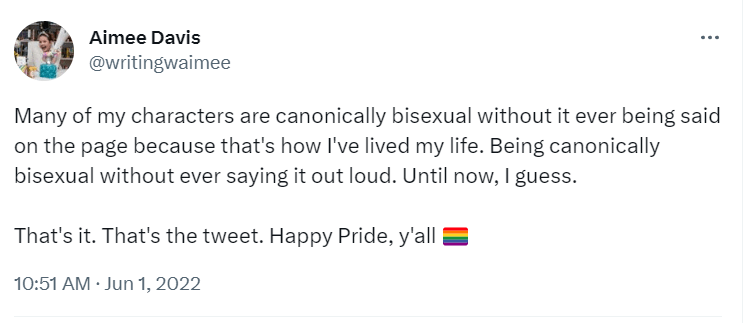
Tweet from June 1, 2022 which reads: Many of my characters are canonically bisexual without it ever being said on the page because that's how I've lived my life. Being canonically bisexual without ever saying it out loud. Until now, I guess.

That's it. That's the tweet. Happy Pride, y'all.
That’s the tweet. But it’s not the whole story.

Some of my closest friends (many of whom are bisexual as well) knew for awhile. My partner knew. My therapist and I had talked about it, but it was shut down for Reasons I’ll talk about in a minute. I didn’t come out to my family, although I’m sure some saw that tweet. We never talk about it. We probably won’t ever talk about it. To them, it probably doesn’t matter as I ended up with a man, so I look straight and appearance is everything. If my dad knew, he’d disown me. Though he’s an atheist, his Christian roots and hatreds run deep. The rest of my family is deeply religious. Appalachian coal country, Trump loving, right wing, bible thumping religious. IFYKYK.

I’ve struggled with my sexuality since high school, but I never talked about it. The one time I got brave drunk enough to mention it to a friend, I was promptly told not to worry, everyone dreamed about other girls every once in awhile. It was fine. I wasn’t a lesbian.

I grew up in the suburbs of Philadelphia. It’s a purple area. Fiscally conservative, socially liberal. Not restrictive in the ways my parents who’d grown up in western Pennsylvania deep in church culture understand restrictive. Still, I didn’t know a bisexual until college. Not an out one anyway. I had gay and lesbian friends. I had friends who came out as one or the other. No trans friends. That was it. Gay or lesbian. I graduated high school in 2006. Which I guess might sound ancient but isn’t really.

In college, I hooked up with more girls than guys. No one batted an eye. Everyone did wild shit in college. It was “for the guys.” For their pleasure. So they could watch. I’m not shitting you. Nor am I endorsing this behavior, I’m simply explaining why everything got all confused in my head. Never mind I hooked up with plenty of girls when dudes weren’t present but okay I guess? My friends all said the same thing. Don’t worry, I wasn’t a lesbian. I was just drunk. Wild. Free. Everyone did it.

Everyone did seem to do it. Not everyone seemed to think about it the same way I did, though. To get jealous when the girl’s boyfriend came to take her away. To wish he would disappear. To watch them, fantasizing about being anywhere but there, hoping she’d pick me instead of him. But it was fine. I had a boyfriend, too. I was normal. Yeah, he beat the shit out of me, and insisted I do weird things I didn’t like, and paraded me around like a trophy, and told me I earned him “points” in the frat house because they could see my ribs and vertebrae in my bikini which was so hot, and fed me drugs to keep me thin. And yeah, his frat brothers cornered me and tried to do things with me I didn’t like, and yeah, I had bruises around my neck, and yeah, I had to do more drugs to cope with it all, but that was normal.

To me, it was. This was the life I’d watched. It was the family I’d grown up in. Still, I didn’t know any bisexuals.

Until I did.

Image of a heart wit the bisexual flag colors: pink, purple, blue. 
Image source: Pixabay

For anonymity, I won’t use her real name. Let’s call her Jessi. A girlfriend of another frat brother. Fuck, she tore my world apart. Dominican, with these hips for days and this beautiful, golden brown skin that reminded me of the sand when the ocean kisses it. She had this amazing, thick, curly black hair that I wanted to sink my fingers into, and this smile that made shy, awkward me feel welcome. I loved being around her. She was gregarious, laughing loud and easy. Smart, sophisticated, calm. Most of all, she understood me without me ever saying a word. There were times we’d all be hanging out and she’d look at me and her smile would shift into something sad, and I knew she hurt for me. That she saw things others didn’t. She saw the pain I hid.

When my boyfriend told me Jessi liked me and he was okay with us “trying things” I did the absolute most obvious thing a damaged girl like me could do.

I stopped talking to her.

It wasn’t about Jessi. It was about him. He was grooming me for something I didn’t want, which I’m sure you’re all smart enough to put together. Because that’s what everyone thinks about bisexuals, right? But I didn’t want that. I didn’t want him. I wanted her. But I wouldn’t have been “allowed” to have only her. So I said I didn’t “swing that way” and I stopped talking to her. Even when tragedy struck and her boyfriend was hurt in a terrible accident and everyone begged me to call her because she was crying for me. I swallowed another pill and shut my phone off. I had class. I was busy.

Busy being an asshole. Busy breaking my heart.
Drawing of a white woman with blond hair sitting on a bed with her hair covering her. 
Source: Pixabay.

I regret not telling her the truth. Being too cowardly to find out if she was in the same position. I regret never asking if those smiles ripping through my pain were because she was trapped, too.

I hate that I ran. From her. From me.

Over the years, my friend group expanded to include more members of the LGBTQ+ community. My friends came out as lesbian, gay, bisexual, demi, aro, ace, transgender, genderfluid. I learned new names, new pronouns, new ways to conceptualize how love and sexuality worked. Mistakes were made. A lot of them. Shitty things were said and graciously forgiven. (Spoiler: Still happens). The world got brighter, bigger, bolder.

I cheered with my coworkers as we gathered around computers to watch SCOTUS overturn the Defense of Marriage Act, making marriage equality real for everyone, including our colleague who once swore she’d never marry her partner, now wife. We watched a generation sprout beneath us whose parents made them rainbow cakes for coming out parties, then where coming out didn’t even seem necessary. In some places, anyway.

Image of US flag next to LGBTQ+ flag. 
Source: Pixabay.

We also saw shootings at LGBTQ+ nightclubs. Grieved when our friends in religious communities didn’t get rainbow cakes and coming out parties but were ostracized and disowned. I worked on paperwork to help that colleague legally adopt her own children because you never know and there were cases popping up all over the states where atrocious things were happening to tear LGBTQ+ families apart using means so manipulative if I put them in a book they’d be called unbelievable. Then, they’d ban the book. We went to Pride events and protests. We threw glitter while our friends took bullets. Change came in spits and starts, in two steps forward and back. It still does. I think it always will.

All this time, I hid from myself. My friends. Not my community. An ally. Not a member.

Alcohol was one shield. Drunk girl at the bar hooking up with another girl was still nothing to see here. I was wild. A partier. “Just like that.”

When I got sober, things changed. My touch aversion returned with the ferocity of a dragon. I couldn’t even touch my dog without getting nauseous. I confessed to my therapist I thought I might be asexual, and quite possibly bisexual.

Trauma, she said.

Another shield. It was fine. All I had to do was fix the trauma, and I would be normal. I would be a straight, cis, white girl with all the potential the world had to offer laid at my feet. If I worked hard enough, eventually I’d find the brain lost in childhood, and it wouldn’t be another thing I had to be afraid of. I wouldn’t have to run from myself anymore.

It’s an ugly thing, to be ashamed of yourself. That’s why Pride is so important. Why we call it Pride. It took me a long time to realize that. Some days I’m still realizing it.

The symbol for the LGBTQ+ community is a rainbow. Under it are so many beautiful, colorful stories begging to be heard. But so many of them aren’t neat. Or clean. They don’t start with rainbow cakes and glitter. Too many don’t even end that way. Out isn’t as solid as it sounds. It can be nebulous and shifting. It’s still not safe.
Rainbow smoke.
Source: Pixabay.

Our history isn’t perfect or pretty, but it’s something to be proud of. That it was ugly and horrible, and we got up and kept fighting anyway. That we still do. My history isn’t perfect or pretty, and in it are things I’m not proud of. There’s shame I carry, not about myself and who I am, not anymore, but about how I hid from who I was and still do. About how long it took me to get into the fight.

It’s shame I want to shed. To acknowledge and release. In our beautiful, colorful, bold, proud, community there are so many stories that aren’t neat with so many reasons not to be. There’s enough shame without us taking on or giving more.

I am enough. You are enough. We are enough.

Doing enough. Being enough. Giving enough. Loving enough.

So on this Pride, I want you all to BE proud. Of who you are and what you’ve done. Whether you’re leading a campaign in Washington DC or a Pride event in Portland. Whether you’re hiding in a closet (metaphorically or literally) in Kentucky and simply surviving. If you’re still trying to figure out where under the flag you fit. If your sexuality might have been informed by trauma or you were born knowing exactly who are you, screaming it to the world. If you’re testing your pronouns. If you have a toe out or do drag. I want you to be proud of your life. Of your breath. Of your beauty.

You are the rainbow. And I’m so glad you’re here.

Happy Pride, y’all!
Rainbow.
Source: Pixabay.

How to Write (and not Write) Bi Characters

Author’s Note: This blog might have some spicy takes in it but please note it is not a blog-sized subtweet of any particular book, genre, series, or author. I genuinely want to try and explain some things for my fellow writers so what I’m seeing so much of I can see less of, because it’s… not great. Also, remember this is not a be-all, end-all, that no marginalized person can speak for the whole, we are not a monolith, and every experience is different, especially where intersecting identities exist. Please don’t use this blog as anything more than a tool and one perspective. Please also don’t think to use it as a way to try to analyze anyone’s sexuality (i.e. you did one of the things so you must not be bi and are writing outside your lane). Don’t do this, because you don’t know. This is for writers to improve their own representations, not dissect others’ in a way to potentially hurt them. Many authors are not actively out for safety reasons, and they should not be forced out to “prove” anything.


Dear fellow authors,

Bisexual characters are not a quick and easy worldbuilding nod to the LGBTQ community at large. Please stop using them as such.

Yep. I just went there.

If you’re bisexual, you might be nodding. I hope you’re nodding. If you’re not, you might be wondering what the hell I’m talking about. Let me elaborate on this somewhat spicy take.

I have noticed recently what seems to be an uptick of what I assume are well-intentioned authors attempting to diversify their worlds by building in bisexual characters. It seems like they might think bisexual characters are easier to write than other LGBTQ characters, but they’re not. To be fair, I don’t actually know why they’re doing it. I can’t get in their heads anymore than they can get in mine, but the way I’ve seen these characters written that seems to be the most likely situation.

If you’re still lost, let me just dive in to what I’m seeing that makes my head swivel and my back tense and how to make it better, shall we?

Image of a blackboard with a chalk drawing of a boy in shorts and a tee-shirt carrying books at the bottom of a set of steps, each on reading a different word. Ascending order: Start, fair, good, very good, excellent success.
To offset some of the spicy I provide motivational images. Time to whip characters and your worldbuilding from surface level nods to allyship to an actual world that accepts bisexuals. Image by Gerd Altmann from Pixabay

Bisexuals Don’t Forget They’re Bisexual

Example:

Character A (cis female presenting as hetero) says to Character B (cis male presenting as hetero and an obvious love interest) “If only I could find the prince I’m looking for.” Her eyes darted to the side, and after a beat she added, “Or princess.”

This kind of thing seems to find its way into a lot of books these days. And I think it’s well-intentioned. I think the authors writing this are intending to say to the LGBTQ community, “I am an ally and I recognize you’re here. May I present you with this character?” But the problem is that this character is not bisexual. How do I know?

Well, I wrote Character A! Ha! Jokes aside, this type of character is really just a hetero girl the author added some extra words for one time and then forgot. This kind of dialogue reads to a bisexual (or at least to this bisexual) as an insert character for the author who has forgotten the character is supposed to be bisexual and quickly adds it in. As a bisexual woman, let me tell you about how I never forget I’m bisexual despite many people in my family wishing I would. The other part of my sexuality is not really an afterthought to be casually tossed in then not mentioned for the next 400 pages.

Could it be written to imply the character is embarrassed or nervous to admit her sexuality? Absolutely, but it almost is never done in a way that suggests that because it’s like a drag and drop. Whoop, I’m bisexual in this sentence and that’s that. If your intent is to indicate some kind of embarrassment, that really should be explored more for the representation to be more than surface level. I really would recommend you get a second read from a beta or CP or sensitivity reader on any exploration of that, because as someone who has spent most of my life closeted, that embarrassment and shame is real but it is… there’s a lot going on that you can do wrong. I don’t even write it (yet).

If it’s the more common thing I think it is, and the author is trying to indicate the character is bisexual then never talk about it again, I have some news. Don’t do that. Bisexuals don’t stop being bisexual when they meet the love interest (regardless of gender). They also aren’t going to forget it. You don’t have to bang the reader over the head with a bisexual mallet or anything, references can be subtle, something as simple as the character taking notice of something attractive in the opposite gender, maybe. An off-handed comment here or there. But please spare us from the casual, “Hey, remember on page 10 when I hinted I was maybe into girls then never looked twice at another girl for the entire book except to view them as competition between me and the boy?” I just… am not going to buy that as a real bisexual character.

Cartoon image of a blue elephant holding a blue picket sign that says "Don't forget"
Don’t forget that we don’t forget. Unless we have ADHD and forget everything. KIDDING, those of us who have ADHD still don’t forget our sexuality but fun side note I’m going to briefly touch on intersectional identities later. Stay tuned. Is this blog long? Ask yourself, did I write it? Then you should know the answer already. Image by Gerd Altmann from Pixabay

We aren’t half hetero and half lesbian/gay. Bisexuality is a unique experience

Example:

Character A (cis girl explicitly stated to be bisexual and described as having a previous girlfriend) meets Character B (cis boy presenting as hetero who is the love interest). Character A, upon meeting Character B, never looks at another girl, or mentions, discusses, her bisexuality ever again.

This one is a little more spicy, I know. Especially framed this way, which is exactly why I put it this way. So let me first say that you as a human and your characters in fiction who are bisexual are always bisexual regardless of the relationship you and they are presently in. How you identify your sexuality is between you and whoever you want to know, and the same is true for your characters. In real life, I am a cisgender, bisexual woman in a monogamous relationship with a cishet man. This does not make me less bisexual.

However, if you are not a bisexual author and you are writing the narrative in the example above or something akin to it, you might not be digging deep enough. First of all, bisexuality is a spectrum. Second of all, as a bisexual woman, I am not part lesbian and part straight. When I’m with my male partner, I am not hetero, just like when I was with females I was not a lesbian. Being with one gender or the other doesn’t “turn off” some other switch in my brain. I am still attracted to women when I’m with a man, and I’m still attracted to men when I’m with a woman. I don’t ever stop noticing either.

Sometimes I think hetero authors might try to write bisexual characters as their “token” queer characters because they think “Well, I can empathize with half of this person, at least.” Which I appreciate the attempt at empathy, truly. But that isn’t how it works. It is pretty obvious to those who actually are bisexual that’s what you’re trying to do, though. Like you tried to reduce a person’s unique experience to a binary, sever it, cut out the portion you don’t understand (while paying cheap lip service to it), then focus on the portion you do.

Again, appreciate the effort to try and be inclusive, but… don’t do this. That’s not how this works. Bisexuality runs through the entirety of my life the same as everything else about me that makes me who I am. Loving my boyfriend and being devoted to him didn’t “cure” me of being attracted to women anymore than it “cured” me of my trauma or anxiety or anything else. And yes, I mean “cure” in a roll my eyes sort of way, not a real sort of way. Obviously I do not believe I or anyone else needs to be “cured” of their sexuality.

Cartoon images of many different faces on squares in the colors of the bisexual flag (Pink to purple to blue)
There are so many ways to be bisexual but none of them are by being gay or a lesbian. Image by wage212 from Pixabay

Bisexuality Isn’t Being “Open Minded”

Example:

Character A (cis male presenting as hetero) is forced into an arrangement whereby he must marry for political reasons. While there is no evidence in the text to indicate he is bisexual, he still welcomes male suitors into his court, but he never actually goes on dates with any of them, and they are hardly mentioned except to remind readers every once in awhile they’re there (and they’re men!)

This one. Oh man, this one. Okay, I know this might seem nice and logical in 2023 when we all want to be open-minded and inclusive and that’s great. And a political marriage has nothing to do with attraction or love anyway, right? So what does it matter? Well, it matters because this kind of worldbuilding implies that bisexuality is in some way a choice. Or that it can be. Which is really harmful because there are a lot of people (even in the queer community itself) who still don’t believe bisexuality is “real.” Who still are operating on the binary. One or the other. Anything else is a cry for attention or “edgy” or trying to be I dunno, “woke” or some shit. Like being bisexual is super cool and trendy, and we definitely never get persecuted by friends, family, coworkers for it. Like we definitely wanted to make a choice that makes people feel awkward around us sometimes and scares away potential partners and makes others think we’re into sexual shit we’re not. Like… oop, doing it again gonna stop.

So when we as writers world build what essentially constitutes a “choice” to be bisexual, it further solidifies the idea in people’s minds that this is some liberal nonsense that should be snuffed out and erased. And that’s… well, it’s hard.

Real talk, as someone who has experienced the shit end of this kind of harassment, who has repeatedly been told her sexuality isn’t real, or is a phase, or is “trauma-induced,” or that it’s some kind of attention-seeking behavior, I can tell you it really sucks. It makes you question yourself, your reality, your own experiences. I’ve spent a large chunk of my life closeted, feeling like I had no right to write bisexual characters, to call myself bisexual, to speak on subjects like this because of exactly this kind of thinking baked into books I love.

So here’s the thing, I can’t speak for the entirety of the queer community, but if you’re trying to world build inclusively, there are ways to do it without… this. I would rather have a hetero character courting exclusively women than a poorly crafted hetero man pretending to be open-minded enough to “choose” to be bi for political reasons. In my opinion, that’s just giving a weapon to some ignorant asshole to hurt the community you’re trying to be an ally to.

Photo of a red-painted sign against a large tree trunk. Sign reads "Eat, Drink and Be Married"
+ Be Authentically Queer (or not, no rep is better than bad rep, I said what I said). Photo by Ben Rosett on Unsplash

Avoid Common Bisexual Stereotypes

Final thing then I will stop, I swear. But, like all marginalizations, there are some common stereotypes that you should avoid if you’re trying to write an authentic bisexual character. This list isn’t exhaustive by any means, but it does contain the ones I personally see in fiction (and TV) most often:

  1. Bisexuals are cheaters. This is by far and away the most common stereotype about bisexuals you will hear bisexuals yell about. Rightfully so. The common thinking is something like because bisexual people are attracted to more genders they have more temptation. Or something. Do bisexual people cheat sometimes? Yes. Do they cheat because they’re bisexual? No. They cheat because people cheat and bisexual people are, in fact, people. Surprise! If you’re not bisexual, probably don’t write bisexual cheating, though. Like just leave that nuance to those who have had to deal with the bullshit. We got it.
  2. Bisexuals are promiscuous. Sort of related to the above, but there’s a stereotype that bisexuals will basically sleep with anyone or anything because I don’t know, they can? Which is wild, because if you’ve tried to date within the last 5-7 years you’ll know it is harder than it seems to find someone who will even swipe right on you. Subcategory, bisexuals don’t want to have auto-threesomes. Sorry. Many of us are just regular old homebody types who have enough trouble managing the one partner. There are definitely bisexual folks out there in healthy, loving polyamorous relationships, but I absolutely would not recommend tackling this unless that is your lived experience. There isn’t much in print, and it needs to be approached with nuance from several different angles that are not “sex sells.”
  3. The Evil Bisexual. For some reason I see a lot of bisexual villains. If you’re going to write a bisexual villain, please make sure you have some bisexual goodies to make up for the badies.
  4. The One Exception. Liking all women and one goofy dude who happens to be the love interest? Just… I mean does it happen? Sure. But it’s not the most common bisexual experience, and it seems overrepresented and sort of plays into that whole idea of bisexuality being a phase or a one-off weird thing on your way to hetero or lesbian. And that’s… not how it is.
  5. Not including intersectional experiences. This one is tricky, I know, but it’s absolutely crucial not to forget when crafting characters that there are intersections of identities at play everywhere. Not all bisexuals are white women. Trans and nonbinary people are not excluded from the bisexual experience. Know that there can be bisexual people who are ace or aro. I’m not going to speak to these experiences because they are not mine, but they exist and they should be recognized.
  6. Not using the word “Bisexual.” A lot of bisexuals like to see the word actually written and not used as some kind of dirty word or with shame or judgment. I… do not use the word bisexual in my fantasy writing; however, I do not use the word with intention. It’s part of my own worldbuilding which is queer normative and usually label free (and second world fantasy, not using the word bisexual would make absolutely no sense in a book set in Philadelphia in 2022).
  7. Bisexual Erasure. In case you’re thinking, “Wow, this all sounds like a lot, maybe I just won’t have bisexual characters in my book at all” I have news. Bisexual erasure is also really common (possibly because it IS difficult to accurately represent this sort of nuanced perspective), and is one of the things the bisexual community has really worked to bring awareness to in recent years. Good news is I think it’s working! People are starting to include bisexual characters in their works. Now, we just need a little more leveling up from the superficial to the fully rounded.

And here is perhaps my spiciest take of all. In my opinion, moderation is key. You don’t have to tackle it all at once. You don’t have to include in your novel a bisexual of every variation, or understand every nuanced identity intersection. That would be a lot for one book and your book should be about more than like… an encyclopedia of bis. Plus, there are other people and experiences to show and think of. The world is big and different and no one who is reasonable is expecting you to fit the entirety of the human experience into one novel. Pick and choose what you think you can write most authentically, and go for it. Don’t surface level that shit so you can check as many boxes as possible. There are a lot of us writing our own stories that deep dive into our identities. All we need from you is empathy when you write characters like us. Quality over quantity.

Questions?

I really need to work on wordcount on these blogs. But if after ALL THAT you’re still curious about writing an authentic bisexual character, please feel free to email me at aimee@aimee-davis.com and I will do my best to try and get back to you with what information I can!

Happy writing!

Xoxo,

Aimee