A Submission Survival Guide

Author’s Note: Being a Pitch Wars alum has offered me a unique perspective by allowing me access to aggregated information in the form of rapid succession stories about all the things that once hid behind the “After Agent” veil. Super successes. Quiet wins. Loud defeats. Agonizing almost-but-not-quites. Rewrites and redos. Some of this information (non specific, all anonymous) is gathered from that experience. Some is gleaned from reading too many articles about all the things I never thought to think about before I was agented. All the advice is my own. I compile it here not to discuss one specific event or series of events but some of the many multiple possibilities that could await you in your next chapter. It’s information I wish I had before and with Pitch Wars gone and so many other mentorships with it, my hope by putting it here is only to help someone else who may not have the same access I’ve enjoyed.

To those who have let me be part of their journeys, thank you. There’s no better crew than you.


Congratulations! You wrote a book! Edited the book! Had it critiqued! Survived those critiques! Probably edited the book again! Survived that without burning the book! You queried the book! Survived the rejections! Maybe you did that for years over the course of many books (don’t know anyone like that at all). Maybe you got that lucky book the first time. Doesn’t matter. Whatever the situation is…

YOU GOT AN AGENT!

Graphic of three fox-children jumping up with a black bubble image of the word success above them.
Image sourced via Pixabay.
CELEBRATE! BASK! EAT CAKE! MAKE THE TWITTER ANNOUNCEMENT! CHANGE THE BIO! SLEEP FOR ONE THOUSAND YEARS! I’ll wait, because the rest of this post is uh… not as exciting as all that.

Pause. Bad News™ incoming.

Turn around now if you haven’t appropriately partied your socks off. Publishing doesn’t give us enough opportunities to do that, so we sort of have to seize the moments we can and hang on tight. Bookmark this bad boy for later. Go party some more. Eat another piece of cake. Or the entire cake. I’ll be here.

Photo of a white woman (me) in a white sweater wearing rainbow gloves and a crown gesturing toward a contract and a blue cake with a Cinderella slipper on it. 
Copyright: Aimee Davis
Did I party my socks off when I got my agent? Abso-fucking-lutely. With a custom cake, cookies, princess crown, photoshoot and all. Nothing is too ridiculous. THIS IS YOUR MOMENT!

Last opportunity to turn back.

3

2

1

Bad News: There’s still a long way to go before that sweet, sweet book deal

For most of you who have been around publishing awhile, this won’t come as a surprise. (Your family will still be surprised. I have a post on that if you’re interested.) What might come as a surprise, however, even to those who have been around a little, is how much further away the book deal feels once you get over the hurdle of getting the agent.

Moving goal posts is probably a big reason. Everything in publishing is a moving goal post. The achievement benchmarks are constantly growing. It’s a bit like Pacman. A wish for a single personalized rejection turns into a wish for a partial request turns into a wish for a full request turns into a wish for ten full requests, into an offer, into three offers, into a literary agent, into one editor being interested, then three, then six, then an auction, then a five figure advance, no six, no seven, hardcover, audiobook, book tour, no BOOKCON, Netflix deal and on and on and on.

Out there somewhere, your favorite author with all the success is moving their goalpost, I can almost guarantee it. If they weren’t, they’d have written a book on how to stop doing that and be even more famous. The fact is this is an industry where there’s always something else to strive toward, to want, and that makes the “end” seem… well, endless.

Yellow Pacman eats yellow balls.
Sourced via Pixabay.com
Oh look, it’s me, just mindlessly eating all my goalposts without stopping for one second to celebrate any of my achievements. Don’t be a Pacman. Stop and savor your food. I mean, wins.

Practically speaking, however, if you’re someone who has queried for a bit, submission also might seem daunting because, well, you’re fucking tired. You’ve already taken a hell of a beating so to dive right into the enterprise of receiving more rejections but at arguably higher stakes is… a lot. And then there are the steps that you didn’t think about or you didn’t know about or seemed too far away when you were querying to worry about.

Well, they’re here now so let’s go ahead and talk about them.
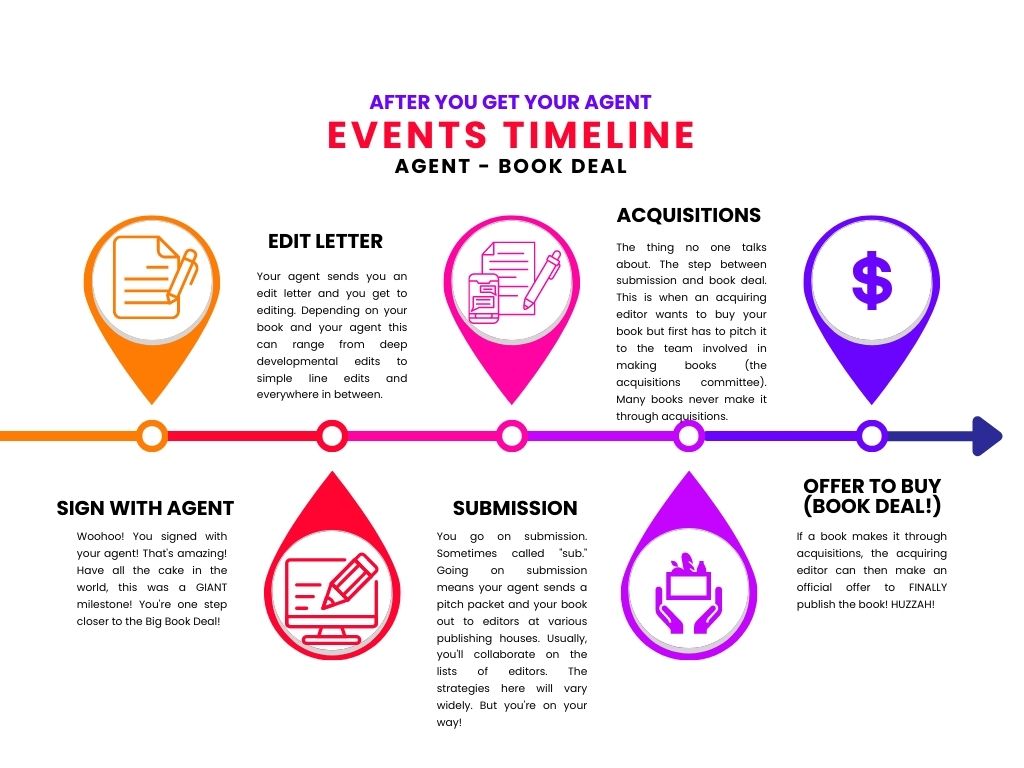
Timeline: Ater you get your agent events. Sign with Agent; Edit Letter; Submission; Acquisitions; Offer to Buy 
Made using: Canva.com
Honestly if I made a timeline for the whole publishing process it might unroll halfway across the United States. No wonder our families don’t understand this.

Sign with Agent

If you haven’t done this yet, read your contract before you sign it! I wrote a blog about that, too. Look at me, I’m a whole wealth of information 😎 NEXT! (Look at me also trying to be brief(ish)).

Edit Letter

Woof. More Bad News. You have to edit this thing. Again. If the book sells, this won’t be the last time, either. Buckle up, buttercup! Depending on your agent, what you both see for the book, the state of the market, the shape of the book, etc. your edits might be anything from line edits to developmental rewrites. This is definitely something you should have talked about on your call prior to your offer though, so it shouldn’t come as a huge shock. If your edit letter does come as a shock, don’t be afraid to reach out to your agent to talk to them about it! Also don’t be afraid to inquire after your edit letter if you were given a timeline and it’s unreasonably delayed.

Tip: If this is your first agent and first book, this is a weird time. It’s hard to go from querying (especially if you’ve been querying for awhile), where you spend a lot of time agonizing over everything you can do to win agents over, to seeing yourself as an equal business partner to one. Even the most supportive agents can’t fully make this dynamic different because it’s a partnership and it takes two (meaning you need to shift your mindset, too). I’ve seen it in my friends and felt it in myself, and my agent could not be more open, honest, communicative, or lovely. It’s simply a strange period of time while you try to transition from “terrified of writing the wrong salutation” or “providing 5.5 sample pages instead of 5” lest I piss off this person I desperately want to impress to “it’s totally fine to disagree with their artistic vision for my work.” But advocating for yourself is normal in any relationship, and if that can’t be normalized in your business relationship with your agent, you have an issue. I know it’s hard to hear and trite and probably no one will listen because it’s just one of those things you have to learn yourself but I’ve seen it enough now to know in my soul that a bad agent (or a bad for you agent, also a thing!) is worse than no agent. That said, be professional, as always.

So you have to edit the book again. At least once. Probably more. Super bummer. Add that to this list of reasons why the submission process can be a bit… well… soulsucking. If you’re going from querying to signing with an agent to submission for the first time, this is the first time you’ve made it this far and… it’s still the same book. In theory, this could be the book that lives with you the longest of any book in your career if it goes the whole way because once you have an agent, they’ll hopefully stay your agent and sell your next book so that book won’t go through the whole, you know, querying thing. Of course there are a myriad of publishing snags embedded in that statement, but let’s just say it’s good to be really in love with this book, just in case.

The act of writing a book is not about falling in love. It’s about staying in love.

Leigh Bardugo, MadCap Retreats, 2017
A photo of a white woman (me) wearing a white PitchWars shirt, with her hand on her chin in front of a computer with a red-lined document open. 
Copyright: Aimee Davis
Is this me editing my book for the 9th time during #PitchWars? Yes. The one I started in 2020? Yes. Was this in 2021? Yes. Was I still editing the EXACT SAME book a year and a half later with my agent in 2023? Also yes. Does a world exist where I might still be editing the EXACT SAME book potentially into like 2026? I think you know the answer. (It’s yes).

Submission

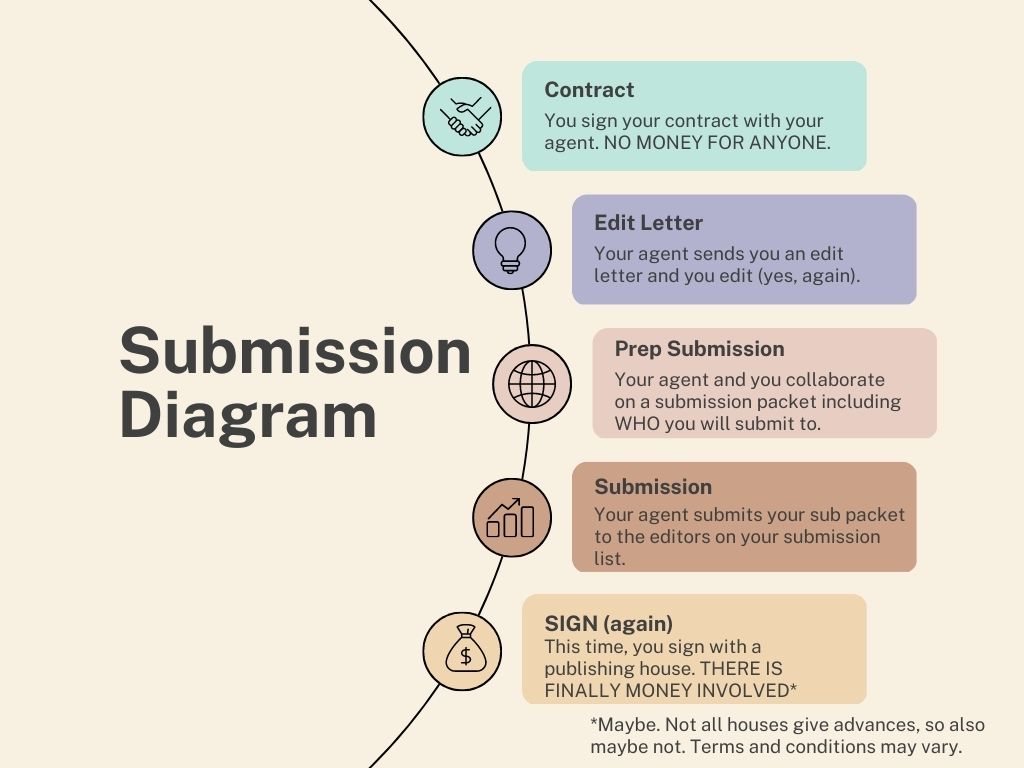
Submission does not go down the same with every agent. I’ve heard and seen lots of different strategies (which one is being employed for your book should also have been a topic of conversation during your call). In many respects, however, submission is like Querying 2.0, but where you at least don’t have to do the querying.

Who and Where

Your agent will prepare a list of editors at publishing houses to submit your pitch packet and book to. The who will depend on the strategy your agent (and you) have devised. Some author/agent teams want to submit only to Big Five publishing houses (or their imprints). Some author/agent teams are interested in independent presses but contingent on size. Some author/agent teams want to shoot all the shots. You and your agent should discuss the strategy that’s right for you both on your call and before submission (and hey, there’s always room to revise it along the way).

Note: Many publishing houses are “one and done” just like many literary agencies, meaning your agent can only submit to one editor at that imprint. Also, there are a lot less editors to submit to than agents (it seems impossible but yeah, less shots this round, folks). Selecting editors carefully is important. It’s also important to remember (IMO) that publishing is a business of connections and your agent has built them in a way that no amount of deep research on Publisher’s Marketplace will be able to replicate (likely). You have an agent for a reason, it’s not a terrible idea to listen carefully to their suggestions for submission. Or even cede this responsibility entirely.

What

After you have an editor list, your agent will prepare a pitch packet with an introductory email that is essentially a query but to an acquiring editor. Often, they’ll include personalization from the agent to the editor (remember that connections bit from above?) about why they’ve chosen the editor in question. They’ll also include a pitch of the book, and your bio. Some agents will then wait for the editor to request your full. Querying 2.0 strikes again, yes. Although there’s some difference here. Some agents will send the full book right away because (thanks to your agent’s connections) the editor has already expressed interest. Some agents will do a combo (especially with one and done imprints). Good news? You’re not the one waiting this time. Well, you are, but you’re not on the front lines of waiting. There’s someone between you and waiting. That distance matters.

When

Many (but not all) agents will do submission in “rounds” just like querying (or how querying used to work). The round sizes and length between each will vary based on the submission strategy and breadth.

Tip: Talk to your agent before you go on submission about what their thoughts are on public mentions about submission. Submission is being talked about more on social media but it’s still not always recommended to discuss submission (or certain aspects of submission) publicly.

Bad News Time (again)

Now you wait. For… well, it can be a while. Unless you’re a rockstar with an auction and movie right fights on the way of course. But honestly most everyone falls into the “probably not” category where that’s concerned so let’s talk about that.

What do you do while you’re waiting?

You know, the standard hurry up and wait writing fare. Obsess over your email. Talk to your writing pals about your lack of emails. Immediately thereafter get an email but with Bad News™. Eat ice cream. Try to figure out the corporate structure of Penguin Random House and all its bazillion imprints. Doom scroll.

Or you can always go with the old addage that continues to ring true and through: Write the wait.

Like I said, Querying 2.0.

Tip: If you’re an author who wrote a series (fantasy, sci fi, romance serial, mystery serial, whatever) do not spend this time working on the second book unless you can sell it as a standalone. There’s no guarantee the book on submission is going to sell. (I cannot tell you how sorry I am to report this.) Even if it does, there’s no guarantee you’ll land a multi-book deal. Not all you see on Twitter is reality. Make life easier on yourself and get to working on another book your agent can try to sell if this one doesn’t. (Also, many agents will help you with the next idea if you’re trying to figure out which one might be most marketable.)

Mood board with images of devil, woman with roots growing out of her sleeves, queen on a chess board, castle near the river, and a rose with text that reads "Once Upon a Time A man told her she would never amount to anything. Society told him he was a stone under its boot. Together, they will break their tales and their world." 
All images sources via Pixabay, Unsplash or Canva.
Not really a write the wait book but a chance to talk about my New Thing at least! Is it another adult fairytale retelling? Yep, sure is. Is it marketable? Who knows. But at least it doesn’t count as a sequel because it can be sold alone. SO THERE.

Acquisitions

CONGRATULATIONS! SOMEONE WANTS TO BUY YOUR BOOK! YOU HAVE ARRRR…

JUST KIDDING. (Maybe).

Acquisitions is the least talked about cruelty in all of publishing. You wrote the book. And probably another one (or ten). You wrote the query. And ten more versions after that. You queried everyone. And waited. Finally, you got the agent. You revised the book. Again. And maybe again. You worked on a submission strategy and a pitch packet and a revised bio and synopsis and fuck, you finally found real comp titles that work. You’ve written all the waits. Now, FINALLY, an acquiring editor says they want to acquire your book. Buy it. Make it a real live book.

You’re here.

Except there’s another step. The acquisitions meeting.

All publishing houses do this differently and there’s been much blog ink spilled over how, so if you’re interested, you can do a google and read up on it, but the gist is basically an acquisitions team consisting of loads of people who are involved in book production (from finance to marketing to other editors to distribution) all get together to listen to pitches from acquiring editors and decide what books they’re going to buy for how much.

Acquisitions is where many midlist and debut dreams go to die.

You don’t always get through. If you do get through, the offer isn’t always what you were hoping for. There’s a plethora of available emotions involved with this process that aren’t deliriously excited, and the honest truth is that sucks. It sucks to be anything less than deliriously excited over something you’ve been working toward for so long. It sucks to feel guilty because you’re not excited, you’re actually just fucking scared or worried or disappointed while you have friends still struggling in the querying trenches. Friends you believe in. Friends you know are just as talented as you. Friends you think might have books more sellable if they were here and you weren’t. I imagine that guilt is one of the things preventing us from talking about this part of the process.

But here’s the thing.

You made it this far.

When your agent tells you you’re going to acquisitions: Celebrate! Do not move that fucking goal post one inch before you’ve celebrated! Screamed! Squealed! Taken pictures! Yelled frantically! Eaten cake! Run around the house! Danced! Made an impulse purchase! Whatever it is you do to celebrate, do that thing. Don’t hold back.

Tip: Acquisitions can take awhile to get through depending on the meeting schedule and the press involved. Sometimes meetings can go over, your book might get bumped to the next meeting, it might get held up while the editor tries to convince people in the press to buy in (like Nancy Pelosi counting last minute votes). It may also take some time to get an official offer because proposals have to be drafted, signed, etc. But this is also an opportunity for your agent to nudge other editors so they can get in the game as well. Ever wonder how an auction or a preempt happens? This is how. And yep, agents nudge too. It’s a stressful time while you wait so celebrate before!

A piece of cheesecake on a white plate with light pink flowers around it, a glass slipper behind it, and a bookmark that reads You're Never Too Old for Fairytales. 
Copyright: Aimee Davis
CAKE! This was absolutely as delicious as it looks, yes.

Offer to Buy

YOU REALLY MADE IT THROUGH! In software, what happens after an acquisitions team signs off on a book is what we call a “business verbal.” It basically means the business side of the house has given the financial approval for the go ahead on the purchase. The general offer terms are conveyed to your agent in a brief written proposal. This is the dollars and cents things, timeline, royalties, what is being acquired (type of rights), and other pertinent terms.

All the nudging goes next. Your agent notifies editors who still have the book that there’s an offer to see if they might also be interested in making an offer (Querying 2.0, yes). If multiple editors express interest, you might be set up for an auction. If one editor is super interested and wants to sort of steal the deal, they can make a preempt offer (like the Buy Now link on eBay, beat out the auction price by paying potentially a little bit more right now). Regardless, you’re at the finish line (at least as it relates to your and your agent’s unpaid labor, because money comes next).

Because after that you have…

Contract Negotiations. My favorite part.

But first, don’t forget to eat more cake. You’re going to be a published author (probably 😉)*

*We’ll leave that Bad News for another day.

How to Explain Publishing to Your Fam: A Primer

Author’s Note: This post is about traditional publishing. My days of self-publishing are behind me, but that comes with a whole other dynamic and set of ins and outs to explain to people. Godspeed me, having to do this multiple times with multiple methods now.

So we all have that friend or relative (or twenty) who has no idea how the hell publishing works. My mom thinks my agent is a publicist. My dad doesn’t understand editors work for publishing houses. Everyone in the world thinks that now I have an agent, my book is soon to arrive on the shelf of their local Barnes & Noble within the week. You too have friends, family, and coworkers like this. I know you do because I have never met a writer who doesn’t. And also because publishing is a legitimately strange business, so it’s perfectly reasonable that people who are not glued to Twitter/Querytracker/Publishers Marketplace don’t understand how it works.

For you, and your struggling family, I have created a primer. Complete with visual aids if that is your jam. Let’s start with a very bare bones flow chart, then break it down, shall we?

Obviously, this is all assuming you don’t have to go back to the beginning and start over, which you might have to do… multiple times. At multiple steps in this process. But let’s make this as clean as possible and assume we live in a utopia and you have one book that goes straight through. (Hahahahahahahahahahahahahahahaahaha)

Okay, so I know you, writer, understand all of this. But your well-meaning family doesn’t. And if I’m guessing right, no matter how many times you try to explain it to them, they still aren’t getting it. So let me break down some of these steps highlighting some of the most frequently asked questions I hear from non-writers and how I’ve navigated explaining them.

STEP ONE – WRITING BOOKS AND QUERYING

Writing books is mostly simple enough but querying really seems to confuse the shit out of people. And it’s hard to blame them. It’s confusing. Even for us. Who among us has not been tripped up by unwritten querying etiquette? Right. So here are some of my go-to favorite tips for trying to explain the whole querying thing to Uncle Donny three schnapps deep at Thanksgiving dinner:

Remember to tell them about the free bit. I don’t know about your family, but a few members of mine seem to get really hung up on the amount of unpaid labor that goes on in publishing. It could be the Steelworkers and Teamsters in them, but they seem convinced they must have it wrong about the free bits. Remind them. Often if necessary. In the simplest terms you can. In my household, I caveat almost everything with: THIS IS A FREE PART.

Compare Querying to Corporate. Query letter means nothing. But most everyone has prepared a cover letter and a resume. Many people have had to either take a skills test of some type or provide a writing sample. I have found this simple conversion to be handy in comparisons:

  • Query letter = Cover letter
  • Synopsis = Resume
  • Sample pages = writing sample

Keep it Simple. I have at this point entirely given up trying to explain to people who are not in publishing how requests work. Partial? Full? Meaningless. Pointless. Throw them out the window. Celebrate your wins with the people who get it. Is it mildly annoying that my dad STILL doesn’t understand what the difference between a full and partial is after I’ve been doing this for approximately 100 years? Yes. But not nearly as annoying as it is trying to explain it AGAIN. The people you love will be there to celebrate with you when that partial turns into a full turns into a call turns into an offer turns into a… you get the deal (ha! there’s a pun there!). Absolutely celebrate every win, but in my experience, cultivating who you celebrate the wins with can drastically improve your overall mental health and make the wins themselves much more enjoyable.

STEP TWO – AGENTS, SIGNING, AND SUBMISSION

Thissssss is where we really start to lose folks. Because at this point, if you’re having a normal querying journey, you’re probably a few (or more) years in STILL DOING FREE SHIT. That is admittedly weird in most every other business. Like even in the worst (US) economy most people are not job searching for 3-5 business years. Hopefully. But that is a totally normal thing to be doing in publishing. Add to that the part about how getting a literary agent is actually just ANOTHER free step and people are just checking out on you (or perhaps checking your temperature for a fever). Some ways I’ve found that can sort of help explain some of this:

Remind them that a new book or new revision means starting over. Just because I’ve been querying for three years or five years or ten years doesn’t mean it’s the same book or the same revision. Explaining that is helpful. “I decided to pivot and am trying to pitch a new book to literary agents. That means starting over from square one but hopefully this idea will hold more traction.” See, I say pitch instead of query. Again, query does not mean anything.

Literary Agent Comparisons. Most people do not seem to understand what a literary agent does. Some useful comparisons:

  • Real estate agent – They sell books instead of houses, they don’t get paid until they sell my book (to a publisher). Don’t forget to mention a BIG KEY DIFFERENCE: Except they exist in a market where there are waaaaaaaaaay too many houses and not enough buyers, so they’re only going to pick the nicest, fanciest, best ones (where your book is the house).
  • Recruiter – They are trying to land me the gig with the publisher and don’t get paid until they do so. BIG KEY DIFFERENCE: Except they exist in a market where there is like 1 job, 5 recruiters, and 100,000 potential applicants, so you (the author) have to apply first to the recruiter before you can even try applying to the actual job. This is probably a more accurate comparison but if the person you’re talking to doesn’t work in white collar corporate America it might not be that helpful.

Again with the free stuff. Yeah, you’re going to need to tell people that literary agents don’t get paid until you do. Call them a middle man. Remind people that yep, I am FIVE YEARS into pitching this book and have just gotten someone to agree to try to sell it. Correct. And they don’t get paid until they do it. Yes.

The Call. Call this an interview. Plain and simple. That’s really what it is anyway. The agent’s chance to interview you, your chance to interview them.

Celebrating. When you do finally sign with an agent, you’re going to celebrate the shit out of that win (as you should). This is going to confuse people though, especially if you’ve been querying for approximately forever. Because they’re going to think you’ve sold your book. Because really, why haven’t you? It’s been like… a decade. This is your opportunity to ignore the fuck out of them. Please refer to my earlier comments about cultivating the people you celebrate with. If your family calls your agent a publicist, or people blow up your Facebook or Teams messages wanting to know when they can buy your book, laugh and move along. Now is not the time to waste energy educating or get frustrated with people’s lack of understanding. You can do that all later. Now is the time to wear your tiara and celebrate.

Submission. Godspeed. Do we need another chart? Okay, yes. If only to break this long ass post up. I swear I write short books. Long tweet threads. Long blogs. Long emails. Short books. Do with that information what you will.

Submission is like Querying 2.0. Probably at this point even the people who love you most have dead eyes. They’re starting to wander off, checking their phones for the latest updates on… literally anything except this. Might be time to just go ahead and admit defeat. But if not, you can pull out the good old rinse and repeat methodology. Basically, submission is like querying version 2.0. Except, pause for effect, there is MAYBE MONEY AT THE END.

Three piles of coins with small sprouts growing atop each one. Image by Nattanan Kanchanaprat from Pixabay

STEP THREE – ACQUISITIONS

We are really only on step three, huh? Well, hopefully people have perked up because I mentioned money. We’re getting somewhere (finally). And yes, we are. Below are some optional steps to discuss about acquisitions if people have started listening again. If not, you can probably get away with simply saying acquisitions is when an acquisitions editor at a publishing house (the person with the buying power) acquires (aka buys) your book. Huzzah! BUYS! Money has arrived. I mean sort of, you know there are exceptions here but like for the basics let’s assume you’re getting some kind of advance and finally, finally, dear sweet baby Jesus, finally get paid. And so does your agent. Whoop!

Types of Sales. If you really want to get into this, you can tell people about the different types of sales traditional publishing has to offer, but I would recommend keeping it as short as possible so as not to get that dead-eyed stare coming back. Just keep letting them follow the money without getting too bogged down in the details:

  • Regular Sale – An editor read your book, liked your book, offered to buy your book. Sweet.
  • Auction – Multiple editors read your book, liked your book, and WENT TO WAR for your book. Admittedly, this is the scenario most of us are dreaming of but our families are like, “Whatever, greedy, money is money you’ve been doing this for free for 87 years are you really going to be picky?” And they are not wrong.
  • Pre-empt – Multiple editors read your book and liked your book, but one in particular really liked your book and decided to avoid the war they would make you an offer you couldn’t refuse and buy it before there could even be a war. For the publisher, this is sort of like that button on eBay where you can buy the item for the set price to avoid the risk of getting bid up at an auction, but you could also lose out on getting a lower deal. You as the author, of course, get the bird in the hand. This is also a Very Excellent outcome. Guaranteed any outcome that results in you no longer doing this for free anymore is an excellent outcome to your loved ones.

Advances. Okay, listen, we all know that advances are a lot to process. Not all publishing houses offer them, how they’re paid out is ridiculous. That publishing houses can take them back for sometimes no reason is wild. Want to explain earning out to someone not in publishing? No you don’t. Just tell them when the publishing house buys your book you get some money in advance and then some more when you fulfill other contractual obligations like turning in the final draft and the book going up for sale. Might also be worth telling them this is going to take a lot longer than they think (like all things publishing) and no, when your book sells they will not be seeing it stores near them in the next couple of weeks and/or months. Don’t we wish.

Editing (again). Time for that good old rinse and repeat situation. Just… repetition is everything in publishing. I’m going to have a chart about that here in a minute to summarize. Skip to the end if you want that because you, just like Aunt Darla, are getting glassy-eyed with this post. Yes, dad, I have to edit this book again. With someone who has the title of editor this time, though. Which is new. (Unless you’ve had your book edited professionally before you queried, which is also a thing that happens that I don’t even have the spoons myself to get into but am not knocking, to be clear).

STEP FOUR – FINISHING

I have a not very good title for this step because I have never found myself remotely near it (yet), but my friends have, and I’ve been in (?) around (?) traditional publishing long enough to know what goes on. So I have summed up all the fine tuning bits that make your book sparkle into a step called “Finishing.”

Line Editing. Yep. More of this. Just like… tell them it’s edited a lot. By lots of different people. Many of whom are underpaid and overworked. Remind them to support the HarperCollins Union.

Copy Editing. Rinse and repeat.

Title. No, you don’t get to choose your own title. Tell your family to get over it. No, cousin Susie, trust me, I don’t care what your friend from the office said or did or read on the internet, getting to choose my own title is NOT worth bootstrapping it on my own and self-publishing. Trust me. Oh boy, trust me.

Cover Design. Don’t get to do this, either. But someone who knows WAY more about the market and Photoshop does get to do it. It will be great. And if it isn’t, you will act like it’s great.

Formatting. The book is formatted (!) into a book looking thing (!) This is when you will finally be able to answer that annoying question every non-publishing person in your life has been asking you since you finished your first draft: How many pages is it? They probably don’t care anymore, because it’s now like… six years later, but you’ll be able to tell them.

STEP FIVE – LAUNCH

In my flowchart I labeled this “Marketing/Sale” because there are a few steps that happen in-house before the official go live date for your book, but the most important part of this step is:

Cat wearing a hard hat presses a red button with text that reads LAUNCH.

Marketing. LOADED QUESTION. PASS. Mumble mumble marketing stuff maybe there’s a lot of gray area TikTok mumble mumble not a lead title mumble mumble eARCs bloggers mumble mumble. OKAY, BYE IRENA, THERE IS STILL MORE PROMO THAN SELF-PUBLISHING, YES. But marketing is fraught and no, I really don’t want to talk about it that would need more words than you want to read because you’re probably already sick of me, right? MOVING ALONG.

Pre-events. Yeah, kind of same as above. No one wants to hear about the debate around whether it’s pronounced A-R-C or

An ark with a bunch of animals Photoshopped (poorly) onto it.

For the record, though, it’s totally the latter.

Distribution and Sale. YES. MY BOOK IS FINALLY AVAILABLE. IT IS OFFICIALLY PUBLISHED. AND MONEY. IT IS TIME ONCE AGAIN TO TALK ABOUT MONEY! We have arrived! You can BUY my book now! And review it, and add it on Goodreads, and do all the things you’ve been waiting to do! Here are some extra points to make now that we’ve reached the finale:

  • This whole process from start to finish if everything went absolutely perfectly and not a single thing ever went wrong (LOL!) would take 2-3 years. At best. Like if you fast drafted the cleanest book you’ve ever seen and threw it into the trenches and got a million requests right out of the gate and signed with an agent immediately and the book was almost perfect and went on submission right away and editors loved it and WENT TO WAR and pushed it through as fast as possible, you could MAYBE have a book on the shelf in 2-3 years.
  • This absolutely never happens to anyone. I mean maybe like three people ever in the history of publishing. More likely it is going to be a 5+ year process.
  • You will not be paid for most of it.
  • Neither will your agent.
  • You’re not quitting your day job anytime soon sobs.
  • You’re going to do the same things over and over and over (a chart on that is coming, I promise).
  • Publishing is not a meritocracy. It’s about luck and persistence and honestly privilege since it’s overwhelmingly white, straight, cis, able-bodied, and male. No, Uncle Earl, I do not give a shit what you think you saw on Fox News about book banning or white dudes not being able to sell their books. They can. And do. They’re fine. Sit down.

Royalties. Remember what I said about trying to explain earning out? I stand by that. Just… don’t. Royalties are sort of similar. We don’t want to talk about royalties. But if you have to, keeping it simple might go something like, “If I meet contractual obligations I’ll start to earn a small percentage of every sale after a certain point. The publisher keeps most, my agent gets about 15%, I end up with an amount less than that. Nope, I do not want to debate that with you.”

REPITITION

If you’ve been keeping track, there’s a lot of repetition in publishing. Which you and I know and can appreciate. But sometimes seeing it laid out can help people who don’t come from inside publishing understand where and when it’s happening, so they don’t think you’re just… I don’t know, working harder instead of smarter or some other corporate jargon that cannot be applied to this business. So, as promised, here is my repetition chart!

There are a couple of bonus features in my chart, yes.

And because I know this is probably The Most Important Thing to most people’s Nephew Ryan who is surely not a 24-year-old techbro running a startup in his mom’s basement just dying for the chance to mansplain to you about how you should really quit it with this “starving artist” thing and “get a real job” I present for you the Publishing Money Flow Chart.

Don’t hate on the graph, Ryan. This is just how our business works. I didn’t make the rules. Trust me, I would have made better ones.

IN CONCLUSION

Did I do a good job summarizing this succinctly? Checks the wordcount. No. Did I work out some deep-seated family issues I appear to have? Yes. Also, I made some pretty charts perhaps you’ll find helpful when next you confront one of YOUR family members who “just doesn’t get it” despite your 87th explanation of querying. At the very least, I hope I made you laugh a couple times as I tried to untangle this messy business we all know and love and so fondly call “Publishing.”

Until next time! Xoxo,

Aimee