Author’s Note: Being a Pitch Wars alum has offered me a unique perspective by allowing me access to aggregated information in the form of rapid succession stories about all the things that once hid behind the “After Agent” veil. Super successes. Quiet wins. Loud defeats. Agonizing almost-but-not-quites. Rewrites and redos. Some of this information (non specific, all anonymous) is gathered from that experience. Some is gleaned from reading too many articles about all the things I never thought to think about before I was agented. All the advice is my own. I compile it here not to discuss one specific event or series of events but some of the many multiple possibilities that could await you in your next chapter. It’s information I wish I had before and with Pitch Wars gone and so many other mentorships with it, my hope by putting it here is only to help someone else who may not have the same access I’ve enjoyed.
To those who have let me be part of their journeys, thank you. There’s no better crew than you.
Congratulations! You wrote a book! Edited the book! Had it critiqued! Survived those critiques! Probably edited the book again! Survived that without burning the book! You queried the book! Survived the rejections! Maybe you did that for years over the course of many books (don’t know anyone like that at all). Maybe you got that lucky book the first time. Doesn’t matter. Whatever the situation is…
YOU GOT AN AGENT!

Pause. Bad News™ incoming.
Turn around now if you haven’t appropriately partied your socks off. Publishing doesn’t give us enough opportunities to do that, so we sort of have to seize the moments we can and hang on tight. Bookmark this bad boy for later. Go party some more. Eat another piece of cake. Or the entire cake. I’ll be here.

Last opportunity to turn back.
3
2
1
Bad News™: There’s still a long way to go before that sweet, sweet book deal
For most of you who have been around publishing awhile, this won’t come as a surprise. (Your family will still be surprised. I have a post on that if you’re interested.) What might come as a surprise, however, even to those who have been around a little, is how much further away the book deal feels once you get over the hurdle of getting the agent.
Moving goal posts is probably a big reason. Everything in publishing is a moving goal post. The achievement benchmarks are constantly growing. It’s a bit like Pacman. A wish for a single personalized rejection turns into a wish for a partial request turns into a wish for a full request turns into a wish for ten full requests, into an offer, into three offers, into a literary agent, into one editor being interested, then three, then six, then an auction, then a five figure advance, no six, no seven, hardcover, audiobook, book tour, no BOOKCON, Netflix deal and on and on and on.
Out there somewhere, your favorite author with all the success is moving their goalpost, I can almost guarantee it. If they weren’t, they’d have written a book on how to stop doing that and be even more famous. The fact is this is an industry where there’s always something else to strive toward, to want, and that makes the “end” seem… well, endless.

Practically speaking, however, if you’re someone who has queried for a bit, submission also might seem daunting because, well, you’re fucking tired. You’ve already taken a hell of a beating so to dive right into the enterprise of receiving more rejections but at arguably higher stakes is… a lot. And then there are the steps that you didn’t think about or you didn’t know about or seemed too far away when you were querying to worry about.
Well, they’re here now so let’s go ahead and talk about them.
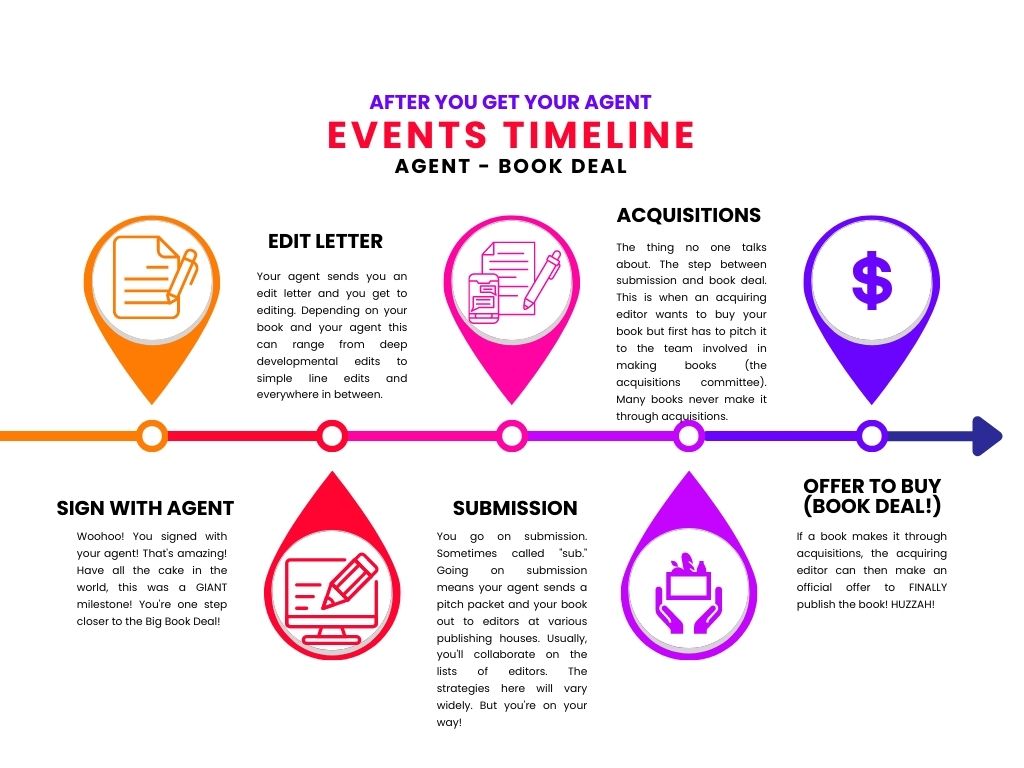
Sign with Agent
If you haven’t done this yet, read your contract before you sign it! I wrote a blog about that, too. Look at me, I’m a whole wealth of information 😎 NEXT! (Look at me also trying to be brief(ish)).
Edit Letter
Woof. More Bad News™. You have to edit this thing. Again. If the book sells, this won’t be the last time, either. Buckle up, buttercup! Depending on your agent, what you both see for the book, the state of the market, the shape of the book, etc. your edits might be anything from line edits to developmental rewrites. This is definitely something you should have talked about on your call prior to your offer though, so it shouldn’t come as a huge shock. If your edit letter does come as a shock, don’t be afraid to reach out to your agent to talk to them about it! Also don’t be afraid to inquire after your edit letter if you were given a timeline and it’s unreasonably delayed.
Tip: If this is your first agent and first book, this is a weird time. It’s hard to go from querying (especially if you’ve been querying for awhile), where you spend a lot of time agonizing over everything you can do to win agents over, to seeing yourself as an equal business partner to one. Even the most supportive agents can’t fully make this dynamic different because it’s a partnership and it takes two (meaning you need to shift your mindset, too). I’ve seen it in my friends and felt it in myself, and my agent could not be more open, honest, communicative, or lovely. It’s simply a strange period of time while you try to transition from “terrified of writing the wrong salutation” or “providing 5.5 sample pages instead of 5” lest I piss off this person I desperately want to impress to “it’s totally fine to disagree with their artistic vision for my work.” But advocating for yourself is normal in any relationship, and if that can’t be normalized in your business relationship with your agent, you have an issue. I know it’s hard to hear and trite and probably no one will listen because it’s just one of those things you have to learn yourself but I’ve seen it enough now to know in my soul that a bad agent (or a bad for you agent, also a thing!) is worse than no agent. That said, be professional, as always.
So you have to edit the book again. At least once. Probably more. Super bummer. Add that to this list of reasons why the submission process can be a bit… well… soulsucking. If you’re going from querying to signing with an agent to submission for the first time, this is the first time you’ve made it this far and… it’s still the same book. In theory, this could be the book that lives with you the longest of any book in your career if it goes the whole way because once you have an agent, they’ll hopefully stay your agent and sell your next book so that book won’t go through the whole, you know, querying thing. Of course there are a myriad of publishing snags embedded in that statement, but let’s just say it’s good to be really in love with this book, just in case.
The act of writing a book is not about falling in love. It’s about staying in love.
Leigh Bardugo, MadCap Retreats, 2017

Submission
Submission does not go down the same with every agent. I’ve heard and seen lots of different strategies (which one is being employed for your book should also have been a topic of conversation during your call). In many respects, however, submission is like Querying 2.0, but where you at least don’t have to do the querying.
Who and Where
Your agent will prepare a list of editors at publishing houses to submit your pitch packet and book to. The who will depend on the strategy your agent (and you) have devised. Some author/agent teams want to submit only to Big Five publishing houses (or their imprints). Some author/agent teams are interested in independent presses but contingent on size. Some author/agent teams want to shoot all the shots. You and your agent should discuss the strategy that’s right for you both on your call and before submission (and hey, there’s always room to revise it along the way).
Note: Many publishing houses are “one and done” just like many literary agencies, meaning your agent can only submit to one editor at that imprint. Also, there are a lot less editors to submit to than agents (it seems impossible but yeah, less shots this round, folks). Selecting editors carefully is important. It’s also important to remember (IMO) that publishing is a business of connections and your agent has built them in a way that no amount of deep research on Publisher’s Marketplace will be able to replicate (likely). You have an agent for a reason, it’s not a terrible idea to listen carefully to their suggestions for submission. Or even cede this responsibility entirely.
What
After you have an editor list, your agent will prepare a pitch packet with an introductory email that is essentially a query but to an acquiring editor. Often, they’ll include personalization from the agent to the editor (remember that connections bit from above?) about why they’ve chosen the editor in question. They’ll also include a pitch of the book, and your bio. Some agents will then wait for the editor to request your full. Querying 2.0 strikes again, yes. Although there’s some difference here. Some agents will send the full book right away because (thanks to your agent’s connections) the editor has already expressed interest. Some agents will do a combo (especially with one and done imprints). Good news? You’re not the one waiting this time. Well, you are, but you’re not on the front lines of waiting. There’s someone between you and waiting. That distance matters.
When
Many (but not all) agents will do submission in “rounds” just like querying (or how querying used to work). The round sizes and length between each will vary based on the submission strategy and breadth.
Tip: Talk to your agent before you go on submission about what their thoughts are on public mentions about submission. Submission is being talked about more on social media but it’s still not always recommended to discuss submission (or certain aspects of submission) publicly.
Bad News™ Time (again)
Now you wait. For… well, it can be a while. Unless you’re a rockstar with an auction and movie right fights on the way of course. But honestly most everyone falls into the “probably not” category where that’s concerned so let’s talk about that.
What do you do while you’re waiting?
You know, the standard hurry up and wait writing fare. Obsess over your email. Talk to your writing pals about your lack of emails. Immediately thereafter get an email but with Bad News™. Eat ice cream. Try to figure out the corporate structure of Penguin Random House and all its bazillion imprints. Doom scroll.
Or you can always go with the old addage that continues to ring true and through: Write the wait.
Like I said, Querying 2.0.
Tip: If you’re an author who wrote a series (fantasy, sci fi, romance serial, mystery serial, whatever) do not spend this time working on the second book unless you can sell it as a standalone. There’s no guarantee the book on submission is going to sell. (I cannot tell you how sorry I am to report this.) Even if it does, there’s no guarantee you’ll land a multi-book deal. Not all you see on Twitter is reality. Make life easier on yourself and get to working on another book your agent can try to sell if this one doesn’t. (Also, many agents will help you with the next idea if you’re trying to figure out which one might be most marketable.)

Acquisitions
CONGRATULATIONS! SOMEONE WANTS TO BUY YOUR BOOK! YOU HAVE ARRRR…
JUST KIDDING. (Maybe).
Acquisitions is the least talked about cruelty in all of publishing. You wrote the book. And probably another one (or ten). You wrote the query. And ten more versions after that. You queried everyone. And waited. Finally, you got the agent. You revised the book. Again. And maybe again. You worked on a submission strategy and a pitch packet and a revised bio and synopsis and fuck, you finally found real comp titles that work. You’ve written all the waits. Now, FINALLY, an acquiring editor says they want to acquire your book. Buy it. Make it a real live book.
You’re here.
Except there’s another step. The acquisitions meeting.
All publishing houses do this differently and there’s been much blog ink spilled over how, so if you’re interested, you can do a google and read up on it, but the gist is basically an acquisitions team consisting of loads of people who are involved in book production (from finance to marketing to other editors to distribution) all get together to listen to pitches from acquiring editors and decide what books they’re going to buy for how much.
Acquisitions is where many midlist and debut dreams go to die.
You don’t always get through. If you do get through, the offer isn’t always what you were hoping for. There’s a plethora of available emotions involved with this process that aren’t deliriously excited, and the honest truth is that sucks. It sucks to be anything less than deliriously excited over something you’ve been working toward for so long. It sucks to feel guilty because you’re not excited, you’re actually just fucking scared or worried or disappointed while you have friends still struggling in the querying trenches. Friends you believe in. Friends you know are just as talented as you. Friends you think might have books more sellable if they were here and you weren’t. I imagine that guilt is one of the things preventing us from talking about this part of the process.
But here’s the thing.
You made it this far.
When your agent tells you you’re going to acquisitions: Celebrate! Do not move that fucking goal post one inch before you’ve celebrated! Screamed! Squealed! Taken pictures! Yelled frantically! Eaten cake! Run around the house! Danced! Made an impulse purchase! Whatever it is you do to celebrate, do that thing. Don’t hold back.
Tip: Acquisitions can take awhile to get through depending on the meeting schedule and the press involved. Sometimes meetings can go over, your book might get bumped to the next meeting, it might get held up while the editor tries to convince people in the press to buy in (like Nancy Pelosi counting last minute votes). It may also take some time to get an official offer because proposals have to be drafted, signed, etc. But this is also an opportunity for your agent to nudge other editors so they can get in the game as well. Ever wonder how an auction or a preempt happens? This is how. And yep, agents nudge too. It’s a stressful time while you wait so celebrate before!

Offer to Buy
YOU REALLY MADE IT THROUGH! In software, what happens after an acquisitions team signs off on a book is what we call a “business verbal.” It basically means the business side of the house has given the financial approval for the go ahead on the purchase. The general offer terms are conveyed to your agent in a brief written proposal. This is the dollars and cents things, timeline, royalties, what is being acquired (type of rights), and other pertinent terms.
All the nudging goes next. Your agent notifies editors who still have the book that there’s an offer to see if they might also be interested in making an offer (Querying 2.0, yes). If multiple editors express interest, you might be set up for an auction. If one editor is super interested and wants to sort of steal the deal, they can make a preempt offer (like the Buy Now link on eBay, beat out the auction price by paying potentially a little bit more right now). Regardless, you’re at the finish line (at least as it relates to your and your agent’s unpaid labor, because money comes next).
Because after that you have…
Contract Negotiations. My favorite part.
But first, don’t forget to eat more cake. You’re going to be a published author (probably 😉)*
*We’ll leave that Bad News™ for another day.
 Aimee Davis