Legal Disclaimer: I’m not an attorney, so nothing in this post should be construed as legal advice. If you believe your intellectual property rights have been infringed upon, please contact your agent, your publisher, and/or your (or their) legal counsel. The Author’s Guild is also available for many traditionally published (or agented but not yet published) authors.
Work Disclaimer: These opinions are my own and are not intended to represent the views or opinions of my employer.
Yes, I work in software compliance. Not in the arts, but in healthcare. Still, the ethical constructs remain the same. My job is to guard data with, to be frank, utter ferocity. I take this job extremely seriously. Because at the end of the day, data isn’t simply data.
It’s also my job to remind people of that.
Data is protected health information. Emphasis on protected. It’s that diagnosis you’ve been hiding from your family because you don’t want to worry them. It’s the abortion you had when you were young held between you and your doctor. It’s your birth sex that no one has a right to know except you and your OBGYN. It’s your weight. Your mental health history. Your struggles and triumphs. It’s precious. Sacred.
Data is personal information. It’s the social security number you fought to earn over a course of years as you worked toward citizenship. It’s the driver’s license you won back after you won your sobriety. It’s the credit score you battled to on your way out of poverty. It’s the zip code you’re hiding from your abusive ex.
Data is dreams. It’s decades of callused fingers holding a pick to strings. Frustration as you mixed and remixed colors trying to capture the exact shade of pink in that sunset over your grandmother’s funeral. It’s the cool grass beneath your head, a book in your hands, reading about a female knight for the first time, realizing you might be able to write stories like this too if you tried. It’s burning, bloodshot eyes staring at draft after draft after draft. It’s bitten down pens and pencils and charcoal stained hands. It’s college tuition money you’ll never see back in your lifetime, and arguments with parents that echo in your ears as you chase a dream so far out of reach but worth chasing all the same. It’s years of jobs you hate, trudging home exhausted, trying to find time for the only thing that quenches the ache in your soul. It’s a first commission. A demo tape slipped into the right hands at the right time. An advance split into four payments that dwindle to nearly nothing but not quite. The not quite is important because it’s something after years of nothing, nothing, nothing.
Yes. I take data seriously. Data ethics, too.
So imagine my surprise and dismay when I signed off my work computer after giving an hour and a half long presentation on ethical AI and secure coding to my compliance and data security teams only to find ethics had once again been breached in relation to my dream: publishing.
For those who don’t know, yesterday, a company incorporated in Oregon doing business under the name Shaxpir, went viral in the Twitter writing community after it was revealed a project called Prosecraft (operating under the Shaxpir name), had collected thousands of books to be fed into its algorithms without authors’ or publishers’ knowledge or consent. At this time, it’s unknown how many books or authors were affected but Prosecraft boasted of having a database of more than 25,000 books. Authors like Angie Thomas, Victoria Aveyard, and Kate Elliott addressed the issue head on, stating consent was not given for their books to be listed there (yet there they were). Dozens of other authors confirmed the same. Some of them friends. Debuts. People I know who have clawed their way through impossible odds to arrive to… this.
Shaxpir founder Benjamin Smith took the Prosecraft website down after public cries of outrage and issued an… apology looking thing, but made no mention of the data. Not where he got it, or if he was keeping it, or if it was indeed fueling Shaxpir, the software as a service business model billed at $7.99 a month. According to the Shaxpir site, though, the Prosecraft data is indeed part of the paid model.
Note that Shaxpir also boasts a “Concept Art” feature. Just pointing that out.
Taking the website down but not deleting the data is a big deal. It means there are authors out there who don’t know if their books were part of this because they didn’t get a chance to search the website before it was shut down. I myself was in the middle of searching the website for friends’ books (and actually my own once upon a time self-published books) when it was taken down. I found one final friend’s book before it went dark. I never got to check on my own.
There’s a larger picture, here, however. It’s one I talk about frequently in my day job and one that hovers at the front of my mind almost constantly. It goes beyond one man running a two-person startup, and shit apologies, and the fury burning through my veins when I see my friends’ books blatantly stolen as robot food.
It’s a picture about the larger picture.
Technology isn’t inherently evil. We can very easily make it so, though. Because we make it in our image. And when we make technology without considering the global picture, we recreate ourselves, only worse. The decisions come faster, are often unexplainable and undetectable (even to their makers), and in being so, are often indefensible. This is sometimes called the “black box” problem. To avoid it, AI and algorithms (deep learning in particular, which to be clear, Shaxpir does not appear to have been using) have to be created with purpose, transparency, ethics, and a global framework in mind. They cannot be created simply because wow, wouldn’t that be cool?
Wouldn’t that be cool? The question that started a thousand dystopian novels. (That some techbro went and data scraped for their LLM lolz.)
This was titled “AI This was titled “AI generated dystopia.” Whether that means it was generated by AI or the dystopia was generated by AI is unclear. Perhaps both. Both seems appropriate. I try to avoid AI generated art in these posts (where I can, I’m no artist and sometimes can’t tell) because many of them are using LLM to create their generative art which is stealing art the same way LLM text features are stealing books but the transparency with the title gave me enough pause to be equally transparent with the use case here. Because transparency is what I’m about to talk about.
The fact is AI isn’t going away. It’s been here awhile and it will continue to be. It’s doing amazing things in a lot of places. It’s also hurting people. Whole industries, actually. Like the people who act as its gods, it creates and destroys in their image. It can be biased and prejudiced and innovative and beautiful and ethical and transparent and honest. It can learn and develop and change and evolve. It can become worse. Or better. It depends on the guide.
Software developers are creators, too. We just speak a different sort of language. Are they all going to listen? I’d be naive if I thought so. But if enough of them do, we’ll be a hell of a lot better off.
So that’s my goal every day. To help people in tech understand these aren’t just points of data fed to a machine. To encourage them to slow down for five minutes so they might better understand the base of that LLM learned to speak human by STEALING from a human. From someone like you. Like me. From someone who had a dream.
A dream just like theirs, really.
Am I angry? Yes. Today more than other days. Honestly, I started this blog to be a seething commentary about Shakspir and AI and all the shit tech keeps stealing from us. But as I wrote, I realized I only feel sad. And tired. Maybe a little scared, too. I’ve fought so hard for my dream and I’m not ready to give it up.
From that springs hope. Hope for ethical, responsible AI. Hope that we can find common ground. Hope that we’ll be able to understand one another if tech can slow down and maybe we can all sit down and work this out together.
Before we destroy all the data. Or all the dreams it holds.
Author’s Note: Full disclosure, my full time job is in software (healthcare sector). I’m the Vice President of Compliance, meaning I’m highly involved in data security and data sourcing. I live and breathe data issues not only in my publishing life but in my 8-8 (ha!) as well.
Disclaimer: I am not an attorney and nothing in this post should be construed as legal advice. Please consult an attorney in your jurisdiction should you require legal advice.These opinions are my own and are not intended to represent my employer.
The [Copyright] Act “reflects a balance of competing claims upon the public interest: Creative work is to be encouraged and rewarded, but private motivation must ultimately serve the cause of promoting broad public availability of literature, music, and the other arts.”
Twentieth Century Music Corp. v. Aiken, 422 U.S. 151 (1975)
Right now, a bot is scraping this for my words to train a machine to sound like me. Well, not like me specifically, because I’m a nobody, but like a human who is well-read and well-studied. A human who happened to get an 800 on the English portion of the SAT. Who has a degree in English literature from a highly ranked university. Who has written sixteen or more books. Who has a literary agent. Who has spent seemingly endless waking moments since she was four chasing the dream of becoming a published author. Who has sacrificed other dreams, other lives, other paths in that pursuit. Who has cried, screamed, bled, sweat, studied, pulled all nighters, read millions of words, wrote millions of words, all pushing toward that singular goal.
Thirty-one years of language to eat. Steal. Regurgitate for a profit I’ll never see.
It’s hard to figure out how to come at this topic, honestly. There’s a legal angle. What are the four factors that make a copyrighted work “fair use?” A technical angle. What is data scraping? A large language model (“LLM”)? An emotional angle. Why are writers and artists and actors so pissed? A philosophical angle. What does it even mean for something to be art?
I know them all. Each one pumps through my rapidly beating heart, coursing through my veins, itching to be freed through my fingers. Tabs fly open as I try to discern what angle I’ll take. On my right screen, tabs upon tabs upon tabs of Westlaw copyright cases. On my left screen, emails and articles about LLM and NLP (natural langauge processing) and the differences between the two. Techopedia ready to go, to explain. All the while, thoughts of that horror movie M3GAN flash through my mind.
Does AI write itself as the villain, I wonder?
Perhaps that’s how we know it truly is starting to come alive…
Something shudders through me. An echo. A whisper against the back of my neck. Somewhere, a ripple.
My ADHD flies into overdrive. Speared on by the unknown. The unseen. Desperate. Trying to outpace a thing I know I cannot outrun.
On the right screen, I open the Author’s Guild’s open letter to generative AI leaders: Open AI; Alphabet; Meta; Stability AI; IBM; Microsoft—God there are so many already, since yesterday it seems—begging them to stop this madness, to pay writers their fair share. Another tab. The NPR article about median writers’ income for 2022 being $23,000. Poverty levels for the US for 2022. $13,590 for an individual. $18,310 for two. $23,030 for three. There it is. Poverty comes quickly. A single child and a spouse not working for whatever reason, there are so many reasons these days. A single parent and two kids. Options there, too. Nevermind I don’t know anyone who can live off $23,000 on their own in Philadelphia and publishing doesn’t pay for an author’s healthcare.
Our dreams. Our dinner. Our lives. Our livelihoods. Is there nothing they can’t have?
They’re the newage Ursula, stealing our voices and our princes and our happily ever afters. There’s probably a book there somewhere if the bots don’t scrape it first.
My neck aches. I press my fingers into the place where my skull meets my spine, molding my skin like clay. Skin. Clay. Sleep. My stomach growls, reminding me of my humanity. I ignore it. Move forward.
I’ve written this before. Literally and metaphorically. I’ve been drafting it in my mind. But a draft I spent hours on also disappeared. I thought about giving up. It doesn’t matter anyway. I can’t keep up. But it has to come out. I’m angry enough to write it again. And again. And again. Our dreams are being fed to the machine while we aren’t being paid enough to feed ourselves.
Virginia Woolf comes to mind. Money and a room of one’s own is needed to write fiction. Art is for the economically privileged. It always has been. Does it surprise us that art was the first to fall victim to Silicon Valley?
The fair use doctrine permits courts to avoid rigid application of the copyright statute when, on occasion, it would stifle the very creativity which that law is designed to foster.
Stewart v. Abend, 495 U.S. 207 (1990)
So far, there are concrete answers. What is fair use. What is LLM and NLP. Why are authors and artists and actors mad.
What is literature, though. That has me frozen.
Except… maybe there aren’t concrete answers for everything.
The court notes the purpose of the Campbell’s logo and label was commercial: to advertise soup. Warhol’s purpose in reproducing the image was the opposite: to comment on consumerism. Therefore, the use was fair.
Controversial statement but… I wonder if the designer of the label, someone who was presumably a real human who didn’t profit off the can label nearly as much as Warhol profited off the reproduction of the soup label, finds that particularly fair.
I wonder if that person cares they are unknown for their creation while Warhol is known for its reproduction.
I wonder if I am also afraid of AI replacing me into anonymity.
Art is my only potential legacy, after all.
Pertinent to this discussion, I googled “Who designed the Campbell’s soup logo” and Google highlighted Andy Warhol despite his name not making an appearance in my search because hi, bots. Also, people apparently ask if Andy Warhol designed it. Just saying. But for the record, Dr. John T. Dorrance created the logo in 1897. In 1898, Herberton L. Williams swapped the orange and blue (yikes) colors out for red and white because he saw Cornell’s colors at a football game and liked them better. Herberton later became the company’s treasurer, comptroller, and assistant general manager, so probably we don’t have to cry too hard for that guy.
Is it the intent of our art that makes it art, then?
Because as someone who has spent a lot of time in writing workshops listening to snobbery about the bastardization of literature due to genre fiction’s pandering to commercialization; who has also spent a lot of time listening to programmers talk about programming rules that sound a lot like intent, let me tell you about how that is a slippery slope.
The court goes on.
The Court of Appeals noted, correctly, that ‘whether a work is transformative cannot turn merely on the stated or perceived intent of the artist or the meaning or impression that a critic—or for that matter, a judge—draw from the work. [O]therwise, the law may well recogniz[e] any alteration as transformative.'”
Andy Warhol Foundation for the Visual Arts, Inc. v. Goldsmith, 143 S.Ct. 1258 (May 18, 2023) (Internal Citations Omitted)
Not intent then. Or at least not entirely.
Relief floods me.
Still, legality and literature have entangled in my mind. Day job and dream job comingling again.
What makes something art.
Life.
The answer is life.
It’s a falsity that you must suffer to create art. But you must live. My art requires suffering because that’s my lived experience. All that’s truly required, however, is a lived experience. Write what you know. You.
Art is about the individual life experience. The individual voice. The individual expression. Not a little of me and a little of you and a little of him and a little of her and a little of them strewn together to create one voice, one story, one experience. Art requires many singular voices and stories and experiences. Canon but more importantly, culture, then becomes that body of singular works. The thousand, single stories. Then a thousand more. Art isn’t a single story put together by a thousand voices. That’s what creates the danger Chimamanda Ngozi Adichie warns of in that TED talk. The danger of the monolith. AI puts together experiences that cannot be unified or reconciled. That’s exactly what marginalized voices have been fighting against except so much worse. It’s the stripping of language of all its nuance. All its individuality.
We have forgotten.
Words have power.
We have to pay people appropriately, so they can wield them well.
Author’s Note: Hard truths time. Before you go in, some disclaimers about where this is going so you can read it in the right headspace. This isn’t a subtweet blog, but it does vaguely track the relevant discussion of the publishing hour (how an agent rejects you) and my vast experience being rejected by pretty much every agent in this business (including my own at one point). It’s for newer writers and is more relevant to 2023 than not. It’s not particularly positive (or I would argue negative, it’s honest). It’s based on my experiences in both self-publishing and traditional publishing over the past decade, though focuses mainly on traditonal publishing. It can thus be reflective of only one person’s point of view, which as I like to remind folks is white and cisgender. It contains minimal advice except some tricks I’ve seen used and to practice mindfulness and self-care. Finally, I think it’s fair to note that I am (finally) agented, so I do have a rose-colored perspective on querying (sort of, lol).
Content Warnings/Trigger Warnings: Discussion of rejection, loads of it.
Welcome to Publishing, Everything Sort of Sucks Here
I’ll be the first to admit that when I (re)entered the querying trenches in 2017, I was not prepared for what I was about to face.
Neither failure nor rejection were particularly new to me. I was querying on the heels of what I considered two failed self-published books. Those books were rejected by what felt like the world. They had also been specifically rejected by hundreds of bloggers, bookstagrammers, and Goodreads reviewers* who I had to pitch to one by one, according to their varying instructions. Those emails were frequently rejected and ignored. Sometimes, they were accepted, only for me to spend dwindling money on printing and shipping to the result of no review. Once (only once, a victory, honestly!), one was read, resulting in my first one-star review.
Not so unlike querying, truth be told. Except querying never cost me hundreds of dollars.
*(No shade to reviewers, by the way, an honest review is an honest review, and your time is your time! You’re as unpaid as the rest of us, I mention this experience only for a close comparison to the traditional publishing world’s rejection to link the two together).
This is what I told myself as I prepared to query (for real, as an adult) my first novel.
I was ready.
The first of many lies I would tell myself over the next five years.
The Rejections
It’s been awhile since I did a nice chart here, so let’s start with one of those then break it down from there.
Was this a pricing chart before I reformatted it? Maybe. Is it missing Closed No Response? Yes. Did I try to reformat it and give up? Also yes.
The Form Rejection
In 2023, the form rejection is the most common type of rejection to receive (besides potentially Closed No Response, more on that at the end of this section). I hear legends this wasn’t always the case, but for me, it sure as shit has been, so I’ll take people at their word when they say that wasn’t true in 2017. (I also hear that a 20% request rate was a perfectly reasonable thing to aspire to in 2017 but again, rocking that big goose egg for years over here, so I’ll have to believe other people when they say that).
What does the form look like? Well, it depends on the agent. Some agents have forms that say “This is not right for me, but thank you.” Some agents have forms that are so un-formlike I (and others) mistake them for personalized rejections. Some agents have multiple versions of form depending on what (in their mind) went wrong (thanks for submitting this, but I don’t accept this genre versus thanks for submitting, but I didn’t connect the way I’d hoped, for example).
If you’re new to querying and aren’t sure what might be a form, the best way to figure out if you’ve been formed is to go to QueryTracker and read the comments for that agent. Lots of people will record what the form for the agent is or what they believe it to be. If you received the same thing as others, you’ve been formed. Try not to stress, it happens to literally everyone at least ten times (or ten dozen). (If you did not get formed ten times or more, please happy dance elsewhere, this post is not for you).
Sample of someone reporting a form response on Querytracker. I didn’t pick on this agent if you know this form, I literally just signed in and clicked on the first form rejection I saw on my account and scrolled through to find this.
When I started querying, I hated form rejections. I particularly hated form rejections of the “this isn’t for me, bye” variety. I hated them for all the reasons many new (or newly querying) writers hate them. Because they didn’t give me any information about what was “wrong.” And there’s so very much that can be wrong. The query, the pitch, the idea, the pages, the writing, the genre, me.
What. Was. Wrong.
If I knew what was wrong, I could, presumably, fix it.
Hard truth. A lot of the time, you can’t. I’ve said it before, I’ll say it again. If you’re doing The Things (getting beta reads, critiques, improving your craft, putting together a strong query package, listening to fedback and taking it, etc.) you’re probably doing nothing wrong. You are simply having bad luck.
I also hated them because they felt cold. Some didn’t have my name, or the title of the book. I had no indication if the agent had even read the damn thing.
Hard truth. They are cold. I don’t know these people. They don’t know me. I’m a drop in the bucket. It isn’t personal. Therefore, it doesn’t feel personal. That hurts because it is personal. Here I was, putting all this time and effort into something, no not just something, my dream, and on the other side of a screen someone didn’t even take time to read it! It felt unfair. Unjust. Wrong.
Yeah, there’s that word again. Wrong.
I thought if I could prove to an agent I work harder than everyone else I could show I deserved this more.
Wrong. Wrong. Wrong.
I don’t work harder than everyone else. I work hard. There are people who work harder. I know that without a doubt now. I admire these people. Envy them. Sometimes worry about them. There are people who deserve this more. I feel guilty about that. Frequently. There are better writers than me. People who I feel have stories more worthy of being told. My distinguishing factor is I was determined and lucky. I hope loads of others will be too. Some of them already have been, and I cheered for them harder than anyone.
After I got over myself, of course. Some days I still need reminidng, and humbling, yes. That’s normal. Human. Don’t hate yourself for it, but do try to be better in spite of it. Be kind to yourself when you fail to be better, then try again. Forgive when others around you inevitably fail (and with the exception of a few, most everyone will fail at this along the way).
Anyway, back to rejections.
By year four of querying, I started to prefer form rejections. Better than a no-response. Better than a personalized rejection that made me wonder if the agent liked it why not request? Better than feedback that suited one agent but not another. Forms were tidy. An answer to pilot me to QueryTracker to mark this one closed and move to the next. In and out like a wave.
Were they gentle like a lightly lapping wave? Not really, no. Did some of them hit me in the back like a newbie surfer, dragging me off my board into the depths of existential fear? Sure. Was I probably disassociated by year four and rejection many hundred? I mean, yeah. Listen, I said they were like a wave. That can be all kinds of interpreted.
Also by year four I had (sort of) learned that I wasn’t really doing anything wrong and even if I was, agents weren’t here to teach me about it. I had to learn from other writers, from critiques, from doing the work. But more than anything, I needed the right idea at the right time pitched to the right agent in the right way.
Honestly, it’s shocking it only took five years and four books.
The Personalized Form Rejection
According to the Wisdom that Was, personalized form rejections used to be much more common than they are now. Again, I never saw one until Pitch Wars, but I’ll believe people. They’re not common now. At all. If you get one, celebrate. Believe it or not, this rejection is a victory. It’s the partial request of the new querying era. Someone liked your work enough to spare the time to tell you (even if it’s a line, in this overworked, underpaid industry, a line is money not made so you earned that, celebrate it).
If you’re not sure what a personalized form rejection is, usually it’s the form plus something a little extra specific to your book or pages. Maybe it calls out a character or a particular element of your world the agent thought was interesting or unique. Maybe it’s more generic. I received one for my Pitch Wars book that said, “I definitely remember this one from Pitch Wars!” Then go on to praise my writing and premise.
Personalized rejections are (in today’s market) an indicator that your query and sample pages are “working.” They aren’t a reflection of your work.
Hard truth. They still feel that way.
If there’s one thing that’s true in this business, there’s two. Here are two things to know about publishing and personalized rejections:
The goal post will keep moving, so celebrate every win as best you can (this is harder than it seems and doesn’t get much easier). When I was in the query trenches, I always seemed to be doing Worse Than Everyone Else. Friends would bemoan their losses and I would envy them for where they were. Must be nice to be sad about a personalized rejection. I’ve never gotten one. Then, one day I got one. Annnnnd was sad about it. Quickly, my bitterness turned to Must be nice to be sad about a partial rejection, I’ve never had a request. Then, one day I got one. Which wasn’t good enough because it wasn’t a full. Which wasn’t good enough because it wasn’t 10 fulls. You see how this escalates. It’s hard. Keeping your eyes on your own paper isn’t really possible with social media or writing friends and you need at least the latter, I’ll be honest. You’re going to compete against your friends, your peers. You’re going to feel these feelings (probably, or maybe I’m the only asshole, but I like to think not). When you do, acknowledge them for what they are, and keep them on the inside or with an extra trusted friend or two. Better, have a friend to call you on your bullshit, gently and with compassion, but honestly. Megan Davidhizar is mine (ps if you like YA thrillers you should totally Add Silent Sister On Goodreads, it’ll blow your mind I should know I read it FIRST and told her then it would be The One which was of course, correct). Megan parrots my own advice and moving goal posts back to me with the memory of an elephant, and the humor of a patient saint. “Oh, look at that, remember when you said LAST TIME this thing then you moved your own goal post? Funny how it becomes impossible to do things.” Okay sure, fine, she’s right. My sincerest wish is you all find a Megan to annoy the shit out of you with the exact right amount of tough love plus validation you need.
“Near misses” are a thing to seek and destroy from your brain. The concept of a near miss is somehow more haunting than a flat out nope, goodbye. It’s like that partner you break up with not because anyone did anything wrong but something just wasn’t quite “right.” The person you think about every once in awhile, a nagging worm in your brain. You know the one. The one who got away and left you with this whole world of possibility you didn’t explore for reasons that aren’t entirely clear. The one you think about reuniting with on an Oprah episode in some serendipetous act ten years in the future “First Loves Reunited.” After all, it wasn’t bad it just wasn’t right but that could have been fixed, couldn’t it? Nope. That person is not The One. And your book, I’m sorry to say, was not the agent’s The One. There was nothing fixable to make it “right.” Not because it was horribly broken but precisely because it wasn’t. It’s fitting a square peg into a round hole. The square is perfect, the circle is perfect. They just don’t fit. Acknowlege you wrote a great square and you need to find your square hole, and do your best not to let that near miss eat you alive. Easier said than done, I know. Which is why I prefer the form rejection now!
Why this rando image you ask? Well, because the dog on the left looks like Megan’s dog and the calico cat on the right is sassy because calicos always are which is how I feel today. Plus dog and cat, square peg round hole, fits both points. Now you know how my brain works. Welcome to the circus, it’s weird in here sometimes.
Feedback
All right, I’ll be honest here, I don’t know too much about feedback because I’ve literally only received it one time, and it was from my now-agent on a book they passed on prior to offering on another book. The feedback was lovely, in depth, and kind. It made me want to revise the book, which I did. It resonated the way a CP’s feedback resonates, and was in large part the reason I queried my agent with another book immediately thereafter despite having quit writing forever. Because I know feedback like that from anyone, but especially an agent is rare.
Feedback in a rejection (i.e. not a request to revise and resubmit) can be a bit perilous, however. What one agent dislikes or thinks should be revised isn’t always the same and feedback is so rare these days it’s unlikely you’ll get enough of it to see the same thing repeated often enough for you to say okay yes, this is the market saying I need to revise this, or this is objectively a hole in the craft, or whatever. Revising your book for an agent who didn’t offer on it can change something another agent would have liked. Or, it may change absolutely nothing but waste time you could spend working on a new project. Worse, you’ll never know which it was, so there’s a good chance you’ll end up doing that should I should I not have dance forever more. Or, for awhile, anyway.
The best advice I have on feedback is to take it and run with it only if you know in your gut it will make your book better for you. Not anyone else. You.
The book that my now-agent gave me feedback on? I revised it after I’d shelved it. Because I wanted to see if I could make it better. Because the feedback made me excited to write again. I revised that book one final time for me and no one else. It’s a better book for it. I’m a better writer for it. Revise to make the book better in a way you believe in, and your decision will hopefully be easier to swallow regardless of what happens.
CNR (Closed No Response)
Okay so first, CNR means Closed No Response. It took me more years than I’m willing to admit to learn this, so you’re not alone if you’ve been head scratching.
What it means is the agent didn’t respond to your query. That “No response means no” policy you see on many agent websites these days. Next to the form rejection, the CNR is probably the most common form of rejection these days (maybe more common?). It’s the source of much controversy and despair. I hate it. I’ll never learn to accept it. Well, I could, but the only way I could publishing will never be able to accomplish, so I suspect we can both continue to stubbornly ghost and glare.
The way, you ask? Well, as a neurodiverse individual, I could probably be persuaded to grudgingly accept the CNR as I’ve accepted the other forms of query rejections if it followed rules. The hardest thing for me with the CNR has always been how erratic it is. No response means no except not always. No response means no within 6 weeks not in 2023 though, lolz. No response means no for some agents here but not others but good luck figuring out who.
I’m not faulting agents for this. They’re busy. It takes time to send even a form rejection. Time they don’t have because they’re not getting paid unless they’re selling books. Timelines are impossible to keep. Websites are obnoxious to update, so updates are pushed to the neverending to do list of small business life.
It’s a reality, though. CNRs are hard. And sometimes they aren’t actually CNRs. Rejections you closed out in QueryTracker (and your heart) pursuant to a no response means no policy might come again in a form months later. They sneak out of nowhere and knock you right off that surfboard. Shitty, silent waves.
Hard truth. All you can do is brace yourself for them.
I have a CP who marks every single query CNR in her spreadsheet as soon as she sends it. Something about ticking a box from “mystery void” to “known rejection” makes her feel better than taking an empty box and ticking it to “mystery void” after months of waiting (and potentially getting hit again months after with a form). It makes a certain kind of sense to me, really. It’s killing the hope before it gets a chance to breathe. One of those it can only get better from here kind of tactics.
The Conclusion of Care
In my author’s note, I said this blog doesn’t really have advice. I guess it has some, but I don’t profess to know the secrets for everyone. Different things work for different people. I always recommend setting up a separate query email just for that, then turning the notifications off. I know people who have loved ones take control of their query inbox, filtering out rejections for them. Others who only check the inbox when they have the ability to take on the rejections.
Some people try to find meaning in every form, every word. Some people find solace in research, in trying to perfect the query for every agent. Others say fuck it and send queries to everyone (but never in a blind copy or absolutely not carbon copy sort of way). Some people have to space out rejections by querying in batches of 10-20, others prefer the “bandaid method” as I call it of making the query package as strong as possible, then querying every agent on their list all at once.
I’ve done it all. None of it has made the rejection easier.
Friends have made it easier, though. If there’s one piece of universal advice I could give to everyone it would be that: Make friends. Now. Don’t wait. Don’t do this alone.
At the end of the day, rejection is rejection. Yes, it’s part of the business. Yes, you’re going to face a ton of it. No, I’m not going to preach thick skin because some people can’t do art without access to their skin. Me, for one. My trauma history causes me to disassociate when I’m facing a lot of upset. It helps me work well under pressure when the work I have to do is survive. When the work is logical and practical and decision-centric. It doesn’t help me write. I can’t access the feelings I need to write in that state.
What I need to do in those moments isn’t pull up my bootstraps and keep working. It’s grieve. Sleep. Cry. Scream (in private). Rage. Vent (in private). Then heal. And if and when I’m ready, try again. And again. And again.
Hard truth. Rejection is part of the business. There’s no easy way to do it or receive it. It simply is. Naked, plain, true.
Welcome to publishing, everything sort of sucks here.
As Jerry Springer (RIP) used to say, “Take care of yourself, and others.”
Author’s Note: It would be in poor taste not to acknowledge my huge privileges in life before saying the things I’m about to say. I’m white, cisgender. Though I grew up economically disadvantaged, my father got it together by my teenage years and brought me to middle class suburbia for high school which created another set of wild and varied life experiences for another discussion another time. I inherited money because of my privilege, the unions, and because my grandparents were depression-era savers. Many suffered and continue to suffer much worse than I did as a result of not only the financial collapse of 2008 but because of systemic injustice built into our society. Those are their stories. This is only mine.
Content and Trigger Warnings: Discussion of financial instability and insecurity, debt, recession, job loss, C-PTSD, misdiagnosis, brief mention of sexual assault and domestic violence (nondescriptive).
I write about my experiences with my creative writing workshop a lot. Here. On Twitter. I crack jokes and complain about lit fic. I talk openly about how the pursuit of writing The Next Great American Novel broke me.
That’s a simplistic view of things, truth be told.
What really broke me was the 2008 financial crash.
Which started in 2007. Arguably before then, but for this post let’s start in 2007.
In February of 2007, I celebrated my 19th birthday as the US housing bubble burst. I was a freshman at UNC Chapel Hill, trying to find myself. Partying too much and sleeping at weird hours. Taking a Milton class I loved, learning how the devil is the best character, and making friends with a girl whose friendship I cherish to this day. Dating a frat boy who abused me while I crushed on a girl so beautiful she terrified me, then a boy who would later become my first real love.
I had no idea what a subprime lender was. Or that in April the largest one in the US, New Century Financial Corporation, would file for bankruptcy, starting an economic slide that would change the course of hundreds of millions of lives across the world. Including mine.
In September of 2008, the US government announced it would seize control of Fannie Mae and Freddie Mac. I was 20 now, a junior fully emeshed in the competitive creative writing program that had brought me to UNC in the first place. I’d put away fantasy, trading it for lit fic. I’d also put away partying, trading it for studying. Shakespeare, Milton, Chekhov, Faulkner, Woolf, Hemingway, Joyce, Hurston, Marquez. Quotes about shitty first drafts and butts in seats and killing darlings written in caligrophy pens wallpapered my dorm room. My sights were set on the Iowa Writers’ Workshop at the University of Iowa. The most prestigious MFA in the country. That spring, at UNC, I would be eligible to apply for advanced fiction writing. Getting in was one leap away from my year-long senior honors thesis and the recommendations and portfolio I needed for Iowa.
Dreams have only one owner at a time. That’s why dreamers are lonely.
William Faulkner
The financial crisis made its way to campus in the way of chatter about sudent loans. Freddie Mae and Fannie Mac held not only mortgages, but student loans.
I was one of the fortunate few who didn’t have student loans. Scholarships had paid for my first year at UNC, a trust fund left to me by my deceased paternal grandmother was paying for the rest, with money left for grad school.
A trust fund invested in the stock market.
A week after Fannie Mae and Freddie Mac, Lehman Brothers went bankrupt. The next day, AIG had to be bailed out. The snowball picked up speed, barreling down the mountain. Many had already been hurt. Many more were soon to be in the path. Me included. A $700 billion bailout was announced. Using taxpayer money. Protests started. The snowball did not stop. It didn’t even slow. If anything, it hastened.
In October of 2008, the Dow Jones suffered its worst week of losses in history, dropping more than 20%. More bailouts were announced. Sometime during this period my dad, an environmental engineer, lost his job. He’d lost jobs before, but not like this. Not in this economy. No one could remember an economy like this.
He called me. My college tuition money was nearly gone. Wiped out seemingly overnight. His job was gone, too. We would have to take out loans, but in this economy who was giving an unemployed man and a college student loans? There was the house as collateral, a house that he’d do everything to keep, but I would have to get a job to pay back the loans as soon as I could. Did I know what I was going to do?
“It was her habit to build up laughter out of inadequate materials.”
Ernest Hemingway, The Grapes of Wrath
For the first time in my college life, I went to my advisor. Before, I hadn’t needed her. I thought I had it all figured out. Writing minor, get to the honors program, finish my thesis portfolio, get the recommendations for Iowa, get into Iowa, go to Iowa, get my MFA, write the Next Great American Novel. I’d been so close I could smell the ink on my fingers from the hand printing presses my professors at UNC talked about learning to use at Iowa.
My advisor told me with AP credits from high school, how highly I’d tested on some of my entry testing, combined with the heavy course load I’d undertaken, I had enough credits to graduate a semester early. She also told me that meant giving up the honors program, because I couldn’t apply until I was a senior, and the program was a year long.
It meant giving up Iowa, too.
I told her that was fine and asked for early graduation paperwork. By that point, my tuition and housing as an out of state student was costing about $40,000 a year, so that would save us $20,000.
In November of 2008, America elected its first Black President – Barack Obama. UNC errupted into a fit of joy. Students rushed out of their dorms to flood Franklin Street like we’d just won the National Championship. I laughed and screamed and danced. Inside, though, something started to disintegrate. I would miss it here.
There are so many moments in our lives where we split. Forks in the road where we make decisions that will shape who we become. Often, we have no idea we’re making the decisions until it’s too late. We’re simply operating on auto pilot, trying to survive in this mad world. Then, we’re left grieving this version of us who never had a chance to live. I grieve a child who wasn’t abused. A girl who wasn’t raped. A student who got to chase her dreams and ambition without fear. The Next Great American Novelist. A Real Lawyer. A wife. A mother. So many could have been’s but never were’s.
In December of 2008, Bush bailed out the Big Three automakers to the tune of $17 billion while I turned in my final application to my writing professor for Advanced Fiction and told her I wouldn’t be able to pursue the honors program so if my seat was better given to someone who could, I understood. I’d fought tooth and nail for every seat at every stage in that program. Now, it was time to surrender.
She stared at me with steely fury and told me I was making a mistake. I was meant for the honors program. For Iowa. Loans could be paid back. My father’s financial troubles were not mine. I was acting out of fear.
I shook my head and told her she didn’t understand. I didn’t elaborate. Much of my life had been spent in poverty. Debt terrified me, yes. But for good reason. And though I had no real inclination of what I was heading into out there in the real world, I operated on what I knew, and what I knew was the world had never really been particularly kind to me and was unlikely to change its perspective.
She took my portfolio. And my surrender. I got the seat in Advanced Fiction writing to complete my coursework for the minor at the very least.
A woman must have money and a room of her own if she is to write fiction.
Virginia Woolf, A Room of One’s Own
In February of 2009, I celebrated my 21st birthday by getting far too drunk and ruining my relationship with my Bosnian boyfriend. My last escape plan had, wildly, been Bosnia. Obama signed a $787 billion stimulus pacakge into law. It was loved and hated for every reason.
In the summer of 2009, I entered my final semester at UNC with less hope than any senior ought to have. I had no plan, no ambition, no idea of what came next. I’d been working toward a singular dream since I was 4. Now, it was dead, and I was soon to be flung into the worst economy and job market the world had seen in a century with a somewhat useless degree and no direction.
While my friends studied for MCATs and GREs and LSATs, and others started courting past internships and alumni for employment prospects, and my writing peers entered the honors program and started on their theses, I got lost. On the quad, I had nothing to say to chatter about Iowa applications and GRE studies and The State of the US Job Market.
They were trying to thrive. I had, as always, chosen to simply survive.
During my final semester at UNC, I had my first psychotic break after going 5 days with little to no sleep. My psychologist wanted to have me committed, but my dad flew to North Carolina to take care of me. I was diagnosed as bipolar by a psychiatrist who spent less than 12 minutes with me based entirely on my family history and information that I had not been sleeping, despite the foot stamping of my psychologist who insisted it was my C-PTSD and chronic nightmares combined with my recent relapse with flashbacks inducing this episode.
He was right. The depakote the psychiatrist put me on caused me to gain 50 pounds in a matter of months and did absolutely nothing to help. I never lost that weight. A nearly two decade long struggle with medication and diagnoses began. Depression set in heavier.
In December of 2009, I graduated as expected. A semester early. I came out with only $8,000 in student loans and a dead dream. My dad had a new job he loved at an energy company working to clean up and close down its coal plants safely and efficiently. As an environmental engineer from coal country, it was perfect.
For me, there was a $9 an hour clerk job with no benefits at a law firm and the bottom of a rum bottle.
It would be six years before I read or wrote again.
Hold fast to dreams, for if dreams die, life is a broken-winged bird, that cannot fly.
Langston Hughes, Dreams
I like to say it was the lit fic that did that. It makes it easier, I guess, to blame the writing for the lack of writing. But recently, an opportunity to write a short for a literary magazine was brought to my attention, causing me to shake off the spiderwebs of that dead dream, and as I wrote, I realized it wasn’t all the lit fic. With each word that brought me back to that campus and those dreams, with every keystroke that reminded me of the girl who yearned for the smell of ink on her fingers, who danced in the sreets when Obama broke a barrier, who fought until surrender, I grieved.
Author’s Note: While I write both young adult and adult fantasy, this post will focus on my adult fantasy. Also, I am using the term “women” here to encompass a general target audience in publishing (and to make a snazzy title) but don’t intend this term to be narrowly construed and will use gender neutral language throughout.
My college writing program was highly competitive and well-known. Our school of journalism was equally so. As a consequence, sometime during the fall semester of my sophomore year, I found myself at a Starbucks, sitting across from a 4’11”, journalism major from New York who’d emailed me out of the blue requesting an interview with me for a story she was writing about the creative writing program.
I had no idea this petite girl with a less than petite attitude would become one of my closest friends and future roommate. Honestly, I thought we might not ever see one another again because most of the time we spoke she never took notes, so I assumed she didn’t find me particularly interesting. But when I told her I “used to” write fantasy, she pushed her chai tea to one side and picked up her pen. Apparently that was more interesting than anything else I’d said about the writing program, how it worked, or lit fic.
“Why fantasy?”
It was a question that has followed me ever since. My answer hasn’t really changed, though, even if it has probably become more nuanced.
What I told her then was fantasy gave me a way to address things that mattered to me in a way that didn’t seem so on the nose, something I was constantly getting scolded for in my writing classes when it came to my lit fic. “This isn’t a morality tale, Aimee.” Was a not infrequent comment on my short stories. At the time, I hadn’t learned the subtlety needed to nudge in a real world setting.
Possibly because I’d spent my entire life reading fantasy. Possibly because I sort of hated writing lit fic.
But fantasy gave me that outlet and let me make it as bold as I wanted, because with fantasy the reader is steps removed from the real world. They can disconnect when their ideas are being challenged and come back later. It’s a softer way to influence. A more fun way, too.
What I would add now is that issues can also be targeted and isolated in fantasy. You are the builder of your world. You can throw out some things from our world to focus in on others. (That bit admittedly took me much longer to figure out and is always going to be a work in progress).
I’ve written before about fairytale retellings and why it’s important we market them to adults and shelve them as fantasy. But while I was in Boston for work last week, I was (naturally) asked about my books, and why I write fairytales for adults.
What a question. A good one. More complicated than you’d think.
It took me back to college. To that question about why fantasy. But also to a comparative literature class I took about fairytales and how they affected the socialization of children across the years. Spoiler: Walt Disney was pretty sexist, and racist, and all the isms, really.
Yet, fairytales have a structure that appeals to me as a neurodiverse individual. Plus, their goal is the same goal I seek in writing, well, anything: Influence. They are quite literally morality tales.
Children aren’t the only ones who need morality, though. Adults do, too. But it’s different. Like the adult life, it’s messier, grayer, more complicated. So what do I do with that? Well, I take the structure of a fairytale and I bend it, twist it. As my Pitch Wars mentor would say, I often fracture it.
After all, it’s only when something has been broken that it can be put back together.
My tales are more than once upon a times and happily ever afters, but strip them down and all the elements of a typical fairytale still remain.
Main Components of a Fairytale
Characters
There are three main types of characters in fairytales: goodies, baddies, and allies. The main character “goodie” is typically young, poor, unhappy, and “pure.” They’re likeable. The one you’re rooting for. The Disney Princesses. The baddie is usually the direct opposite of the goodie. They’re often old, rich, miserable, and “evil.” Often, they’ve stolen from the goodie and intend to keep that just how it is, thanks. The wicked stepmothers and vain witches. Then there’s the allies. The allies are across the board in fairytales. Sometimes they’re animals, sometimes they’re friends, sometimes they’re love interests. Dwarves, princes, helpful mice, a well-placed good witch. The baddies have allies too. Flying monkeys come immediately to mind.
You know what I’m on about, right? There are really neat formulas here. We as readers like the goodies and dislike the baddies. There’s not much gray area, so down the yellow brick road we go.
I mean, unless you’re reading one of my fairytales. Then you might not actually know who’s a goodie or a baddie and the traditional roles might not be what you expect. Because that’s life, right? Sometimes we don’t know who to trust and… oh, I’m spelling out my moral again. Guess you’ll have to read the books someday!
Magic
Fairytales have loads of magic. Not only magic systems with evil (and good) witches but also magic numbers (3 and 7 are big ones). And, of course, magical creatures. This puts fairytales in the fantasy genre.
My magic systems are often based on morality concepts I want to explore. What is selfishness? What is really selfless? What happens when the goodie wants to be a baddie? And what makes a baddie a baddie, anyway? They also often deal with power. Who has it, who wants it, and what it takes to get it.
Obstacles or Tasks
The basic structure of a fairytale requires the goodie to overcome tasks or obstacles that often feel or seem insurmountable to reach their happily ever after. Usually they need magic and allies to accomplish these tasks plus one of their handy and winning traits that makes us love them, like courage or cleverness.
Most stories have obstacles or tasks, if we’re being honest. My fairytales are no different. The tasks are just more adult than in a traditional fairytale. Because they’re for adults! Don’t fall in love with this guy even though he’s sexy. Do this job even though you hate it. Kill this dude so you can reclaim your position. You know, normal life stuff.
Happily Ever After
Most fairytales have a happily ever after BUT NOT ALL. Especially in older tales, this was not as much of a genre convention as it came to be. Depending on your definition of happily ever after, you might see this differently, too. If you’re like my partner and have a taste for dark justice, you might see the version of Snow White where the wicked queen is made to dance wearing red-hot iron shoes until she dies as a suitably happy ending. But probably few see The Little Mermaid telling where the prince marries someone else and the Little Mermaid throws herself into the sea, turning into foam as an HEA.
Today’s fairytales, however, do typically require a happily ever after. Mine have them, but they’re never what you expect. #LitFicTaughtMeThat
The Moral Lesson
This is probably the biggest concept in a fairytale, and the reason I love them as a medium for retelling. Fairytales teach the morals of the time period in which they’re told. It’s why they’re told and retold again and again. It’s why we don’t tell the version of Snow White with the dancing on hot iron shoes, or the version of Sleeping Beauty where she isn’t woken by a chaste kiss but by the kicking of her babies because–surprise!–she’s been sexually assaulted in her sleep. It’s why the new live versions of Disney feature a Princess Jasmine who wants to be a Sultan, and a Black Little Mermaid. It’s why our new fairytales expand to a Queen who loves her sister and is ultimately rescued by her, not a prince; a Polynesian “Daughter of a Chief who isn’t a Princess;” a demi god who self-corrects he’s a hero of men, no women, no all; a Colombian family who is magical but traumatized; and a Mexican boy who wants to chase his dream of playing music.
My tales have moral lessons, too. For the millennial primarily. Things we didn’t get in our versions of Disney. But also things that are important to us now, as adults navigating a world that, in many ways, is different than the one we were prepared for.
I joke that my brand of adult fantasy is “fairytale retellings for women with work issues” because I primarily write retellings centered on women who have some kind of issue with work. All Her Wishes is about a fairy godmother who hates her job. My current retelling is a genderbent Beauty & the Beast about a sorceress who is pissed about a promotion gone all sorts of sideways.
At their hearts, though, my books aren’t really only about work, or even mostly about work. They’re about finding your power and your place in the world. My books have morals, but not the ones I grew up with. Ones I’ve learned along the way. And the thing is, while it might be children are easier to influence, they’re not the only ones who need influencing.
I guess in the end, I ignored those comments about morality tales.
Authors Note: So first of all, my font on the backend seems to have changed. I have no idea if this will change things how you see them, but apologies if it makes it harder to read for anyone who has any reading challenges. Please let me know if that’s the case and I’ll try to fix it!
ANYWAY! HAPPY PRIDE Y’ALL! This post has been brewing a bit, and it’s moderately tempered because I am An Old. Therefore, it doesn’t speak for everyone (obviously) but it’s occurred to me recently there’s this history between Boomers and Gen Z and it’s… mine? But it’s not only the Millennial history it’s currently being played out in small towns and places that are not the internet all over America right now, so this Pride that’s what I wanted to talk about, I guess.
Trigger/Content Warnings: Discussion of homophobia, gaslighting, religious persecution, bigotry, domestic and sexual assault, and trauma.
I came out as bisexual when I was 34 years old. On Twitter. Sort of.
That’s the tweet. But it’s not the whole story.
Some of my closest friends (many of whom are bisexual as well) knew for awhile. My partner knew. My therapist and I had talked about it, but it was shut down for Reasons I’ll talk about in a minute. I didn’t come out to my family, although I’m sure some saw that tweet. We never talk about it. We probably won’t ever talk about it. To them, it probably doesn’t matter as I ended up with a man, so I look straight and appearance is everything. If my dad knew, he’d disown me. Though he’s an atheist, his Christian roots and hatreds run deep. The rest of my family is deeply religious. Appalachian coal country, Trump loving, right wing, bible thumping religious. IFYKYK.
I’ve struggled with my sexuality since high school, but I never talked about it. The one time I got brave drunk enough to mention it to a friend, I was promptly told not to worry, everyone dreamed about other girls every once in awhile. It was fine. I wasn’t a lesbian.
I grew up in the suburbs of Philadelphia. It’s a purple area. Fiscally conservative, socially liberal. Not restrictive in the ways my parents who’d grown up in western Pennsylvania deep in church culture understand restrictive. Still, I didn’t know a bisexual until college. Not an out one anyway. I had gay and lesbian friends. I had friends who came out as one or the other. No trans friends. That was it. Gay or lesbian. I graduated high school in 2006. Which I guess might sound ancient but isn’t really.
In college, I hooked up with more girls than guys. No one batted an eye. Everyone did wild shit in college. It was “for the guys.” For their pleasure. So they could watch. I’m not shitting you. Nor am I endorsing this behavior, I’m simply explaining why everything got all confused in my head. Never mind I hooked up with plenty of girls when dudes weren’t present but okay I guess? My friends all said the same thing. Don’t worry, I wasn’t a lesbian. I was just drunk. Wild. Free. Everyone did it.
Everyone did seem to do it. Not everyone seemed to think about it the same way I did, though. To get jealous when the girl’s boyfriend came to take her away. To wish he would disappear. To watch them, fantasizing about being anywhere but there, hoping she’d pick me instead of him. But it was fine. I had a boyfriend, too. I was normal. Yeah, he beat the shit out of me, and insisted I do weird things I didn’t like, and paraded me around like a trophy, and told me I earned him “points” in the frat house because they could see my ribs and vertebrae in my bikini which was so hot, and fed me drugs to keep me thin. And yeah, his frat brothers cornered me and tried to do things with me I didn’t like, and yeah, I had bruises around my neck, and yeah, I had to do more drugs to cope with it all, but that was normal.
To me, it was. This was the life I’d watched. It was the family I’d grown up in. Still, I didn’t know any bisexuals.
Until I did.
For anonymity, I won’t use her real name. Let’s call her Jessi. A girlfriend of another frat brother. Fuck, she tore my world apart. Dominican, with these hips for days and this beautiful, golden brown skin that reminded me of the sand when the ocean kisses it. She had this amazing, thick, curly black hair that I wanted to sink my fingers into, and this smile that made shy, awkward me feel welcome. I loved being around her. She was gregarious, laughing loud and easy. Smart, sophisticated, calm. Most of all, she understood me without me ever saying a word. There were times we’d all be hanging out and she’d look at me and her smile would shift into something sad, and I knew she hurt for me. That she saw things others didn’t. She saw the pain I hid.
When my boyfriend told me Jessi liked me and he was okay with us “trying things” I did the absolute most obvious thing a damaged girl like me could do.
I stopped talking to her.
It wasn’t about Jessi. It was about him. He was grooming me for something I didn’t want, which I’m sure you’re all smart enough to put together. Because that’s what everyone thinks about bisexuals, right? But I didn’t want that. I didn’t want him. I wanted her. But I wouldn’t have been “allowed” to have only her. So I said I didn’t “swing that way” and I stopped talking to her. Even when tragedy struck and her boyfriend was hurt in a terrible accident and everyone begged me to call her because she was crying for me. I swallowed another pill and shut my phone off. I had class. I was busy.
Busy being an asshole. Busy breaking my heart.
I regret not telling her the truth. Being too cowardly to find out if she was in the same position. I regret never asking if those smiles ripping through my pain were because she was trapped, too.
I hate that I ran. From her. From me.
Over the years, my friend group expanded to include more members of the LGBTQ+ community. My friends came out as lesbian, gay, bisexual, demi, aro, ace, transgender, genderfluid. I learned new names, new pronouns, new ways to conceptualize how love and sexuality worked. Mistakes were made. A lot of them. Shitty things were said and graciously forgiven. (Spoiler: Still happens). The world got brighter, bigger, bolder.
I cheered with my coworkers as we gathered around computers to watch SCOTUS overturn the Defense of Marriage Act, making marriage equality real for everyone, including our colleague who once swore she’d never marry her partner, now wife. We watched a generation sprout beneath us whose parents made them rainbow cakes for coming out parties, then where coming out didn’t even seem necessary. In some places, anyway.
We also saw shootings at LGBTQ+ nightclubs. Grieved when our friends in religious communities didn’t get rainbow cakes and coming out parties but were ostracized and disowned. I worked on paperwork to help that colleague legally adopt her own children because you never know and there were cases popping up all over the states where atrocious things were happening to tear LGBTQ+ families apart using means so manipulative if I put them in a book they’d be called unbelievable. Then, they’d ban the book. We went to Pride events and protests. We threw glitter while our friends took bullets. Change came in spits and starts, in two steps forward and back. It still does. I think it always will.
All this time, I hid from myself. My friends. Not my community. An ally. Not a member.
Alcohol was one shield. Drunk girl at the bar hooking up with another girl was still nothing to see here. I was wild. A partier. “Just like that.”
When I got sober, things changed. My touch aversion returned with the ferocity of a dragon. I couldn’t even touch my dog without getting nauseous. I confessed to my therapist I thought I might be asexual, and quite possibly bisexual.
Trauma, she said.
Another shield. It was fine. All I had to do was fix the trauma, and I would be normal. I would be a straight, cis, white girl with all the potential the world had to offer laid at my feet. If I worked hard enough, eventually I’d find the brain lost in childhood, and it wouldn’t be another thing I had to be afraid of. I wouldn’t have to run from myself anymore.
It’s an ugly thing, to be ashamed of yourself. That’s why Pride is so important. Why we call it Pride. It took me a long time to realize that. Some days I’m still realizing it.
The symbol for the LGBTQ+ community is a rainbow. Under it are so many beautiful, colorful stories begging to be heard. But so many of them aren’t neat. Or clean. They don’t start with rainbow cakes and glitter. Too many don’t even end that way. Out isn’t as solid as it sounds. It can be nebulous and shifting. It’s still not safe.
Our history isn’t perfect or pretty, but it’s something to be proud of. That it was ugly and horrible, and we got up and kept fighting anyway. That we still do. My history isn’t perfect or pretty, and in it are things I’m not proud of. There’s shame I carry, not about myself and who I am, not anymore, but about how I hid from who I was and still do. About how long it took me to get into the fight.
It’s shame I want to shed. To acknowledge and release. In our beautiful, colorful, bold, proud, community there are so many stories that aren’t neat with so many reasons not to be. There’s enough shame without us taking on or giving more.
I am enough. You are enough. We are enough.
Doing enough. Being enough. Giving enough. Loving enough.
So on this Pride, I want you all to BE proud. Of who you are and what you’ve done. Whether you’re leading a campaign in Washington DC or a Pride event in Portland. Whether you’re hiding in a closet (metaphorically or literally) in Kentucky and simply surviving. If you’re still trying to figure out where under the flag you fit. If your sexuality might have been informed by trauma or you were born knowing exactly who are you, screaming it to the world. If you’re testing your pronouns. If you have a toe out or do drag. I want you to be proud of your life. Of your breath. Of your beauty.
Author’s Note: This isn’t a subtweet blog or in response to any discourse, in fact I started drafting it over a month ago, long before the current *state of affairs*. And I might deeply regret dipping my toes back into this water, but with rising difficulties in trad publishing and more and more new writers being inundated with the “Just Self-Publish” advice, I feel it’s time for me to take that on in full.
Please specifically note this blog is not intended for people who are happy self-publishing, have found great success self-publishing, or have otherwise made up their mind about self-publishing. This is for people who are exploring multiple possibilities, are feeling like “just self-publish” might be the answer to querying challenges, or are otherwise interested in different perspectives regarding self-publishing. It is not intended to be an attack on self-publishing as a method of publishing or to pit self-publishing against traditional publishing. They are both legitimate paths forward with different pros and cons. This post is simply an accounting of my self-publishing journey (which was not a Cinderella story), the potential pitfalls I have noticed with the self-publishing narrative, and why it was not a good fit for me.
Content/Trigger Warnings: Alcoholism, rehab, struggles with RSD, financial difficulty, brief discussion of poverty, some brief discussion of writing community gaslighting.
My Self-Publishing Story
It would be disingenuous to talk about this topic from any lens besides my own. As always, I caveat that I am not giving one size all fits advice for anyone. Your story, your journey, your decisions on your path are your own. What I provide here is only information regarding mine. Where and how it went wrong. Why I did what I did. What I wish I’d known. My hope is only that this information can help someone make better informed decisions than the ones I made.
The Decision
In January of 2016, I went to rehab when my struggle with alcoholism nearly took my life. During the early days of my recovery, after not setting eyes on a book for about six years, I’d started to read again, then write. Soon, I finished a book. A book that, for the first time in over a decade, I felt ready to try to publish.
I assumed I’d query this book. That’s what I’d done many years before. What I’d been instructed to do during my creative writing courses in college. “Never pay for something in publishing” was the age old advice. But as I researched agents, query letters, synopses, I stumbled upon blogs about self-publishing. Things had changed. There was a new, legitimate option for writers that didn’t involve agents and publishing houses and years of rejection and waiting.
Control over my own story, the articles told me. No querying rejection. Immediate results. The ability to make all the decisions. And, if I followed the formulas, success. No agents taking 15%, publishers taking even more. I would get 70% of my earnings. I didn’t have to sell nearly as many books to see a return with percentages like that. And getting a return wasn’t so hard, anyway. Good cover, good editor, good mailing list, some great content, and the book would damn near sell itself. Follow the “steps” (to a neurodivergent individual, read: follow the rules), and I’d be all set.
I fell hard for this pitch. Fragile in the early days of recovery, terrified of rejection, and desperate to control my own story after so many years of… not doing that, it seemed perfect. Plus, there were rules. I was great at following rules. I’d been doing that my entire life. Don’t speak. Don’t cry. Tiptoe. Be quiet. Keep your elbows off the table. Chew with your mouth shut. Get only As. 4.0 GPA. Join the proper academic teams. Get a 1450 or higher SAT score. Go to work. Mind your manners. Your voice. Your tone. Not too loud. Or too soft. Don’t mumble. Or stutter. Don’t squirm. Hold your shoulders just so. Maintain your weight. Keep your eyes down. Not like that. Go to the right college. Get the job I tell you. Admit you have a problem. Don’t do drugs. Actually, do the drugs we tell you. Don’t drink. A power greater than you can fix you. That power might just be rules. Follow them at all costs.
Oh yes. Rules I could do.
The decision to self-publish came pretty quickly from there. No querying. All the control. Plus rules to lead me to success. Great.
The Flaw
At the time, there wasn’t much information available about self-publishing failures. Or at least it wasn’t popping up when I searched for self-publishing. Was I explicitly looking for it? Not really. But I wouldn’t say I did zero research, either. I read blogs and articles, followed indie authors on Twitter and signed up for their newsletters, read everything the big self-publishing names were putting out there and none of these folks were saying you’re more likely to fail* at self-publishing than succeed.
*Okay, before anyone jumps at me, let me go ahead and define what I see as “failure.” This is purely economic for me. I see a failure as not making back what you put in (at the very least). If your goal is to simply put a book into the world, and you don’t care about the economic reality of it, you can absolutely succeed and lose money. And if you go into it with your eyes wide about that and have money to burn, I wish you so much success! What I hate seeing is people who, like me, thought they would see a return on their investment instead lose huge amounts of money without realizing this is the more common story than the one of financial success (much like traditional publishing, truth be told but in traditional publishing the author isn’t out the money personally). However, despite my personal definition of failure, it’s also true that a vast majority of self-published authors will never sell more than 100 copies of their book (when I self-published this statistic was 90%. I don’t know what the current number is, however I expect it’s still high, so this is another thing to consider if you’re looking for readership if not economic success).
Certainly, I could have looked harder for information related to self-publishing “failures.” But the overwhelming mass of information out there was so positive it seemed almost impossible to go wrong if you stuck to the self-publishing script: Good book, good editor, good cover design, good website, good marketing plan, good mailing list, ARCs, bloggers, next book on the way. Bingo, bango, you were almost ready to quit your day job.
Spoiler: I was not on my way to quitting my day job. Nor was I alone, though I would spend the next many years feeling very alone and being persecuted for trying to speak this truth.
Buckle up, y’all, we are about to get all kinds of statistical. And transparent. And as per usual, long as fuck. Like really please go get a coffee or bookmark this or find a comfy reading place. I do not know how to write less than a million word blogs I’m sorry.
Book One, Creation and Cost
The Wheel Mages
In November, 2016, I published my first book, The Wheel Mages. But before publication there was development. For this book, I had an alpha reader followed by four beta readers. After five rounds of editing amongst betas, I sent it for professional developmental edits. It went through two rounds of developmental work with an editor (a RevPit Editor actually in case anyone wants to know the credentials). First round developmental edit cost: $700. Second round developmental cost: $250. Total developmental edits: $950. Then, it was professionally line and copyedited. Cost: $1725. My developmental editor helped me create the tagline, back cover material, and written promotional information for online retailers as well. Cost: $150. I had a professional graphic designer create the cover and some graphics for marketing. Cost: $175.
For the first book, I beat my head against a wall repeatedly doing the formatting for the print copy myself. I used Vellum for eBook formatting, which I believe the subscription was somewhere around $100 for unlimited use at that time but don’t quote me (it’s $200 now for ebooks only, and they have a new version that does print and ebook formatting for $250). I launched a website (Cost: $99 a year for WordPress and $19 a year for the domain), Twitter, Facebook, and Instagram in advance of the release and pushed for preorders of the book. I signed up for Goodreads as a Goodreads author. I bought ISBNs from Bowker, 10 of them which at the time I believe cost about $200 (the more you buy the less they cost per ISBN, but you can only buy in increasingly large multiples). I tried to do a pre-sale campaign (which failed, miserably, but I wasn’t horribly deterred, it was my first book, I had things to learn, naturally).
In addition to those fixed costs I can reasonably track, I also spent hundreds on Facebook ads, Instagram ads, buying personal copies to hand sell from CreateSpace (and waaaaaaay more to give away to book bloggers, bookstagrammers, etc. all in the hopes someone would review and promote). I paid I don’t know how much in shipping to places as far as Indonesia. I did giveaways, took days off work to attend events no one showed up to, drove (and a couple times flew) hundreds of miles to hustle wherever I could, go to workshops, industry events, network, etc.
Total fixed costs: $3,418
Total Estimated Costs with Auxiliaries: ~$5,000 (or more)
*Note: I have repeatedly said on Twitter I was in a “strong” financial place and was privileged to be able to set off on this self-publishing endeavor. In preparing this blog, I was reviewing all my financials to get the exact costs because somewhere along the way I lost my spreadsheets, and while I was certainly much better off than many, I was not actually doing as well as I thought. I’m in no way discounting anything I’ve previously said about that,but do note my relative privilege from where I started (I grew up below the American poverty line for reference) tinged my view of where I was in 2016. In an effort to be completely transparent about the financial reality of this journey for me, in 2016, when I started down this path my entire life savings consisted of $5,458. By February 2017, it had dwindled to $776.78. My credit card debt went from $0 to around $5,000.
First book I ever autographed. To my dad. The inscription reads: Dad, Remember the little girl who always said she’d be a writer? She made it. Love you always and forever, Aim. I am still super proud I was able to do this, but honestly it’s good I didn’t sell more copies because this signature would have REALLY been difficult to do in mass.
Book One, Sales
In 2016 when I published The Wheel Mages, things were a bit different in the self-publishing space, so I originally launched on Amazon Kindle, CreateSpace (for paperback), iTunes, and Smashwords which distributed to multiple other online retailors, the most notable being Barnes & Noble. In the first month (November 29, 2016 – December 29, 2016) I sold 58 copies: 27 on Kindle, 23 CreateSpace, 7 hand sold by me, 1 on iTunes. I made a total of $136.81 and €2.18. My goal had been to sell 100 copies in the first month (sweet summer child I was).
The second month (December 30, 2016 – January 29, 2017) I sold only 12 copies: 4 on Kindle, 4 on CreateSpace, 4 hand sold by me. I made a total of $33.50 and £1.85. Bonus fact about European sales and Amazon (at least from 2016): They won’t send you any money until you make more than 100 of whatever currency. I never saw any foreign currency from my years of self-publishing.
The sales declined from there. In months three and four combined I sold only 13 books. I stopped keeping track. In June 2017, I pivoted from the multi-platform model, pulled my book from iTunes and Smashwords, and relaunched on Amazon’s KDP Select Program.
Self-Publishing Side Quest: Amazon’s Murky KDP Select Program
For those unfamiliar with self-publishing, Amazon is the uncontested leader of the self-publishing world. As such, it offers its KDP Select Program for authors who opt to publish exclusively with Amazon and put their books in Amazon’s Kindle Unlimited (“KU”) database. For $9.99 a month, readers can access unlimited downloads of any and all of the 3 million or more books in the KU selection. These are primarily self-published works.
Because the books are offered for free to readers, authors are paid in a somewhat unconventional way. The $9.99 per month paid by each member (minus Amazon’s cut, of course) is put into a total “pool” each month, the transparency of which is murky at best (or was when I was part of the program). That pool is divided up by pages read not books downloaded. So if someone downloads your book and never reads it, tough luck. If someone downloads your book and just flips through the pages without reading a word but it’s logged, cool! You get paid! If you stuff your book with blank pages and random things that make it longer, you uh… also get paid. Amazon has made efforts to crack down on this latter practice which was getting exploited and was hurting the program because readers were unenrolling due to frustration about blank and incomplete pages.
Some positives about the program are that people can’t return your book which actually costs you money in publishing because of complicated weirdness I won’t get into right now. The program also unlocks some great promotional tools on Amazon like the ability to run free promotional campaigns. I found this to be helpful when my second book was coming out (offering the first book for free to get people to preorder the second one is a time-honored marketing technique for series’ writers. Out of 397 free copies given away I gleaned a whole FOUR EXTRA preorders! When you’re hustling though, every sale counts). Also, I actually made more money with the KDP program.
It’s honestly weird to be posting this many pictures of these books I’ve been trying to avoid talking about for so long, but were they pretty or what?
Bottom Line: The Wheel Mages
Fortunately, despite the fact I stopped keeping track, Amazon has a dashboard! Which I can still access. Which is mildly horrifying, but see how much I love you all! I even went there of all places.
I took The Wheel Mages and its sequel The Blood Mage off the market in May 2020 for a few reasons. I wanted to focus entirely on my traditional publishing career and put the self-publishing path behind me, and I was afraid my self-publishing history was hindering my ability to get an agent (I think it wasn’t, but sometimes you need to close doors to prove to yourself the book you’re querying is just not the right book). Prior to that time, I had dabbled with the idea of maybe figuring out a way to finish the series, but I realized I had no desire to return to self-publishing and leaving an incomplete series out there for people to consume and be disappointed by its perpetual incompleteness was pretty rude. Finally, though I’m proud of the work I put into those books, and I think they taught me a lot about working with editors, and being professional, and how a book is put together, and all that goes into the business and marketing and failing at marketing, there’s a few things about the books I’d do differently now. I’m a different person, a better writer, I like to think a better human. I love those books but closing the door on them was the right thing for me.
Plus! I got the thing every author wants, FANART! I mean basically my author goals were achieved so there was no more work here to be done.
Anyway, numbers. For The Wheel Mages from it’s launch in November, 2016 through May 2020, it sold 891 total units through Amazon, 822 on Kindle and 69 in print (not including those I sold originally through iTunes and CreateSpace and the hand selling I did at events and my family members, bless them, did). There were 13,114 pages of this book read. All of that super impressive seeming information amounts to… $253.35 in royalties.
Cost: ~ $5,000.00 (or more)
Sales: $253.35
Loss: $4,746.65 (or more)
Book One, The Emotional Cost
Two and a half years of work. Drafting. Editing. Marketing plans. Ten hour work days that turned into eighteen hours when I put my second writing job on top of it. Trips to the post office to send out ARCS to everywhere and anywhere. Reading blogs for submission information on how to get bloggers to review my books. Querying them. Hundreds of emails. To bloggers. To Bookstagrammers. To influencers. Launching a Twitter. An Instagram. A Facebook. A website. A blog. Creating content for the blog. Spending money on Instagram ads. Facebook ads. Amazon ads. Creating a newsletter and newsletter content. Learning MailChimp. Creating free content to entice people to sign up for the newsletter. Joanna Penn. All the indie authors telling me just do more, just spend more, just try harder. Just market better. Just push harder. Write more. Faster. Learn the algorithms. Do the formulas. You’ll win if you follow the rules.
There wasn’t a win. There never would be. But I didn’t know that yet. I kept going.
Going to local events at libraries where not a single person showed up. Staring at empty chairs with a PowerPoint I’d spent hours on and a box of books to sign and sell while five minutes went by, ten, fifteen, thirty. The librarian awkwardly asking if I needed gas money at the least, she could really only spare $15 though. Never mentioning these things because that would be faux pas and wrong and unprofessional. Certainly never getting the benefit of going viral for them. I didn’t need it. I had formulas and orders to keep going.
Going to other events where people did show up but awkwardly shuffled past the weird girl with the fantasy book to talk to the nice lady with the memoir or the elderly gent with the WWII nonfiction. Where people asked me how long I’d queried before I got my agent and I proudly proclaimed, “None!” and they scoffed at me and chalked me up as a hack. Going weekends without rest as I traveled to local bookstores trying to hand sell to kind bookstore owners who smiled sadly and shook their heads. Soliciting librarians who said they had no idea how to shelve self-published books even when I said I had ISBNs from Bowker just like everyone else. Miles on my car. On my heart. Learning how to create this website even though I hate website development. Learning how to format a print book. Talking to designers, reading sample pages of editors, interviewing developmental editors. Going to workshops, being laughed out of industry conferences or simply refused admittance in the first place, told I wasn’t welcome in professional spaces because I wasn’t a real author. Winning awards at RWA only to be told that didn’t matter. I wasn’t a romance author. I wasn’t a fantasy author. I wasn’t a young adult author. I wasn’t an author.
And that was only book one. Because I am persistent and there were rules, I signed up for a second round!
Unboxing videos just aren’t the same when you’ve bought the copies yourself. Still, I did have a real book with real author copies that arrived just like a real author. Because I was and still am a real author with my name on a real book I worked very hard to get there, thank you very much! And other self-published authors should be treated with the same respect.
Book Two, Creation and Cost
The Blood Mage
While I was running around trying to sell The Wheel Mages I was also editing the already drafted and beta read sequel, The Blood Mage. This hulking beast of a 130,000 word round two went for developmental edits in January of 2017. The first round edits cost about $900. The big takeaway: The book was too long and the entire third act needed to be cut off and put into another book. The planned trilogy had to become a quartet. The good news for me (at the time) was that meant more books to sell. Also, because editing costs are calculated by the word by most editors, the costs for the rest of that book would be less when I cut 30k off the ass end of it. It also made the book a lot stronger, obviously! And was a ton of unexpected work, but hey, so was this whole self-publishing thing.
I got back to work on editing, on marketing book one, on my day job when I could remember to think about it. During this time I was also exploring more marketing techniques, trying to get my newsletter presence established (fail), attempting to establish myself in the self-publishing community more, and learning a lot about preorders and ARCs. I had a plan for book two! I would do the things. I’d learned from book one’s mistakes. Book two would be better.
My second-round developmental edits cost about $330. Total developmental costs: $1230. Copy and line edits for this book were about $1840. My graphic design package was a bit more as well as costs increase so the cover and marketing materials were about $250. This time I decided not to beat my head repeatedly against the wall and paid for a professional formatter for the print book (which, if you can spring it and you too find this process completely fucking miserable, worth it, the product is just so much better). Cost: $150. Good news, I already paid for Vellum, the website, Bowker, all that. So no new fees there.
Bad news, marketing is still marketing. And this time I was convinced I had a Real Plan, so I put more upfront money into print ARCs and ad campaigns (although by the time I launched my second book in July 2017 I had signed up for KDP Select, so I had access to Amazon’s free promo campaigns). However, I’d also learned a lesson this time around about international shipping (sorry international peeps) and did eARCs only for international folks.
Total Fixed Costs: $3,470
Total Estimated Costs with Marketing Included: ~$4,000 (or more)
Fun stats from the past: This book took 3 months to draft, 7 months of editing, 11 total drafts, cutting 30,000 words, and rewriting the ending twice before it was published. Sounds uh… like my Pitch Wars book. At least I am consistent in my chaos drafting and extreme editing I suppose.
Book Two, Sales and the Bottom Line: The Blood Mage
I launched The Blood Mage in July 2017 (approximately 7 months after the launch of the first book). Some brief notes about this: That’s slow for self-publishing. Part of the issue was the unexpected redevelopment of the entire end of the book. Part of it was trying to rework my marketing plan when I pivoted to KDP. Part of it was ignorance and poor planning. I did try to do a preorder campaign in advance on Amazon as mentioned (where I gave The Wheel Mages away for free to drive preorders of The Blood Mage but that resulted in only 4 additional preorders). My ARC campaign failed miserably. No one reviewed the book in time or in coordination. There wasn’t enough driven hype at all. Basically, everything I thought I had carefully planned was a total failure.
As a result, The Blood Mage did as many second books do, and underperformed its predecessor by a significant margin. Between its release in July 2017 and when I removed it from print in May 2020 it sold 170 total units. 145 on Kindle, 25 in print (not including author purchased copies for hand selling, ARCs, etc.). There were only 3,935 pages of this book read. In its lifetime, total royalties amounted to a stunning $151.24.
Cost: ~$4,000 (or more)
Sales: $151.24
Loss: $3,848.76 (or more)
I love these covers. I do wish I had used the tagline on the front though… Hindsight, what’re you going to do?
Book Two, The Emotional Cost
I’m not sure when exactly I ran out of steam for self-publishing, but I’m pretty sure it coincided with running out money. As I mentioned, I grew up below the poverty line. When I started this journey it was because I was fresh out of rehab, seeking control over something. There was control, absolutely. None of that is a lie. Honestly, there’s maybe too much control for someone like me who prefers to focus on what I do best while letting others do what they do best, so I don’t have to worry about those other things.
What isn’t talked about quite as much is the loss of control that can and does happen much more frequently than we think: The loss of control of your finances.
After my first book didn’t do as well as I’d hoped, the self-publishing community rallied to reassure me there was plenty I could do to “fix” what I’d done “wrong” the first time around. Better mailing list. BookBub (which I could never get into). Better planned preorder campaign. KDP and free giveaways. Cutting editing costs (which, admittedly, I refused to do because I loved my editors, and the product they helped me create was one I was proud of). But the primary refrain I heard from the community was: (1) More paid advertising; and (2) More books. There were various tactics that went into this, backmatter, campaign strategies, cutting the cost of the first book in the series and heavily promoting it to get people to pay to read the others, but the overall concept came back to: More investment.
This was a business. I understood that. My day job was to work with businesses. I knew you often had to lose money for awhile before you could make money. But this business had a formula for success if I just got better at following it. I buckled down. Planned. Invested. Kept going. Cut where I could without hurting my product, invested more where I thought it would help most. Put in more time. Learned more. Invested in a business and marketing education. Hustled. Sure, it wasn’t as easy as I’d originally thought, but the best things never are. It would be fine. I was a good writer with loads of passion and persistence who was reasonably intelligent, and I had all these great formulas and information. There was nothing to worry about.
Plus I had these badass books! If anyone is super frustrated by the fact I haven’t told you what they’re about, it’s because you can’t buy them except occasionally by third parties on Amazon for 3x more than I ever sold them for because they’re “rare first edition out of print” things now. Lmao. Anyway, you can still read the blurbs on Amazon if you’re interested.
When book two did worse, I talked about it the same way I’d talked about book one (with transparency, my constant brand). But the self-publishing community response… shifted. Besides being told to write more books faster and market them better, people started getting aggressive with their unprompted and unsolicited advice. They began attacking my choice in editors. They were too expensive. I was stupid to pay. My mailing list was bad. My free content wasn’t worth signing up. My genre was wrong. My covers were wrong. My pitch was wrong. What exactly was my marketing plan, in detail? Did I understand this was a business and marketing was the biggest part of it? Did I think I’d get a better deal in traditional publishing? Didn’t I know they’d just steal all my control (and royalties) then do nothing to market my work? I’d be right back here. And really, how dare I talk about self-publishing like it wasn’t working? Or that it was difficult? Didn’t I care about the stigmas? Didn’t I know I was pulling the community down when they were trying so hard to look legitimate? Who did I think I was, complaining about going quietly bankrupt? Questioning the legitimacy of this process when there were gatekeepers out here gatekeeping everything? I should have known better.
It became very clear very quickly that because I’d not been successful and was being open about that I wasn’t welcome. And the only one to blame for my lack of success was myself. I’d done it all wrong then tried to give self-publishing a bad name.
I could honestly write an entire blog just about this experience alone. About the sleepless nights. The tears. The questioning. The sheer panic. I was deeply in debt, my life savings drained, with an incomplete series I knew I couldn’t finish, and a community that had turned on me. There was no one to help me. As it turned out, the control I’d been promised came at a cost: Help.
Spiraling happened here. I lost track of whatever was left of my marketing plan. I threw everything at the wall. I spent money I didn’t have. I begged everyone for a shot. I said things I deeply regret to people I admire to “prove” I was part of this community that didn’t even want me.
But the truth is, I did know what it felt like to be labeled less than. To be told my books didn’t “count.” To have people laugh at me, roll their eyes, dismiss me, tell me I had no business calling myself a real author, refuse to even consider reading my book or allow me to sit on a panel of local authors because “well, you aren’t one, really.” To be denied the ability to enter competitions or be treated like a peer by my fellow traditionally published authors, to listen with rapt attention while they talked about submission processes and editing and try to contribute to the conversation with my experience with real (!) live (!) editors (!) and cover designers and formatters only to be brushed off and told “different world, not the same” when it sounded really similar in a lot of cases. To be told by these same people that they had no interest in learning about self-publishing despite my interest in their careers and their struggles and traditional publishing’s latest Twitter tea because “self-publishing isn’t really serious publishing.”
I absolutely knew what the struggle was like. But I also knew it was unfair to say because of that we should give a false sense of reality about this path. That because it’s hard to be stigmatized we should therefore act like everything is perfect and when people try to point out things that are not perfect, we’ll make sure they know they are the issue, not the falsities about the method.
I knew I couldn’t allow myself to fall victim to that. I had to be better. Even if it meant abandoning the series I’d worked so hard to develop. Even if it meant disappointing the few faithful readers I had.
I decided to get my finances back in line and turn to traditional publishing. In 2018, I began querying a totally new project. In 2020, despite being no closer to an agent and preparing to shelve my second book from querying, I removed my self-published books from print and closed the door on self-publishing forever.
Gabbo helping me edit The Blood Mage. Look how smol she was then!
Conclusion
In total I lost about $8,600 or more self-publishing. Honestly, by the end, it was most likely closer to $10,000 but who knows. Probably if I’d been a better business person I would know, exactly, to the dime. Probably there are self-publishing people out there doing well self-publishing ready to throw flames at me and shoot 87 holes in my process and plans. But that’s the thing: There is no guaranteed success method, and we have to stop promising it. Business is unpredictable and unknowable. People make mistakes. Plans fall apart. We run out of time and money and capacity. You can set yourself up for better success, but it isn’t something that can be promised. That’s why entrepreneurs so often fail and fail and fail before they succeed. And that’s okay if you’re prepared to do that both financially and emotionally. It’s not okay if you have false expectations of what you’re getting into. There is no “just” in “just self-publish.” Self-publishing is hard. It’s expensive. It’s time-consuming. There are stigmas attached to it that make it more challenging. It’s not something to enter into flippantly or without thought. It’s also not something to enter into without all the information including the potentially bad things.
People often ask me if I could do it again what I’d do differently. My primary, tongue-in-cheek response tends to be: I wouldn’t do it at all. But that’s because self-publishing wasn’t the path for me. Why? Well, it was a lot of work I don’t love doing myself so I had to farm out or figure out which I hated. I also didn’t like losing that much money or bearing that much personal risk. And after years of being silenced, I really didn’t like feeling like I couldn’t speak about the shitty things I was going through or the misinformation I felt I was facing.
For example, you hear a lot in self-publishing circles that “You don’t get marketing help in traditional publishing, either.” And that can be true to some extent in some situations depending on what press you end up with and a myriad of other factors. What they don’t mention is there are marketing components you do get with most traditional presses that you have to do yourself self-publishing. Cover control is not always a positive. Covers are a huge reason why people buy books. It’s not just about what you think looks good. It’s about what sells. Nice to have a professional know something about that. Taglines, same thing. Back of your book blurb. Promo material. Getting your book on NetGalley ($499 per book to be listed for a self-published author, by the way). Access to the publisher’s mailing list of influencers and book bloggers all in one fell swoop without having to independently solicit them. There is a lot besides flashy book tours, big posters at Y’all Fest, Kirkus Reviews, pallets of printed ARCS, and an endcap at Barnes & Noble.
But in all seriousness, if I was giving legitimate advice about self-publishing from my (obviously) jaded perspective it would be this: Set real expectations and budgets. Define in advance what you’re going to consider success and really evaluate if it’s feasible to meet it. Also define what you see as failure. Draw a hard line around that and be prepared to walk away no matter what. How much risk can you tolerate? How much debt? How much until it’s too much? Know that in advance and when you get there, pull the plug and exit. Do not look back. Close your ears to anyone who says otherwise or tries to push you deeper forward into your abyss. You know your own life better than anyone else. Never regret protecting yourself.
If you’re publishing a series, budget for the entire thing in advance and have it ready to go (or mostly ready to go) before you hit publish on anything. That way you can rapid release and capitalize on the power of the series. Use backmatter to link to the next book and keep readers hooked. If you’re looking for financial success, publish in a genre you can do that in – romance is a great one and probably the biggest but there are others. Write short books. Do not rely on only the experiences of the successful but also those who haven’t been so you have a centered perspective. And always take all advice (even this advice) with about 1,000 grains of salt.
And as in all business, be ready at any moment to pivot.
Final request: If you’re going to be mean to me without having read this entire thing (and yeah, I know, it’s super long) please don’t. I’m really only trying to help people not end up in debt, depressed, and potentially multiple years behind in their writing career because someone made self-publishing sound like an easy solution to traditional publishing’s problems. If you’re doing great self-publishing, this blog isn’t for you. If you’ve already made up your mind, it also isn’t for you. If you know exactly what you want and you’re not me or even remotely like me and you love all the things I hate, this blog is not for you. And that’s okay! You’re doing great work and I support it! There are many paths forward, and we’re all beautifully unique in getting to choose them. I only ask we be allowed to provide information without fear of reprisal so those people may actually choose.
Final Fun Fact of the blog because I think the universe sometimes just neatly ties things together or maybe my brain does without me knowing. But the tagline for my first self-published book The Wheel Mages is actually: There is always a choice.
Xoxo,
Aimee
Ohhhh y’all didn’t know I had a Serious Author Photo did you? Yeah, I do. Because I was a real author and had a dust jacket which needed a photo.
Author’s Note: This is not meant to be commentary on any particularly literary agency or its contract (including my own), nor any press or its publishing contract. It’s not one-size fits all advice and doesn’t include everything any contract can include because one of the beautiful things about contracts is they’re not one-size fits all documents. I should also mention my background is in commercial and enterprise contracts, not publishing contracts, but there are some tips and tricks about contracts that span the landscape, and I’ve seen a bunch of literary agency contracts and some publishing contracts at this point. For context on my background, I spent 11 years working as a senior litigation paralegal at a law firm that represents only employers primarily in employment, employee benefits, and labor law matters, but also handled a lot of contract work in commercial construction and manufacturing. Currently, I’m employed as a Vice President of Compliance at a medical software company and one of my primary responsibilities is drafting, reviewing, and negotiating all our client, vendor, and employment contracts. In my career, I’ve reviewed hundreds of contracts, from several paragraph letter agreements to hundreds of pages master service agreements and everything in between.
Disclaimer: Despite the above, I am not a lawyer and nothing in this blog should be construed to constitute legal advice or be depended upon as legal advice. I am also not a literary agent. If you have questions about your literary agency or publishing contract, you should consult legal counsel of your own choosing and/or discuss it with your agent (or contract an agent for the purpose of helping you negotiate a contract directly with a publishing house). Further, it should be noted that contract laws and principles can (and do) vary state to state (in the USA and certainly even more so internationally).
Contracts 101
Building Blocks of a Contract: Fancy Legal Language Incoming
Contracts (also called agreements) are basically just written documents that outline the terms two (or more) parties have agreed to in exchange for the parties providing one another with something the other wants. They can be verbal but uh… the TL;DR of this entire blog is they absolutely shouldn’t be in publishing. Ever. Like huge red flag if that’s happening to you. Don’t even go a step further. An offer is (often) verbal. It should be solidified by a written agreement that you read (the whole thing) and sign.
Contracts are built using certain “building blocks” aka legal structures that form the provisions of the agreement. They are usually:
Representations, Warranties, and Indemnification: The representation is an assertion one party makes to another to induce them to enter into a contract in the first place. The warranty is the promise the representation is true. Usually, a warranty is also accompanied by a promise of indemnification if the warranty proves false. This means that if the warranty doesn’t hold up (or someone alleges it doesn’t, don’t forget people can sue for bogus reasons and real reasons alike), the person who made the representation will take responsibility (financial and legal) if the other party gets sued. (Hypothetical Example: Representation: This book that you’re offering on was written by me. Warranty: My promise to my agent and agency no one else wrote this book and it isn’t stolen. Indemnification: The book sells in a preempt (under the same representations and warranties now passed on to the publishing house) and halfway through edits, my editor finds out Chat GPT wrote my book. The publishing house sues me and my agency. I lied, indemnification kicks in. It’s my responsibility to cover my defense and my agency’s defense and likely any settlement or judgment). Pro tip: Don’t steal, write your own books, and this representation and warranty is not a difficult one to meet.
Covenants: Covenants are basically promises from one party to the other to take action or refrain from taking action. Covenants and warranties are often mixed up and sometimes used interchangeably. They are not technically the same thing, however, as warranties are usually promising something about the state of affairs before the contract begins, while covenants are promising action or non-action during or after the term of the contract. (Hypothetical Example: In a literary agency contract, a covenant could be the promise your agency or agent makes to you to make a good faith effort to sell your book.)
Rights: Rights are what the party who has agreed to a covenant gets in exchange for agreeing to the covenant. (In the example I provided earlier, it’s the right of the agent to take a commission for actually selling the book).
Conditions: A condition is something that must be met in order for rights under the agreement to be triggered. There are different ways conditions are applied in contracts (and they can be applied in several different ways in the same contract). (Hypothetical Example: In an agency contract, a set of conditions might be that an agent must not only sell your book to a publisher but they must also have a signed contract in hand and money be paid out before they get their commission).
Mutual Statement of Fact: These are clarifying statements that limit or clarify the above things. You’ll often find them at the beginning and end of a contract. They consist of standard contract provisions like jurisdiction, choice of law provisions, definitions, arbitration or mediation clauses, and the like.
Oh hey! It’s me, building a contract at my day job!
What to Consider When You’re Considering Contracts
In theory, there’s almost nothing in a contract that can’t be changed. You probably can’t make the jurisdiction of your contract Manitoba if your literary agency is based in North Carolina and you live in Pennsylvania, but many other things can legally be changed. Whether they will be is a whole separate thing. Contract negotiation is really a lot more about choosing what hills you want to die on, how much risk you can tolerate, and where your negotiating position is than law, truth be told.
That said, here are some things to consider when you’re thinking about the contract negotiation process:
The relationship between the parties and their negotiating leverage: The fact of the matter is that in negotiating a contract there is always a party who has more power. In the case of an author signing with a literary agent/agency, it is usually the agent/agency who has more negotiating leverage/power, but not always. If you’re one of those lucky authors who had multiple offers, you might have more leverage than you think. Even if you’re not, you should never underestimate the power of the word “no.” That said, that’s a risky strategy, which is where that hill to die on and risk v. reward concept comes in.
The scope of the contract: Are you contracting with the agent as an independent contractor or the agency? For this book only or a whole career? These are things to consider when you’re negotiating a contract (and to ask about on your call as well).
The reputation of the agent/agency including which party might be more likely to breach the agreement: For reasons we have seen play out in the public spotlight a bit too much recently, this has to be considered to the extent possible. Is this agency going to hold up their end of this contract? Are you going to be able to? Because let’s be real, litigation is expensive, out of reach for most individuals, and no one really wants to be on the other side of a lawsuit.
Each party’s risk tolerance: What can you tolerate? What do you think the other party can tolerate? This can be tricky and is super individualized. What matters to you might be different to me. What I trust might be different from what you trust. I have negotiated hundreds of contracts and am often surprised what some companies hang onto with fervor while others shrug at (I expect this has to do with where they’ve been burned in the past). As an individual, I’m risk averse as a rule (anyone who has spent a decade plus watching people get sued tends to be), but I also know myself pretty well. I know what I’m capable of promising and what I’m not. I know contracts. I understand what I’m agreeing to and what happens if The Worst Possible Thing happens. I have contingency plans. If The Worst Possible Thing happens, I can tolerate it. This is what you should sort of evaluate for in yourself and in your contracts.
The potential interplay of this agreement with others: For literary agency agreements, it’s important to think about how this agreement will work with your future publishing contracts. Try to think about the good and the bad. Contracts are there to prevent confusion, but no one can ever think of every situation. Still try. How do the commission payments for your agent work? Foreign rights? Film options? Audio? Multi-book deals? What if you want to write something not covered by the agreement like short stories or poems? What if you want to self-publish later? What happens if the publishing company pulls your deal through no fault of your own? What if you can’t complete the work? Who gets paid? Who doesn’t? What has to be refunded? To who? And more importantly by who? These questions don’t necessarily have to be answered in your agency contract, but if there are provisions in your contract that might play off questions like these in a potential future publishing contract, you can certainly discuss them with your agent and see how the agency negotiates publishing contracts around them (shocking no one, I did! And hey! I didn’t get immediately thrown back in the trenches 🤪)
STOP! Don’t sign on that dotted line just yet! There are things to consider! And also, it bears repeating, please at the very least make sure you read the whole dang agreement before you sign it! (It should not be blank like this guy’s!)
Particular Provisions to Keep on Your Radar
When you’re dealing with an agency agreement, there are some particular provisions to pay attention to. Again, this is not one-size fits all advice and some people might care more about one thing versus another depending on their individual risk tolerance, general negotiating prowess, desire to just get going already, etc. However, these are some of the provisions making the rounds in literary circles lately, which I think deserve a little dissection.
Scope of Representation: This provision might be called different things in different contracts but in general, this should be the paragraph(s) that explain what is being represented (and what isn’t). What isn’t being represented is called a “carve-out.” Common carve-outs include previously published works, certain genres, or lengths of work like short stories, essays, poems, etc. If you’re a hybrid author or want to be, pay attention, this is likely where you’ll want to have some language about what your agency is representing and what you’ll self-publish. Or if the agency gets right of first refusal (i.e. the ability to determine/discuss/offer on trying to sell the work before you self-publish).
Agency’s Representations, Warranties, and Indemnification: These are the promises the agency is making to you and the warranties they’re true plus the promise they’ll defend you if things go south. Note: Many contracts will use terms like “gross negligence” and “willful misconduct.” These terms are: (1) defined differently state to state; and (2) highly fact-specific. However, they are generally associated with conduct that departs from the ordinary standard of care commonly accepted as usual in that industry. It’s also important to note that despite sounding scary AF they are pretty standard contract terms.
Author’s Representations, Warranties, and Indemnification: These are the promises you’re making to the agency and the warranties plus the promise you’ll defend the agency if things go south. You should definitely make sure that whatever you’re agreeing to you’re confident you can agree to and stand by! Pro tip: Don’t lie. It really does catch up to you.
Payment Terms: This explains who is paid, how, and when. Industry standard is 15% commission to agents on an author’s US literary rights. Do not be surprised to see different commission amounts or structures for things like foreign rights, audio rights, and film rights. 15% is the standard for US literary rights (i.e. selling your book for publication and distribution in the US). There’s a lot of information right now that is just “15% is standard.” True. But not the whole truth. The entirety of the commission structure should be laid out in the payment terms, including when payments are paid and to whom (many agencies request/require payment be made from the publishing house to the agency, and the agency pays you after). This is also where you should keep an eye on contract terms that may or may not exist around what happens if your publishing contract gets pulled, or you’re unable to fulfill it for whatever reason. If there are no terms about that, you can still ask – how does your agent negotiate the contract? Can that kind of thing be worked through? We never want that to happen, but being a savvy contract negotiator is all about planning for the scenario no one saw coming. If it’s not in the agency contract, that doesn’t mean it’s a red flag, it very well might be something they negotiate in the ultimate publishing contract, but asking the question can teach you something about the agency’s negotiation habits in general. Don’t forget, the contract negotiation might end for you after you sign on your agency agreement’s dotted line, but a big part of your agent’s job is striking the best deal for you (including negotiating your publishing contract(s)!)
Term of the Agreement: This provision will tell you how long you’re entering into the agreement. Is it fixed? Or evergreen? I’ve seen some really bad information about the latter, so I’m going to take a minute to parse these out.
Fixed Term Agreement. A fixed term agreement is an agreement that lasts a specific amount of time, then ends. The agent or agency has agreed to represent you for a year or two or three or five and then the agreement is renewed or ends. If you have an agreement like that, it should also have an accompanying renewal provision explaining how the agreement can be renewed. Pay attention to that! Is it contingent upon a sale? Upon both parties wanting to continue on with the arrangement? How many days before the end of the term do you have to start the renewal process? Fixed term agreements are more common in commercial contracts than in literary agency contracts (I’ve never personally seen one in the literary space, but I’ve heard of their existence. This is the kind of agreement I negotiate most commonly in my day job, however, hence why I know a bit about them).
Evergreen Agreement. The more common type of agency agreement is an “evergreen” agreement. This kind of agreement might have a stated term, twelve months or so, but its term auto-renews unless one party terminates the agreement. This type of agreement is basically good forever until someone says otherwise. This type of agreement should be accompanied by a corresponding termination provision which explains how you make the evergreen clause stop. All contracts, however, should have a way to get out of them regardless of term, which leads me to…
Termination Clause: This is the provision of the agreement (also called an “out”) that explains how the parties end the agreement and what happens after. Termination clauses in general usually come in two forms, both of which can be present in a contract but aren’t always: (1) Termination for cause – this is what happens when one party terminates the agreement because the other party has breached it and failed to cure that breach; and (2) Termination for convenience – this is what happens when the agreement is terminated for any reason that isn’t a breach. While not mandatory, termination for cause clauses do often offer a “cure” period where the party who is alleged of breaching is notified of their infraction and given a certain period of time (say 15-30 days) to “cure” the breach. If they don’t, the party who alleged the breach, can terminate. Termination for convenience provisions usually also require notice, often 30-60 days or so. During this period, the “notice period,” the contract is still in full effect. This notice period appears to be getting confused with another set of provisions in many agency contracts that come after the termination is effectuated and which apply only to certain works.
Post-Termination Provisions: Many agency contracts also outline a period of time after the contract has been terminated. This is not the notice period described above, and what (if anything) these provisions contain varies from agency to agency. Some agencies have provisions regarding this period of time, some do not. However, in general, things discussed in these provisions seem to include: manuscripts actively out on submission with editors, how long the agency of record (aka the terminated agency) gets to continue soliciting these manuscripts, who gets the commission if they sell, what happens if they don’t sell within the period of time described, and how long a terminated author has to wait to query that project after it is released. I am unsure if these provisions might also sometimes contain a blanket prohibition from querying at all for a period of time after termination of the contract (I have never personally seen this in an agency contract) or if this is being confused with the notice period referenced above where you are still under contract (usually an exclusive contract) and thus cannot query.
From what I can tell, the period of time an agency has to attempt to finish up soliciting a manuscript actively on submission (different from the notice period) ranges anywhere from 90 days (seems to be pretty standard(ish)) to perpetuity (not standard, I don’t think I would sign up for this myself, but I’m not you). The work covered also seems to vary widely from only projects that are actively on submission (pretty standard) to anything you ever pitched to your agent ever (not standard). If the project sells, the agent who sold the project gets the commission (standard) and will continue to do so for that book, pretty much (also pretty standard). If the project doesn’t sell, some contracts seem to allow you to go solicit that book to whatever agent you want while others seem to say you can’t. Some say you have to wait certain periods of time, others don’t mention this at all. This is really where it seems to get quite muddy and where you really have to decide for yourself what you’re willing to accept in terms of risk, reputation, and where you might find yourself in the worst case scenario.
*Note: I haven’t read every agency contract in existence. Honestly, I’ve read probably a paltry sampling of them. Some of the information I gleaned for the above two paragraphs came from Twitter threads and allegations and might be misinterpretations of contracts, which is why understanding your contract is so important! Understanding your outs (and what happens after) is very important.
My agency agreement is the only evergreen agreement I ever liked, truth be told.
Shorter is not always Better
Contracts are all about clarity (which is why I love them). When they’re unclear, things can get needlessly messy. The best contracts plan for every scenario (or at the very least the ones most common to that industry) and describe the procedures for those scenarios. Doing that takes up word count. Real talk: ambiguity very rarely works in the favor of the party in the shitty situation. If something goes wrong, you want to be able to confidently point to your contract and say, “I know what happens now.” Even if what happens now means you have to ask for certain provisions to be waived.
So while it’s more footwork to read and negotiate a longer contract, they’re often a good indicator the agency is taking its business (and you) seriously. It’s also a good sign your agency knows how to predict common industry scenarios and negotiate a clean contract, a skill you’re going to be interested in when you’re ready to work with your agent on your next contract – your publishing contract!
Contracting an Agent for a Contract
Finally, if you receive an offer of publication from a press without an agent, please know there are agents (and lawyers) who will contract with you for the sole purpose of helping you negotiate that contract. There are fees for this, but they’re not 15% of the contract like a standard agent commission, and it’s definitely worth it, because if you think what I just wrote is complicated, it’s nothing compared to a publishing contract.
Power Dynamics
The hardest part of negotiating any contract is being (or feeling like) the “little man.” It would be irresponsible of me not to mention the power dynamics at play here. After years in the querying trenches, despite how kind and candid and honest and lovely my agent is, I was terrified to say the “wrong” thing or do the wrong thing or seem like I was being in any way entitled or difficult or less than humble. I was overcome with gratitude to even have an agent offer. So when I was sent the contract and my compliance brain kicked on, and I immediately set to red-lining and asking questions and having lawyers review the thing, I started to stress.
Maybe I should just sign it and accept the risk. Maybe it didn’t matter. Maybe I was worrying over nothing. What if I was thrown right back into the querying trenches where I came from? I should just shut up and sit down and say nothing.
Tell them there brain worms to shush themselves. You have every right to be here. Words of affirmation: Your book is good. Great. You are smart. Strong. Brave. Deserving. Worthy.
Incorrect. Valid. But incorrect. This person is truly going to be your business partner. Right now, they’re representing their agency, but as soon as you sign on that line, they represent you. We all put “rep” in our bios, right? Believe it or not, you representing you is a professional look. You’re showing your new business partner that you, too, take business seriously. That you’re taking them and their offer and their agency seriously. If they view this any other way, they’re belittling you as a true equal in business.
Now, this also means you have to be professional in business. You should do your level best to understand your negotiating position, and the agency’s explanations. You should be courteous and choose your hills and be prepared to meet halfway. Negotiation is about both parties walking away feeling like they got a good deal (or if you see things from the glass half empty perspective feeling like they both got just a little bit shafted). You won’t get everything you want. Might not get nearly as much as you’d hope, but you’ll have set a good tone for your future, and you’ll have learned quite a bit about the negotiation skills of your new partner in the process.
Author’s Note: I am actually out of #NottheDarling posts so if you’re interested in submitting to this series (which is not usually about Corporate America but is usually about querying) please read more about it here.
As writers, sometimes we have to channel our pain into weird places, and mine found this vehicle this time. I guess there might also be a reason I write fairytale retellings about women with job issues… I hope no one minds me grabbing the title for a brief moment. I won’t do it again, I Promise.
Trigger/Content Warnings:Job rejection, feelings of mediocrity, discussion of RSD, minor body horror.
Disclaimer: The views expressed in this piece are my own and not those of my current or past employers.
Mediocrity: The Millennial Manifest Destiny
By: Aimee Davis
Mediocre: me-di-o-cre – adjective – of only moderate quality; not very good.
I don’t usually talk about my IRL day job On Main™ for the same reason a lot of people don’t talk about querying On Main. The general wisdom is it makes you look bad to the very people you’re trying to court, be that employers or agents. Never mind that in America you have Section 7 rights*.
*For those who don’t know, Section 7 rights are those guaranteed to you by the National Labor Relations Act (whether you’re in a union or not) to engage in “concerted activity” which is activity with two or more employees to improve hours, pay, working conditions, or other aspects of your job. Section 7 rights extend to an employee’s posts on social media in certain instances. (This is not legal advice, I am not a lawyer).
But in this the age of technology where everyone decides whether to take a gamble on you based on your profile, it’s not worth the risk. Employers can swipe right or left on someone with the flick of a button. I know, I’m in HR. And legal. And compliance. Yet pain has called, and I am a writer, so here I am. And I suppose this is less a critique of my employer and more a critique of myself. Or perhaps the system in which we exist. A system not made for me.
I know labor law, and employee benefits law, and employment law. I can recite sections of ERISA and the Tax Code, of HIPAA and Title VII. My acronym vocabulary is strong. I can redesign benefit plans as simple as single employer and as complicated as Taft-Hartley. Hell, I know what a Taft-Harley Plan is. When I’m done designing them, I can explain them back in meaningful ways to employees of every level to help them make decisions that will improve their lives within the system I built. I’ve been in board rooms and at union negotiating tables. In judge’s chambers and on manufacturing floors. I’ve interviewed prisoners and CEOs. I’ve stared down men running Fortune 500 companies and told them to pay up. I’ve argued with teams of lawyers from multi-billion dollar health insurance companies and walked away with contracts more favorable for my company. I’ve soothed crying administrative assistants and disciplined executives. I’ve coached C-Suites and junior paralegals. I’ve moved up and down the chain of command, working with empathy and honesty. Transparency and ethics. Using the law as my principles, my business acumen as my guide, I’ve fought for employees and companies at every stage of my career. Every company I’ve interacted with has walked away safer, stronger, with some kind of better result for themselves and their employees. Because I toe the hardest line: employee and management.
Yet for myself there’s nothing more. I can’t get any further than where I am. For me, there is no advocate and never has been. Besides myself, I suppose. But I am a poor advocate for myself. I’m told it’s a “trauma thing.” Or maybe I simply don’t deserve the things I think I do. Maybe I aim too high.
For years, I’ve struggled against every machine, racking up rejections like tallies on the wall of life’s life sentence. In dating, swipe left on relationship after relationship. Not pretty enough. Not skinny enough. Not charming enough. Not sexy enough. Not funny enough. Not athletic enough. Not outgoing enough. Not adventurous enough. Doesn’t drink. Doesn’t backpack. Doesn’t go to the gym 4 times a week. Doesn’t want to have kids. Too weird. Too quiet. Too shy. Too blunt. Too strange. Too nerdy. Too opinionated. In querying, swipe left on failed book after failed book. Weak protagonists. Not active enough. Not interesting enough. Not different enough. Too different. Not enough oomf. Not enough voice. Too wordy. Too prosey. Not enough motivation. Too dark. Hell, even trying to find a house was an app where you swipe left or right and everything is not enough. Not enough budget. Not enough time. Not enough cash.
Not sure why I expected my professional life to be any different. Not enough education. Not enough experience. Too assertive. Too aggressive. Too blunt. Too honest. Too pushy. Too involved. Not trendy enough. Too much generalized experienced, not enough niche. Not the right certification. No masters degree. No law degree. The wrong kind of undergraduate education. The wrong kind of experience.
Not enough, not enough, not enough. Too much, too much, too much.
Corporate America. Where if you dream it you can be it. Except if you’re anything other than a straight, white, cis, able-bodied dude with a great education and a great background who knows another guy just like him to get in the back door.
For the rest of us? Corporate America. Where you’re doomed to throw yourself against the walls of being too much or wanting too much while being eight forms of not enough until you accept your own destiny. Mediocrity. The manifest destiny of Millennials everywhere.
Or maybe it’s not Millennials. Maybe it’s just me. Maybe I’m Icarus flying too close to the sun with my wax wings, thinking I’m worth more than I am. Maybe I should listen to all the people who have come before me telling me to sit down and shut up and take notes. Literally, in most cases. Take notes. I’m good at it. Write reports. I’m good at it. Push paper. I’m good at it. Your decisions? Your thoughts? Your strategies? Your redesigns? Restructures? Planning? Assertiveness? Leadership? You can have that back. High priced secretary, sit. Good girl.
Girl. The times I’ve heard that. It burns under my skin like a thousand ants on the march. I want to rip my flesh open and bleed onto the pavement. Red. My blood is red like yours. I can do what you can do. But that would be emotional. And I’d be punished for being an emotional girl in the workplace. I can’t cry out of frustration. I can’t show weakness. But they can yell and scream and slam their fists and stomp their feet and make decisions on the dime out of emotion and call it gut. They can call it anything they want. Passion. Anger. Rage. Hunger. Ambition. Vision. It’s all fantastic.
In a man.
When I want? It’s manipulative. Condescending. Shady. Sneaky. Demanding. Reaching too far. Overstepping.
I’ve worked sixty, seventy, eighty hour weeks for so many years I don’t know what the free time of a forty hour week would look like. I see politicians rallying for a 32 hour week and I laugh. Part time work for the same pay. Adorable. I haven’t been on a vacation in seven? eight? nine? years. That time I went to Germany to chase a boy after another one broke my heart. I think I was in my mid twenties. I’m 35 now. I never had kids because I was always trying to get ahead, in publishing, in my career, in something. I never got married because I wanted to be something more than some man’s wife.
So I fought with teeth and claws and every bit of intelligence I was gifted. I completed every task assigned to me, learned everything asked. I took on the jobs no one else wanted, and asked for more. “A lawyer without a law degree.” They joked. Instincts. Acumen. Ambition. Drive. Desire. Intelligence. Things in a man that would have gotten me to the top by now. Things in me that fester and rot until I can barely stand to live in my own skin.
Or maybe it’s not because I’m a woman. Maybe it’s because I’m me. Because I’m neurodiverse. Because I say the wrong thing at the wrong time never mind how careful I always try to be. Because I don’t pander or play politics. Because I don’t actually have ulterior motives, despite what might be said. I lay them all right out on the table. For others? I want to help. To motivate. To encourage. To push to their full potential. To teach. To train. For companies? To fix. To make better. To keep safe. To scale. To grow. To make more money. To employ more people. To be bigger. Faster. For myself? I want to matter. To be seen and heard. To have a voice. A seat at the table. I want to climb the ladder all the way to the top. To be more than what I am.
That’s cute. Please take notes. I’m busy.
So here I am. Bleeding my red blood onto the carpet, while ants crawl from beneath my skin. Curled in a ball. Weeping where they can’t see. Always weeping.
I will never be more than mediocre. And I don’t know how to accept it.
Author’s Note: This post is a more practical, craft-based post that relates to my recent post on character agency and trauma. After writing that post, I realized I had some practical application things I wanted to add that might be better as a separate post, so here it is!
Disclaimer: As with my previous post, please note that this is about writing for traditional publishing and any discussion regarding trauma is written from my lens as a white, cis, American writing within that storytelling framework. Please also note this post is about GMC as an author with C-PTSD/trauma not necessarily always about writing characters who have trauma.
I loved it. It felt like finally there was a book explaining to me in simple terms the things other people intrinsically seemed to understand about character. For years, I’d tried to revise to advice about goals and agency and active protagonists that was either too complicated or too simple. Now, here was someone to explain what I was doing wrong. The trick is that having an active protagonist with agency isn’t just about having a character with a goal who does stuff. It’s having a character with a goal who does stuff to drive the plot forward. Having a goal of “Get home to eat some soup”* while it’s a goal the character might take action on doesn’t drive the plot forward.
*Actual example from the draft of my Pitch Wars book my mentor saw, by the way. Listen, someone told me the cure to a passive protagonist was to give them goals even if they were small. Turns out, this is not to be literally interpreted. The goal can be small but only if it moves the plot forward.
What I loved most about Debra Dixon’s book was it gave me easy GMC charts for stories I knew well. Particularly the ones for Wizard of Oz, one of my favorite movies of all time. I’m pretty sure it would be copyright infringement to share that chart in its entirety here, but the structure is simple:
Simplest form of a GMC chart. These can be wildly more complicated if you want to go there. I do not.
The very first thing my Pitch Wars mentor requested I do before I revised a single word of my book was to create GMC charts for my main character (the protagonist), the second point of view (the villain love interest), the main character’s best friend, the antagonist, and the secondary (tertiary?) villain (listen, unclear, this book has a lot of villains). Why? Because my arcs weren’t clear. Why? Well, I suspect because even after fifteen years of trauma therapy I still don’t really understand how agency works. Which is how I came to write this blog. But first! An announcement!
Write What You Know, Except…
Here’s where this whole write what you know thing gets a little off the tracks. “Write what you know” was another piece of writing advice that made absolutely no sense to me for most of my adult life. Again, because I interpreted it way too literally. All through my college classes I heard write what you know and bobbed my head while internally I screamed what the ever loving fuck does that mean?
If people only write what they know how do they write about dragons? Or even simpler, how do they write about people they aren’t? Not every character is a self-insert, or should be. Wow that would be… something. Clearly, we are constantly writing what we don’t know. This is terrible advice and yet here it is. Everywhere. All the time.
As I got older and started really writing novels and more specifically, focusing on craft for novels, I realized write what you know doesn’t mean that quite so literally. This might be obvious to some, most even, but it wasn’t to me. It took me years to figure out. Write what you know doesn’t apply to the external, surface level stuff. To plot. To dragons. To if your character likes tomato soup when you like broccoli cheddar (yeah, here I am with the soup again). It applies to the deeper seated things. Write about the human experience unique to you. Your pain. Your joy. Your identities. I also learned (something they did not teach in my writing classes, by the way) it means you shouldn’t write from those deep places you don’t know. The ones that belong to someone else. The stories that are not yours.
This started to make the most sense to me when my internal stories started to bleed onto the page without me realizing. Whole novels I thought were about magic and worldbuilding and friendship and questing. Whoop. Trauma. Whoop. Addiction. Whoop. Secret bisexual. Whoop. ADHD.
That secret bleeding is authentic to the unique experience of the writer. It’s writing what you know. But sometimes, it becomes necessary to trick the system a bit. NOT to usurp someone else’s identity, but to attempt to reclaim your own. And that’s when, in my opinion, the intellectual exercise of a GMC chart can really come in handy for someone with trauma. Because sometimes, you don’t actually know what you know well enough to write it, or to write it with intention and consistency. Or, through no fault of your own, you haven’t learned it. Such is the way with the loss of agency and the first two points of that chart: Goal and Motivation. So, you have to trick your own system (your brain) and write a bit of what you do not know to get to what you do (Conflict).
Goal
External Goal
For brevity (ha!) I know right? I’m going to focus on the main character in this post. But as I noted above, most of your major players should have GMC. Definitely your POV characters and your villain at minimum.
In its simplest form, the goal is the thing the main character wants. In fantasy, what I write, the external goal is usually the thing driving the plot forward. Steal the thing (heist), overthrow the government (coup), save the world (hero’s journey), become the next queen (palace intrigue).
For my Pitch Wars book, the external goal for my main character was “Save her best friend.”
External goals for me have always been a bit easier to figure out, because as I mentioned in my earlier post, having C-PTSD doesn’t stop someone from wanting things. For this one, I would say the advice given is pretty standard. Read widely and see what’s popular. Then give it your own spin. Fantasy stakes are often epic, as I cited, but there’s been a recent demand in the market for character-focused stories. Character-focused stories require character-focused goals. I don’t love saying anything is “overdone” or “dead” (especially as someone who writes fairytale retellings), but I will say a character trying to save the world isn’t always as easy to relate to as a character trying to save their best friend. Or their mom. Or their dog. Now, if their best friend just so happens to be the person most likely to fix the future of the world, well… I mean… you do you.
Internal Goal
The internal goal is what drives the character arc. The character is not always immediately aware of this goal, but you as the author should be. Usually, it’s related to the character’s emotional wound and is the thing that will be healed by the end of the book.
Oop, I used the word healed and hackles across the traumaverse raised. To be clear, your internal goal in a trauma narrative does not have to be (nor would I recommend it be) “heal their trauma.” Nor are character’s emotional wounds limited to one. Indeed, we all have scars aplenty, traumatized or not. When we’re talking about The Emotional Wound and The Internal Goal, we’re talking about the one driving the character arc forward for this one book. Good news for writers is that people are pretty fucked up and have many emotional wounds so loads of internal goals to work toward (meaning more books for that character which for us fantasy authors is key).
On a more serious note, for those of us with trauma, especially C-PTSD, you’ll know “healing” is not a linear journey made up of one thing but a patchwork of unraveling one thing only to realize you’ve unspooled seven others. Followed by fifty more. Which is why I say it’s probably not a great goal for a single book even if we wanted to convey the message that trauma can be healed (which is another post entirely, perhaps for my therapist to address). Regardless of whether you think trauma of that magnitude can ever be healed or should ever be healed, it’s simply too big to do in one book.
For my Pitch Wars book, the internal goal for my main character was to “find self acceptance.” This was related to her emotional wound: abandonment.
Here’s where things start to get a little bit trickier for someone with trauma, in my experience. Internal goals are where character arcs come into play. In theory, if you were plotting the points of your character’s emotional progression over the course of your book, it should look something like this:
Needless to say, the character arc for my Pitch Wars book did NOT look like this at first
First, I’m not a plotter, so part of my issue with *gestures vaguely* some of this, is that. However, some of my issues around internal character arcs are, I’ve discovered, related to trauma. My character arcs never look like arcs. They always look like EKGs. You know, this thing:
Bless my Pitch Wars mentor for her fortitude, patience, and wisdom to put up with all this. WHICH! If you love a high heat contemporary romance with a cool ass setting, no toxic masculinity, a grumpy/sunshine trope and “Oh no, we’re snowed in” vibes, plus an arc that doesn’t look like an EKG, please check out her newest book, Abbeydon Attraction available NOW!
This has to do with the difficulty I have as a writer with trauma in understanding a smooth progression of emotion in any situation. The act of healing for me is never linear. It’s always this two steps forward, one step back tango of unraveled mess that doesn’t turn into a nice arc and is also apparently quite frustrating to read to anyone not me. Why? Well, because for most readers it reads as repetitive. “We’ve already done this with this character. Let’s move on.”
Pause. I know this is going to be a long blog. They always are, but it’s because I want to try to address the thousand thousand caveats which I know I can’t do but I can try, damn it.
Is it frustrating to you as a writer with trauma to hear that your authentic story reads as frustrating and repetitive to readers? Absolutely. Does it remain true? Also yes. I again repeat you can ignore every single thing I say in this blog as bogus and do it your own way. You can write the book of your heart about survival with no GMC and an arc that looks like that EKG machine. You can break every single rule in the rulebook. There is no such thing as advice that will lead you to success, nor is there advice you must follow to find it. All that exists is kind of in general information about the current ways stories are told in the United States. There’s information about why some things appear to work and others don’t. There are also examples of people saying fuck off with that, breaking the rules, and everyone loving it. However, for every one of those stories there are ten thousand more who tried the same thing and weren’t lucky. There are also loads of people who follow all the rules and get nowhere. So, I have no magic solutions here, only information.
How does the GMC chart help with the EKG machine effect, then? Well, if you know where you’re headed and what you’re working through, it can be easier to chart a smoother course. Or help you smooth things out in edits, depending on what type of writer you are. Each scene can be approached with an eye for how the emotion is moving forward (and if it could be moving back). Keeping in mind that there are some stutters and one big one (at the Dark Moment) you should have where that emotional wound comes and rears its ugly head, but overall it should be a mostly smooth line toward Aha!
Motivation is all about the why behind the want. Why does your character want the thing? Often, you’ll hear this advice about forming GMC which I quite like: My character wants X [Goal] because Y [motivation] except Z gets in the way [conflict]. Or some variation on this.
Figuring out why your character wants something sounds easy enough, and I guess it can be, but there’s another part of this we don’t talk about often enough and everything about it has to do with agency. If you’re writing a character who’s experienced trauma, the why behind the want has to be stronger than their trauma responses.
The why is what pushes the character forward. In the case of a character with trauma, that means pushing forward through their own trauma, which if you’ve got trauma, you might now be understanding why this is harder for us than other writers, perhaps. Primarily because if you asked me this question, what motivation do you hold now that can make you fight through your own trauma responses? The list is… quite small. And there’s a part of me that is still sitting here saying, “If it’s even possible to do, honestly.” Because some things are just y’know, biological. Burned into my brain and all. I might want to fight through some shit for certain goals, but there are things in my brain that are now wired to not fight. So, it can get murky.
Fortunately, we write fiction, and this is one of those moments where fibbing what you know might be in order. But you probably won’t do it naturally. You will not bleed that experience onto the page like some others. So you have to do it with intention. Via an intellectual exercise like the GMC chart. Why does your character want this thing? And make it big.
For my Pitch Wars book, the external goal of “Save her best friend” was accompanied by the motivation “Because the villain is trying to turn her evil.” Goal worth fighting for and a why big enough to aggressively fight forward.
Keeping that goal in your mind (and your character’s mind) is a good way to keep the plot moving forward. Each scene should be moving either the plot or the character arc (or both) forward. If it’s doing neither, well…
Let me just tell you there are not a lot of freely sourced images of the Grim Reaper on the internet. Dude is not getting a fair shake.
Internal Motivation
Internal motivation is also something I’ll argue is not always known, especially if you’re writing a character who has some trauma. But usually, it relates back to the wound. Why does the character want the internal goal? Well, usually because the wound has left them feeling Some Kind of Way and they’d like to uh… not.
But saying to a trauma survivor “Don’t feel like shit” about something is about as disingenuous as telling them to “Just let it go.” Don’t you hate it? So, once again, we as writers are confronted with the dilemma of needing a why that is strong enough to overcome the trauma to move forward toward the want. With internal motivation, this can all happen sort of under the character’s radar, by the way. They don’t have to seek therapy on the page, though cool if they do.
If you’re writing a romance, or something with a romance subplot, you will likely lean heavily on the love interest for this part, which is helpful. Why does the character want to get over their feel like shit feeling? Well, because it’s affecting this new relationship which could be great. The emotional wound should be something that can be healed with a supportive partner’s love. Another reason it should not be trauma. Because that’s a story no one needs in the world anymore. Trauma cannot be healed by love and if I see another fantasy novel written like… I will stop talking now.
Primarily, however, self-improvement happens inside the self, so your character has to be the one to do the work, with or without a love interest as motivation. Consciously or unconsciously. They might not know exactly what they’re seeking in the beginning, but along the way they should find a reason to keep pushing at the edges of their own capacities, and by the end, they should have found a new status quo.
If they’re fighting trauma, the path is harder. You will likely run into the EKG because creating that smooth arc requires some “letting go.” Sometimes, it might seem unnatural, or “too easy” and that’s because it sort of is. Regardless of whether you have diagnosed, clinical trauma or not, most of us don’t heal anything in a smooth line. Old habits die hard. Old suspicions which are born of old wounds, die harder. It’s almost more natural to write an up and down, back and forth dance than a forward-moving progression. No one ever said writing was easy.
Ultimately, for my Pitch Wars book, my main character’s internal motivation of “find self-acceptance” was accompanied by a motivation of “because she needs it to be free.”
Freedom. What a word.
Conflict
Conflict both external and internal is the “But” that gets in the way. I’m not going to spend a ton of time on it because I think most people writing from a place of trauma are plenty familiar with conflict. In fantasy it’s the villain in the external plot, the things that go wrong, the challenges. In the internal arc it’s those old fears related to the emotional wound creeping back in.
When you’re dealing with trauma, it can often be the thing that stalls the forward motion. The conflict for internal progress of an arc of a traumatized character could actually be the underlying trauma itself. “I want to be more confident because that’s a trait that’s desired in leadership roles but I can’t trust myself because trauma has taught me not to.” That’s pretty much something you could say about me.
The problem with making trauma your conflict is again, that point I made earlier about your motivation needing to be strong enough to overcome it. Am I going to overcome my trauma for work? Doubtful. So two things can be done here. You can revise your goal and motivation to be bigger, or you can revise the conflict to be smaller.
Does that mean you’re writing the trauma out of your narrative? I think that’s a point to be argued. I would say no. Because we do exist in multitudes, and I think you can overcome some internal hurdles without leaping trauma to do so. In my Pitch Wars novel, my main character is not traumatized, at least not in the traditional sense (probably all my characters are traumatized in some way because I write what I know). My villain love interest, however, is.
I didn’t share his GMC chart because some of his goals and motivations are spoilers. But the conflict to his internal motivation is based partly in trauma. Trauma done to him and trauma he’s done to himself. I say partly because it’s only one thread in that spool of so many. By the end of the book, he’s found that one thing he’s been seeking without entirely knowing he was seeking it. What he isn’t is cured or healed of trauma. One piece may be unknotted, but in unknotting that, he’s unraveled more. Arguably, he’s more traumatized. As my therapist says, “With trauma, it gets worse before it gets better.”
Aesthetic for All Her Wishes from the villain’s POV. Is it a romantasy? Yes. Does it seem kinda cutesy with the fairy godmother who hates her job pitch? Yes. Does it have dark elements? I wrote it so obviously, yes.
Conclusion
When I was studying creative writing, one of my intermediate fiction writing professors put a list of “Rules” on our workshop door. There were 14 of them. Some I remember, some I don’t. Some were standard, some a little more bizarre. We were not to break them in our stories. One was: “Write what you know.” Another: “Use only said and asked.” Another limited us to one exclamation point per ten pages. Yet another said we couldn’t write teenage girls crying in the bathtub. Which never made sense to me, a teenage girl who often cried in the bathtub, trying to write what she knew.
For years, I framed my dorm room and apartment rooms with quotes on writing from the greats. “Don’t tell me the moon is shining; show me the glint of light on broken glass.” ~ Chekhov (who I have a lifelong feud with, doesn’t matter he’s dead). “Your intuition knows what to write, so get out of the way.” ~ Bradbury. “It’s not wise to violate the rules until you know how to observe them.” ~ T.S. Eliot. “Good novels are written by people who are not frightened.” ~ Orwell “Work like hell!” ~ Fitzgerald. “You can make anything by writing.” ~ C.S. Lewis. “A word after a word after a word is power.” ~ Atwood.
I thought these words would inspire me to keep going even when it got hard. What I didn’t realize was I’d surrounded myself with rules I didn’t understand urging me to do things that weren’t achievable for me. My external GMC was this: I want to be a novelist because my voice has been silenced all my life, but I’m too afraid to speak my truth. My internal GMC was this: I want to be courageous because to speak your truth you need to be, but I’m afraid to be punished. Around and around the trauma wheel I went. Wanting to speak to break the cycle. Too afraid to speak because of the damage done by the cycle.
The truth was, I could work like hell, did work like hell, but no amount of working could help me understand. I couldn’t understand the rules to do the things, let alone break them, which meant there were most certainly things I could not create with writing, like a traditional GMC for starters. I sure as shit did not have intuition that knew what it was doing, and as much as I craved power, I was too terrified to seize it were it handed to me on a golden platter which you know, it isn’t.
I’d surrounded myself with words that said I would never be enough. And I believed them.
But here’s the thing: the greats were wrong.
There’s no singular way to write. No rules that can’t be broken, or for that matter, shouldn’t be. Stories aren’t only for the brave or the powerful or the intuitively inclined or the hard workers. Stories are for everyone. But your story, it’s only for you. Which means only you know how best to tell it. If that means self-publishing or going with a small press or popping something up on a blog or never showing a word of your writing to anyone then do it (after the appropriate amount of research and making sure you can afford it and all that comes with it). If it means throwing your heart book about survival that doesn’t follow a single rule at the gates until someone lets you in, then do it (after knowing and accepting if no one lets you in, you are more than your writing). If it means trying a few things to find the right fit, well, you surely wouldn’t be the first of us to wander around for awhile.
The path I ultimately chose was this one. Traditional publishing. Learning the rules no matter how much they confused me so maybe one day I could break them with intention. Telling the greats to fuck off while also remembering they probably did know a thing or two so maybe some of their advice could apply, it just didn’t have to be crushing. Making compromises about how I tell the stories that matter so they’re heard. Hoping one day someone will be able to tell them the way I’d prefer, regardless if that person is me or not. Knowing maybe I’ll be someone who helps pave the way and that can be enough because in so doing, I found my own voice and power, which was the point. This is the path that fits my story and this exact point in my life. I expect it’ll change. I hope it does. Art requires change, in my opinion, and I want to keep producing it.
This post is not to say there’s only One True Way. Because there isn’t. There never was. There never will be. Your story demands your way. No one else’s. This is but a tool and like any other you can choose to use it or find something better or say to hell with all of them and do it your own way. Invent your own tools. Chart your own path.
Whatever you do, though, don’t let anyone tell you they know more about your story than you do.
You are a warrior. A survivor. And you are courageous.















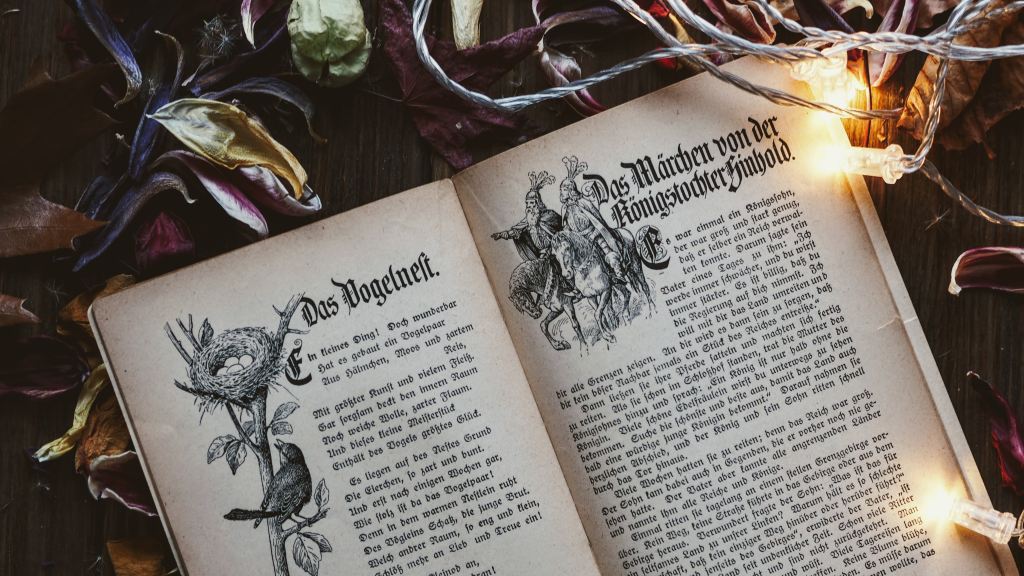


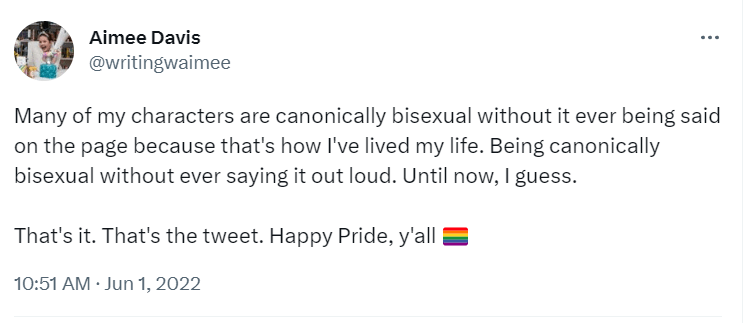






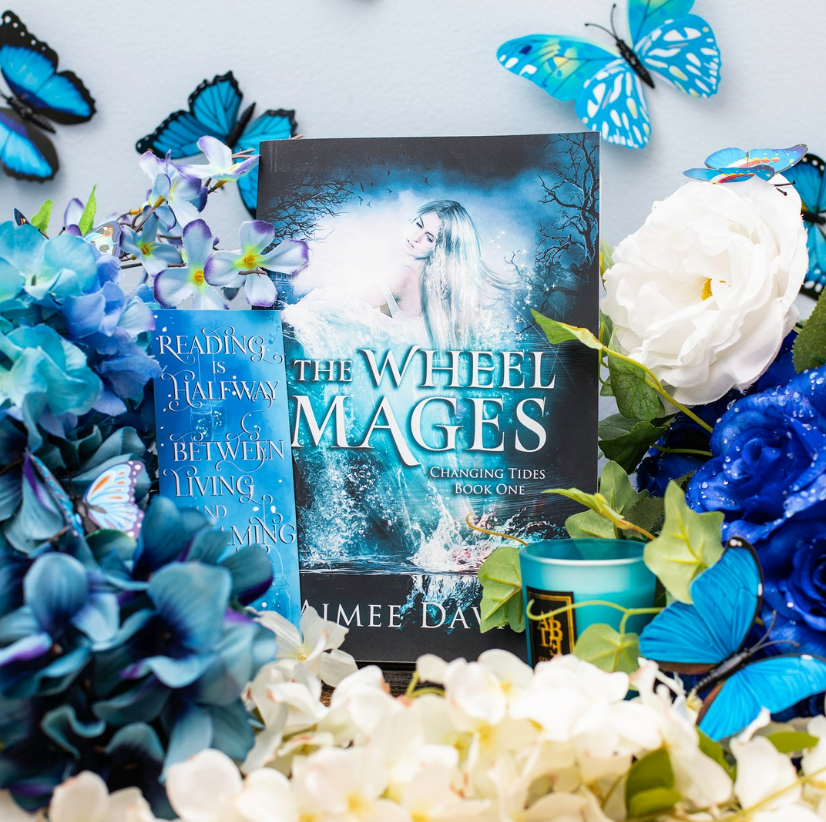











 Aimee Davis