Agency, the Active Protagonist, and Where it All Went Wrong

Author’s note: This post will primarily focus on the concepts of agency and active and passive (or reactive) characters in relation to stories about trauma. I would be remiss not to state clearly this is because I’m focusing on the story I know best: my own. However, I’m white, cis, and American. There are intersectional identities here with their own perspectives that are just as important. For a BIPOC perspective please check out this great post from Vida Cruz. For a more detailed analysis of many of these concepts as they relate to all kinds of storytelling and identities, I highly recommend Matthew Salesses’ Craft in the Real World. (Barnes & Noble).

Content/Trigger Warnings: Detailed definitions/descriptions of C-PTSD including medical symptoms and statistics related thereto.

Disclaimer: As always, I note the views expressed in this blog are mine and mine alone and not representative of a whole identity. Also, when referencing current market and industry trends please note that in this blog post I’m primarily talking about Young Adult Fantasy (traditional publishing).


When I was querying my two YA Fantasies (and pre-PW my Adult Fantasy), the most frequent critique I heard from critique partners, alpha readers, beta readers, editors, agents, and random strangers everywhere was my main character(s) lacked agency. Whether someone had read my entire novel, the first 20 pages, the first 5 pages, a synopsis, query letter, or a 280 character Twitter pitch, the same refrain found itself on repeat in my skull. No agency. Inactive. Passive. Lacks Agency. Reactive. Needs more oomf.

It got to the point every time I saw the word “agency” or “active” whether it was in relation to writing or not, I recoiled. Then, in March 2021, during a regular therapy session, the word agency reared its ugly head, setting the brain worms to squirming.

As it turned out, my characters were not the only ones who lacked agency.

What is Character Agency?

Character agency (aka agency as that word is used in writing) is the character’s ability or power to change things in the direction they want. If you google this you’ll find a million definitions but they all center on this concept. For a character to have agency they must both (1) be able to change things, and (2) want to change things.

What you’ll also find if you google this is about a thousand ways defining agency in this way leads writers with a different story to feel as though their stories don’t matter.

  • “Without agency, characters are little more than leaves, pulled along by the river. They don’t make an effort to change their situation, therefore we don’t care about them.” (emphasis mine)
  • “A character without agency is just a prop. They’re a piece of decoration that doesn’t serve any purpose other than to have the story happen to them.”
  • “Nothing makes a reader put a book down faster than a character who just lets stuff happen to them. These characters feel like shells or puppets, cardboard cutouts that the plot is moving around arbitrarily. Your character should drive the plot, not the other way around.”

I could keep going but honestly, it’s making me sad. Point is, western storytelling circa 2023 is obsessed with agency. If your main character(s) don’t have it, you’ve written a bad book no one will care about.
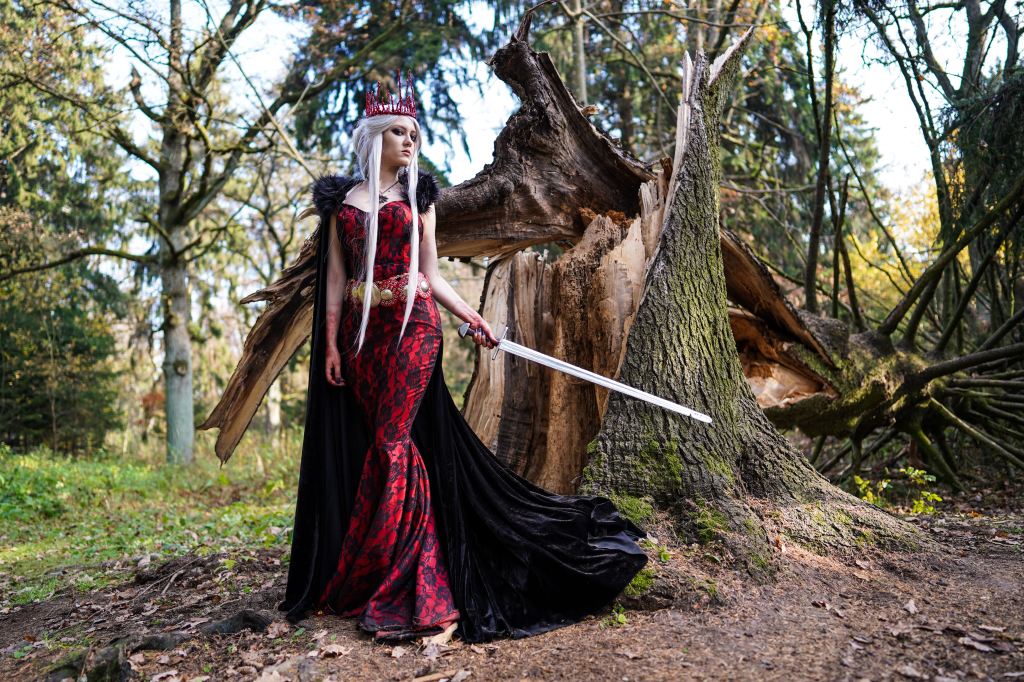
Photo of a white woman with silver blond hair wearing a red crown, a red and black gown with a long black cape, wielding a sword in front of a fallen tree.
Aka if your fantasy heroine is not this woman, good luck. FTR, I’m not shaming the authors of the cited posts (which is why I left the sources out after a long internal debate, but they can be provided upon request!) They’re not entirely wrong in the sense this is the way the world is. But should it be? I mean, don’t get me wrong, I want to write about this woman (damn!). I just think the entire market already has, and I probably couldn’t anyway. Also – presentation is everything. Do we really want to tell people we don’t care about their stories? That they’re shells? Or not rounded? Because guess what? Writing what you know for me means writing characters with trauma and having C-PTSD often feels like being life’s prop. Or a shell. So what? We don’t want to hear that truth? Because why? It’s not sexy? WELP, I have news. Photo by Dmitry Vechorko on Unsplash

What is Psychological Agency?

Psychological agency or the definition of agency used in behavioral psychology is not dissimilar from character agency. In psychology, agency is roughly defined as a person’s ability to act autonomously to control their own life. Source.

C-PTSD and the Loss of Agency

Complex Post Traumatic Stress Disorder (C-PTSD) is a disorder usually brought on due to sustained, inescapable, relational trauma in early childhood. It is distinct from its singular C-less form of PTSD in that the trauma is ongoing and not a singular incident. This repeated abuse causes a child to suffer a lack of agency during critical times in their brain development. The lack of agency often carries over into adulthood even after the childhood trauma has ceased. Adult survivors of C-PTSD suffer from a wide variety of symptoms including amnesia, alienation, mistrust, chronic physical pain, re-victimization, debilitating flashbacks, nightmares, body memories, anxiety, dissociation, trouble regulating volatile emotions, severe depression, toxic shame, and auto-immune disease. They’re 27% more likely to have COPD, 33% more likely to be smokers, and 24% more likely to be heavy drinkers. Source.

Oh hey, that’s me. More on this in a second.

What is an Active Protagonist?

An Active Protagonist is basically a hero with agency. Usually the main character. Listen, you can quibble with me all you want about well technically agency is more than active because it requires a focused goal, so an active protagonist doesn’t always have agency, and sure. But for the most part, if your main character (1) wants something and (2) actively does stuff to obtain that thing, you have an active protagonist with agency. Trying to keep it simple. I know you’d all appreciate I keep it under 40 pages today.

Where the Active Protagonist Fails and Falls

The Active Protagonist is not the end all be all of storytelling. In fact, to think so is to limit yourself to a very narrow view of the whole of the human experience which is, interestingly enough, one of the reasons people read. To learn and all.

This is where I’m going to plug Mathew Salesses’ book Craft in the Real World again. Oh look! There’s a picture if you click on it, you might be able to buy the book!
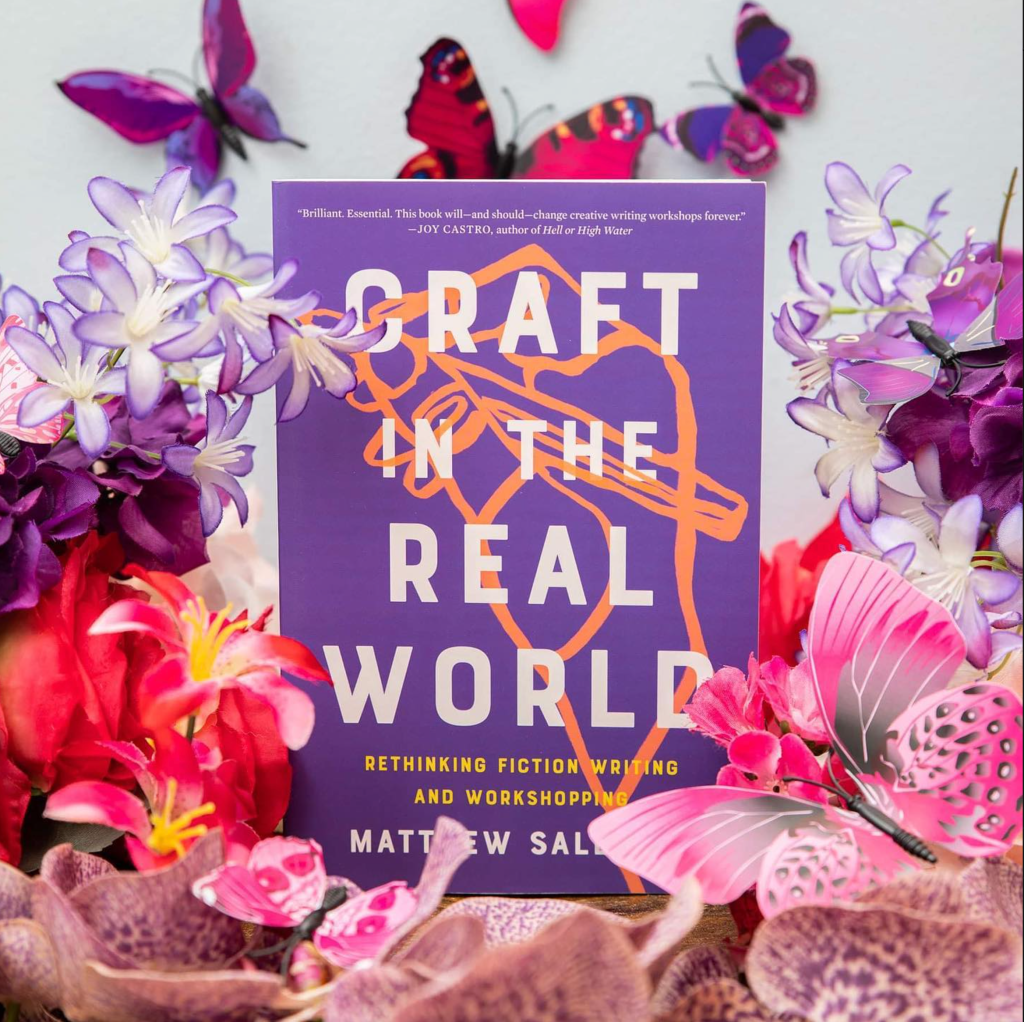
Photo of a purple book with an orange sketched hand. Title: Craft in the Real World by Matthew Salesses. Book is surrounded by purple and pink flowers and pink and purple butterflies.
I will never stop talking about this book. Copyright mine (for the photo, not the book. I am definitely not smart enough to write a book this brilliant).

Matthew speaks on experiences outside my own far better than I ever could, but beyond western storytelling’s obsession with agency and the active protagonist is a whole world of literature waiting for us to embrace a style that is… not that. Just saying.

Active Protagonists and Trauma Narratives: Debunking Survival as an Active Want

I write trauma narratives. Even when I don’t mean to. Write what you know, they say. Well, what I know is trauma baked in deep. What I don’t know as well is agency. Despite over a decade (going on two) of therapy, working toward reclaiming agency, that beast is still fuzzy around the edges. Especially when it comes to writing young adult. I find it extremely difficult to write an authentic, traumatized teenager who possesses agency. Probably because the entire concept of a teen with C-PTSD is (in my opinion) their loss of agency.

This is, of course, where that squishy definition of active protagonists could really get squishy. Because I really don’t want to go down the rabbit hole of the focused goal part of this (like I said, aren’t my blogs long enough?) let’s stay with my abbreviated definition of an active protagonist who has agency and try to apply it to a trauma narrative. And yeah, some of you aren’t going to like where this is going, but I hope you’ll stick with me.

Step One: Wants something. Cool. It would be reductive to say traumatized people don’t want things. They do. Obviously. Usually the want at the forefront of their minds, however, is survival. Even after the trauma has ended, the brain of someone with C-PTSD has often developed in such a way as to hyper fixate on survival. And while survival might seem like a big want, it’s not active in the way western storytelling expects. Why? Because of…

Step Two: Actively does stuff to obtain the want. Active is the key word and needs to be delineated from reactive. When you live in a state of survival, you aren’t actually active. You’re reactive. Your central and sympathetic nervous systems have been wired to respond to every stimulus in your environment with a flight, fight, freeze, fawn response. It’s nearly impossible to make forward actions when all your energy is spent reacting to perceived threats because your body and brain are fried by trauma.

Wanting to survive is therefore reactive. Not active. A character whose primary desire is survival is therefore very likely not active but passive. They do not do unto the world and the world responds. The world does unto them and they respond.

Are there other things that a traumatized character can want besides survival? Absolutely! As I said, it would be reductive to say traumatized people don’t want things. In fact, I might go so far as to argue they possibly want things more because they can’t pursue them. But that’s the problem. They often can’t pursue them. Because they’ve lost their agency, aka their ability to actively chase things they want. So even if your character does want something besides survival, if they’re still in that mode, and they haven’t found agency because they’re living in trauma, then they likely can’t pursue it. I know because that’s how I’ve lived most of my life. Wanting desperately. Unable to chase. It’s a sad story I’d love to tell but can’t because it isn’t wanted. Apparently, characters like me are not particularly interesting. Perhaps because they’re too true.

Photo of a white woman with reddish hair in a white gown floating under a blue water.
Sometimes the wanting feels like drowning. You’re trying to swim to a surface but it’s so far, and you’re too heavy. You’ll never get there. So you just… drift. To the viewer, it seems passive, gentle, maybe even beautiful. But inside, it’s violent and terrible with teeth and claws. Like a beast that will never let go. But the beast is your brain come to eat you alive. Photo by Alice Alinari on Unsplash

Trauma Narratives and Seeking Agency as the Arc

One of the main arguments for why you, the writer, should write an active protagonist is because people like to see character growth. The argument goes that “people” want the arc. The hero’s journey. The descent into darkness. They want the emotional journey that goes with a character starting off at point A and ending at point B. First, let me just again mention this is a very western view of storytelling that focuses on the individual. Not all cultures require, desire, or demand an emotional, individual journey. Some cultures prefer a moral. Or a history. Some prefer a story that centers the growth of the group, not the individual. Others like stories that are sweeping with no human focus at all. And over the years tastes and wants and societal demands change and change again.

But that isn’t my story to tell, and others can and have made their own arguments better as to why western audiences should pay more attention to non-western storytelling.

If I speak to the story that is mine then, I find myself asking: within the framework of western storytelling and arcs and the active protagonist, is there a place for a trauma narrative? And if so, where?

Let’s try again.

Step One: Want something. In my opinion, survival is always at the core of the trauma narrative. But if we dig a bit deeper into the stage that might come after survival, we turn toward a new want for the trauma survivor. It can take many forms: a friend; an education; a place to live; a pet; a job; a hobby. But often, when you boil these wants down, you find at the center a quest for agency. Through connection, or eduction, or financial independence, or the stability of a place all your own, or simply doing something just for oneself a trauma survivor is cautiously asserting (or learning to assert) agency.

Step Two: Actively does stuff to obtain the want. It seems deceptively simple to write a story about actively seeking agency. Want something. Go after it. Except you need agency to go after something. And around and around our active protagonist seeking agency goes. How do you chase something if you need that same something to know how to chase?

I can tell you one thing: it isn’t something I’ve ever managed to convey in a five or ten page writing sample. Which is probably why the most common feedback I’ve heard from queries and samples is silence. Or form rejections.

Personal experiences aside, I do believe it’s possible to tell this story within the western storytelling framework. In YA Fantasy, where I’ve had least success telling it but where I believe it’s most sorely needed, I think it’s a quieter, slower story than the current market demands. The two books that spring immediately to mind are The Light Between Worlds by Laura E. Weymouth and Ever Cursed by Corey Ann Haydu (please be mindful of huge trigger and content warnings on both these books). Both left me with deeply complicated feelings regarding their content and their endings but as I sit here writing this, I know my own YA Fantasy, Deathbringer, were it to ever find its way to shelves, would be critiqued similarly. Perhaps that’s what it is to tell a trauma narrative. It isn’t pretty or quippy or vibey. It is, in fact, quite ugly, and messy with an arc that doesn’t always lead you to a happily ever after.

But it does lead you somewhere different than the start. And that’s all that’s required of an arc.

Digital painting of a white girl with short dark hair in a bob, wearing a purple, sequined dress and long purple gloves holds a turkey vulture aloft.
Always and forever will drop commissioned art when I have half a reason to. This is Violet, the main character of my YA Fantasy, Deathbringer, a 1920s-inspired second-world fantasy about a religion that has rotted an entire society, ruined a family, pushed magic into the underground, and the traumatized girl at the center of it all who–in the quest to find friends–finds her agency. And a cost far higher than she imagined. Image © Jaria Rambaran   

Tell the Story but Remember the Audience

I wrote this heading about ten different ways before I settled on this. I started with “Tell the Story Anyway.” I wanted to say bold advice like that didn’t come from a place of privilege but was instead a recommendation to the traumatized soul to help with healing. To say that even if the book of your heart doesn’t get you an agent or dies on sub, you’ll have the cathartic experience of pouring your trauma onto the page, and it isn’t a privilege to give yourself space to heal.

That would have been a lie.

Sadly, getting to the point where you’re safe enough to heal is a privilege. Which is why western storytelling has failed so many people, because right now the only maybe sellable trauma narrative (as I see it, in YA Fantasy anyway) is one related to healing. Survival still isn’t sellable. There’s one notable exception, yes. I’m not forgetting The Hunger Games. That’s a whole separate rant for another day. Also, that was 15 years ago. One story every 15 years when we have the amount of early childhood trauma we have in this country is… oop, starting the rant. Gonna stop.

Instead, I offer to you this, take it or leave it, advice is only advice. I don’t believe in hard or fast rules, and only you can know your heart and what you need. But if you find yourself writing a traumatized protagonist who’s getting critiqued for lacking agency, and you’re lost on what to do to change that (and you want to), please know this is the arena you’re playing in, these are the rules you’re expected to follow. I know they’re confusing.

Often, writers are given the advice to put things in the way of their protagonists. To create conflict. Talk of messy middles seems to be based on this concept. Personally, I never have trouble with middles. Or conflict. I’m actually laughing to think of having trouble with conflict. Where I struggle is beginnings. The place where we’re supposed to define the want. The goal. The motivation. If you’re in this position, and you have a trauma history, I might suggest you need a new brand of advice specifically for you. So you can write in a system not made for you even though you shouldn’t have to.

Here’s the advice: If you lived in one of your books (or one of your favorite books) outside the chaos of your life, where the possibilities were bigger (not boundless), what would you want? If no one (including you) was holding you back, what would you do? Where would you go? Who would you dream to be? To learn? To love? To chase?

Picture it. Now, unshackle your characters even if you can’t unshackle yourself.

And run.

Xoxo,

Aimee

Let’s Talk: Trigger Warnings

Author’s Note: If you’ve been around here awhile you’ll know this is standard fare from me at this point, but I repeat it for new folks: anything in this post is my opinion as one person not as a monolith. Nothing in this post can or should be used against other people in the same communities I describe.

Trigger/Content Warnings: This post talks about trigger/content warning discourse. Also describes in detail what a triggering event can be like. Brief description of child abuse and related triggering event thereafter; flashbacks; disassociation. References to childhood abuse and trauma.


Let me put this right up front for the TL;DR crowd. I am pro using trigger and content warnings. I am anti policing how people ascribe these things to their personal experiences. I am pro self-exploration about using these words more carefully. I also think we need to do a better job explaining what they are, how they’re different, and why we use them. I also believe failure to do so has caused harm to the communities who need them most.

Trigger; Triggering; To be Triggered

To be perfectly frank, because that’s what I do here, I have a very complicated relationship with the way the term “trigger” has evolved. For me, a person who has C-PTSD (and other mental health issues I don’t need or want to list out today), “trigger” has a very specific meaning. That meaning is the one used by most psychiatrists and psychologists and goes something like this: a trigger is a stimulus that causes a painful memory to resurface (usually the definition used in the context of C-PTSD or PTSD), or a stimulus that activates or worsens the symptoms of a mental health condition. Trigger doesn’t mean something offensive or a bit uncomfortable. It isn’t something that makes me a little sad or a little yick or a little anxious. To be triggered for someone like me means to be mentally fucked for a time.

Considering the volume of trauma I’ve been through, I’m not actually triggered that often. When I was younger, it happened more, but honestly, I couldn’t explain to you what the source of the triggering thing was. Now, I can count on one hand the number of times I’ve been truly triggered in the past five years. But I sure as shit know when I am and what caused it. This is a primary goal of trauma work: identifying triggers and finding ways to lessen their impact on your life.

Impact. That’s what triggers have. That’s what that word is meant to mean.

My C-PTSD wasn’t caused by any one thing, that’s what makes it different from PTSD without the C. A bunch of it stems from early childhood trauma though. I grew up in a violent, chaotic, loud environment. So, I have some sensory issues related to noise (as in, I don’t like it) but I don’t consider all noise triggering, or even all loud noise. Sometimes, when I’m overly stressed or highly tuned in, certain noises irritate me, or distract me. They might even become at times physically irritating, almost like a sting beneath my skin. Those aren’t triggers for me. More like irritations. They’re uncomfortable in the way too many bugs flying around you, ruining your otherwise pleasant picnic might be uncomfortable. Maybe it escalates into the bugs taking a bite or two, causing some frustration or agitation. Is it annoying? Yes. Would I rather it not? Yes. Is it outside the realm of a normal human emotion? Not really. I mean maybe in the sense that most people don’t find noise mildly painful, I suppose. But the emotion itself is not wildly disproportionate in a way that escalates my preexisting mental illnesses or causes a flashback or has any real impact on my life beyond fleeting, everyday annoyance.

Close up photo of a fly on a gray surface with black background.
Tbh, this dude might need a trigger warning of his own. I fucking hate bugs. Image by Christian_Crowd from Pixabay

This is where I’m going to describe a triggering event: Yelling, child abuse. And its impacts: Disassociation. Skip until next bold (after the photo of the bathtub).

What is a trigger for me is the particular noise of a mother screaming while beating her child.

Before I moved to my current home, I lived in an apartment complex. One of my neighbors in the same building a few apartments down constantly yelled at her kids. It bothered me but not to the level of a full-blown trigger. However, one day, I heard her screaming at one of her children. The sound carried through the walls, and with it came the very distinct whap of an object against bare skin. The child screamed. Begged. I had a flashback, then disassociated.

The next thing I remember was coming back to myself to find I was sitting in my bathtub, fully clothed, hands over my ears, rocking back and forth while tears streamed down my cheeks. I have no idea how long I’d been there. Long enough my legs ached and my throat hurt from crying, maybe even screaming.

That is triggering. Real live in the flesh triggering for someone who has a bona fide psychological disorder.

Sepia image of an old bathtub filled with plants on a dirty tile floor.
Bathtubs are a safe space for me. I often sit in them fully clothed when I need to get away from something. It’s just a thing, don’t mind me. Image by Peter H from Pixabay

Who determines what is “triggering?”

The person who experiences triggers determines what they are.

The thing about triggers is they’re highly individualized. No two people have the same set of experiences, or the same brain, so it’s impossible to understand how someone will react to a particular stimulus under any set of conditions. I’ve done years and years of trauma work. In the beginning of this work, I was unable to determine what my triggers were. I knew things triggered flashbacks, and disassociation, that something made me start screaming for seemingly no reason, but it was difficult to discern what those things were. A key part of my early trauma work was focused on identifying triggers (or potential triggers) and working on ways to manage them. I did this with a therapist who specializes in trauma treatment.

I mention it because it’s important to understand that for some people, knowing what their own triggers are might be harder than you’d expect. They’re not as clear cut as the neat little warnings we often see at the top of the page. So if triggers “change” for someone, that’s not abnormal. It’s also why triggers are often given in broad contexts sweeping a range of topics: “abuse,” “trauma,” “domestic violence,” “assault,” because people who experience triggers might not know what specific thing in that wide category will trigger them, but they might know that category contains their past and that content should be avoided. Over the years of my personal trauma work, my trigger sensitivity has been seriously reduced. Not everyone is able to do that or is at that stage in their journey.

Basically, this is not the trauma Olympics. We’re not here to put our scars on display for you to evaluate if that’s a “good enough” reason for us to say “this thing is genuinely triggering to me.” You’ll note I didn’t describe the individual Bad Shit that happened to me as a kid in my story above. Because it’s none of your business. You don’t get to decide if whatever I went through was “bad enough” to warrant my response to my neighbor’s behavior. I control that. Well, I don’t actually which is the annoying part. Because, trust me, if I could make my triggers go away, I would. They’re not pleasant. It’s one of the main reasons I’ve been doing trauma work for a million years instead of putting that money toward I don’t know… literally anything else.

“Trigger” should be used with discernment and self-reflection

Here’s where it gets tricky. I do think the terminology has been a bit… overused. That’s why I provided an example of the reaction I have to a trigger. Reminder about the monolith thing I said at the beginning. And of the definition I used of the word trigger. The reaction doesn’t have to be that extreme for you to consider something triggering. However, a trigger is meant to mean more than, “This makes me feel an unpleasant emotion within the realm of the ‘normal’ human experience.” Feeling sad is normal. Feeling anxious is normal. Feeling uncomfortable is normal. Feeling pissed off is normal. Feeling triggered is distinctly not normal.

The reason this matters is because when the word trigger is misappropriated in day-to-day speech, those who need this language to better explain what’s happening to them are stripped of its value. If the word trigger is so frequently used to mean something less than its definition, it’s devalued. This means the only recourse I have to explain my emotional reaction to a stimulus is to put the actual emotional reaction on display (which in and of itself can be retraumatizing).

I have strange feelings about people who ascribe the word “trigger” to something other than what its general psychological definition is, because this word was given to me and people like me who are suffering immense emotional pain so we might explain that pain without having to relive it. I also have an issue with the idea there is a “trauma” trigger and a sort of everyday use of the word trigger. While practically, I think that might at this point true, it again puts the onus of explanation onto the population whose language was stolen. Triggers also apply to communities of people who don’t have trauma, for one. So to exclude them from their language is a poor solution. And for those who do have triggers because of trauma, forcing us to further delineate “trigger” to “trauma trigger” outs us in ways we perhaps did not want to be outed. Finally, many people have comorbidities that cause this discernment to be almost impossible. I joke with close friends pretty regularly about, “Is it trauma or is it my [x other neurodiversity, mental illness, etc.]?” But the joke hides pain. It’s hard to live like this. Constantly questioning what part of your twisted brain made you lose time this time. Putting the burden of waging that battle of defining pieces of self on people already struggling to do it is unfair and to be honest, cruel. A trigger is a trigger. Sometimes it’s trauma, sometimes it’s not. Always it’s more than uncomfortable.

To be clear: I’m not here to police anyone’s use of the word. This is meant to be a self-exploration exercise only. If you’re using the word casually or colloquially or flippantly, or you might be, or you’re asking communities to drill down language that was already intended to mean a specific thing, then a reexamination could be in order because the casual use of the word is doing actual damage to people who need it.

Photo of a small room with a desk and chair and a round mirror with a man's reflection silhouetted.
Image by Peter H from Pixabay

Content Warnings

What is a Content Warning?

Content warnings can be sort of nebulous. However, I put content warnings in the category of the things you maybe shouldn’t be using the word trigger for. In the context of writing, because that’s what this blog is about, content warnings describe things that may be upsetting or uncomfortable or even things people simply don’t want to read about. Or read about at that particular moment, anyway.

Difference between Content and Trigger Warnings

What makes something a Content Warning or a Trigger Warning is not determined by the person writing, it’s determined by the person reading. That’s what makes them difficult for people to differentiate between because the writer has to use them interchangeably to accommodate multiple unknown readers (i.e. something that could be triggering to me might be something that just makes you uncomfortable, or vice versa).

So, if you’re the person doing their level best to alert readers about what’s coming, using content and trigger warnings interchangeably makes sense as you don’t know your reader. If you’re the person talking about your own TWs and CWs, you should delineate to make room for the nuance in the definitions.

For example, for me personally, I have never experienced a trigger in writing. I think that’s probably because of the way my brain processes information. My trauma is triggered by senses. A book doesn’t have much sensory output (in that it’s not yelling, or flashing lights at me, or smelling of alcohol, etc.). However, I prefer not to read books featuring trauma where the author doesn’t have a personal experience of trauma, because I often find the representations to be poor, stereotypical, and sometimes cruel, and I walk away feeling depressed, uncomfortable, or just pissed. A general content warning is helpful for me, so I know to look into the origin of the author (if that information is readily available), or read reviews to see how other people found the representation, or simply tread lightly on a day I have spoons.

Black and white photo of a stuffed bunny lying on a concrete wall.
Image by Andreas from Pixabay

Use of Content and Trigger Warnings

Step One: Use Them

You can’t know someone else’s life or their experiences. Just because you went through some shit and aren’t triggered doesn’t mean other people had the same experience. Again, we are not here to play trauma Olympics with one another. Don’t be an asshole, use CWs and TWs. You should do your best to use them all the time but especially if someone specifically points out they’d like them. Triply if someone is like THE FOLLOWING THINGS TRIGGER ME LET ME KNOW IF I’M ABOUT TO GO THERE.

If you forget, I’ll remind you to be kind to yourself. Messing up happens. We’re all human. I forget sometimes too, and I’m literally here writing this post at 11:00 p.m. on a Friday after working like 75 hours this week because I care about this topic so much. So, give yourself some slack. Unless you’re being an asshole about it and wantonly refusing to use them because you think people should toughen up. If that is you, I’ll remind you to be kinder to others. And honestly maybe yourself. Because you either have no idea what trauma is like, or you do and you think everyone should suck it up like you have and that is… well, a post for another day.

Step Two: Respect Requests to Include Them

Probably the weirdest thing I’ve seen lately in the writing community is people challenging agents on their ask that TWs and CWs be provided. I mean, listen, this is your future career and all, but my advice is to not do that. Besides being a super bad take for all the reasons I mentioned above about people’s need for them, it’s also just not professional to willfully refuse to do something beneficial to the mental health of the person you’re courting to be your future business partner.

Outside of querying, you should still honor requests to use trigger and content warnings by people when they’re given. The requests are likely not made lightly.

Step Three: Do Not Challenge People’s TWs and CWs

This one is harder than it seems and honestly I’m not 100% sure it’s the completely right advice, so bear with me. There are, in my mind, a spectrum of “Challengers.” On one end are people you should aspire to never be. On the other end might actually be me because here I am writing this post. Nuance. Brains. Complicated topics. Oh my.

Type One: That Asshole. You know the one. The one who has a Twitter bio that’s like “White man and proud. Trump 2024. God, guns, guts. Eats libtards for breakfast.” That’s the one who like gets up in people’s Twitter space and say shit like, “Trigger warnings HA! Do you need a safe space too?” Or “I’ll make sure to send you my [exactly the book the agent requests not to see in their inbox] LOL.” Or the slightly less aggressive but still douchey, “I’m not really a big believer in trigger warnings.” Cool, Tom. They’re not for you. And let me get ahead of you to say I don’t give a shit whether you believe my C-PTSD is real or not.

This type you should never, ever be. But I probably don’t need to tell anyone reading this blog that. Still, any variation on this is a no go. Basically, please refrain from aggressively questioning someone’s triggers or content warning needs because it’s invasive and rude. I might be the type to explain to you in a 7 page blog post about why I need trigger and content warnings and what my precise trauma is, but most people aren’t and shouldn’t be asked to. Whatever caused the need for the warnings is probably hard enough as it is.

Type Two: This Asshole. As in very possibly me. I’m not sure. I much prefer people do self-exploration and reflection to determine if their use of these terms is appropriate when they take into consideration the harm it could be doing to communities that need the language, as I’ve mentioned. However, this blog isn’t going to reach everyone. More like a couple hundred someones. That probably isn’t enough to reclaim the language. And not everyone is going to be self-reflective after reading a long ass blog from some random person on the internet. So what about calling out people’s use of the term nicely?

I’ve seen it done tactfully. Kindly. Gently. I’ve seen people say ‘I have this lived experience, and if you’re using this term loosely or in a knee-jerk way please be mindful of the people it hurts.’ I’ve nodded along with these people. Celebrated that someone finally said it. Then watched them get dragged on Twitter for daring to question a fellow survivor’s experience. Annnnnnnd I see that side, too. Who are we to know? I mean, I think I know. Even now I’m half typing out explanations of how I know, but ultimately no one can know their life except them. So reiterations of self-reflection are as far as I’m willing to go. I just… I would hate to be wrong and hurt someone else more than they’ve already been hurt, I guess. Even though I do really see the collective damage it’s doing. Have felt it myself. Understand the desire to make it stop. But I’ve always been about gentle pushes in the right direction more than sweeping gestures that burn hot and fade fast.

Step Four: There is no step four

Tada! I’m done. It was long again. Sorry. Please accept this token picture of my cat, Apollo, who has lived for 16 years through all my bullshit, just as you, dear reader, have lived through this long ass post full of my bullshit.

Photo of a white cat with a red collar sitting on a scale on a kitchen floor.
In case you can’t read it, his collar says “Mom’s Fav Asshole.” And yes, he is the asshole in chief.

Until next random thought, please remember: language matters, and be kind to yourself and others!

Xoxo,

Aimee

First Reflections on the Not the Darling Series

Hi, this post is being written by me, Aimee, your host for the Not the Darling Series. If you’re new to the blog, you can read about the premise of the series here and can find the blogs by typing “Not the Darling” into the search bar to the right of this post. So, as we wrap up our first month (!) of submissions in this series, I wanted to take some time to reflect on some of the amazing things I’ve learned from the incredible authors who have let me get to know them and their journeys.

Authors at all stages of their career should be reading these.

Let me be clear. This space is and always will be for un-agented, querying (or quitting querying) authors. That is the premise and the purpose and remains my passion behind this project. Accordingly, I thought the main (majority) target audience for these stories would be other querying authors. I’ve since learned that not only do authors at all stages of their career want to read these stories, authors at all stages of their career should read these stories. They’re humbling. And raw. They’re full of passion and pain. They remind us that querying authors are our peers, a fact too often forgotten.

For those of us who queried forever, these stories are a bittersweet reminder of the parts of the journey colored rose when we finally got that yes. They remind us to stay humble and that we are no different than any of the authors writing these posts (which again, is why they’re our peers). For those who did not query long, they teach a lesson thankfully never learned via personal experience but which these authors have been kind enough to do the emotional labor to teach via THEIR personal experiences. To keep you humble.

Humble, I know. It’s a loaded word in an industry where we have so few wins. Where so many of us are crawling and bleeding, scraping our way tooth and nail to be seen, screaming into an empty void for recognition. Where marginalized authors fight every day against stereotypes saying we’re too loud, too angry, too aggressive, too whatever. And I ask for humility. I know. But I don’t ask for humility toward the titans of publishing or Barnes & Noble, toward Amazon or the C-Suites of Big Five imprints. Where they are concerned, I say lift your chin as high as you can and own the fucking room.

I ask for humility toward your peers, who are struggling. Who are just like you, in so many ways. I ask you to check in on them if you can and when you’re able. Because they’re screaming into the void. They’re fighting the industry, throwing ribbons of their hearts into the wheels of the machine that is publishing hoping one might trip over a piece so they might be fed a scrap. For them, yes, I ask you to be humble. We were there once. All of us. And we could be again at any moment, the tables turned. This industry is small, so very, very small. We are stronger together.

Image of a wooden door with intricate metal carvings surrounded by steampunk brass cogs, wheels, clocks, gears, etc.
I am a fantasy author so might be me, but if publishing had a door, I imagine this would be what it would look like. The gate that the gatekeepers keep, held shut by cogs and clocks that make absolutely no damn sense. Seems right, yeah. Image by Amy from Pixabay

It really is luck.

I will be Brutally Honest because that is my brand. When I opened this space and said the only editing I’d do would be to make sure (to the best of my ability) nothing was harmful to the author writing the post or anyone on the other side of the screen, plus minor grammar stuff, I fully expected some objectively bad writing. For those who don’t know my background, it’s a bit… stuffy. I have an undergraduate degree in creative writing from a school whose sole purpose was to groom its students for an MFA at Iowa which is The US’ Best Writing Program for Serious Writers. Everyone thought I was headed to Iowa. I thought I was headed to Iowa. Why I didn’t go to Iowa is a whole separate thing. However, that education never entirely left me. Combine that with a decade plus working in legal, writing Very Serious Legal Stuff, and you get someone who can be… snobbish. I know. I hate it and work hard to battle it every day.

Why am I admitting this ugly truth to all of you lovely people on the internet? Well, because I want you to believe me when I say not a single thing submitted me to thus far has been edited by me at all (except for minor grammar things), nor have I found any piece of writing published on this blog to be “objectively” bad writing. In fact, I’ve loved everything submitted for entirely different reasons. But objectively, it’s all been well-constructed, with a nice voice, good pacing, varied sentence structure, and excellent continuity. I’ll stop reading something I find objectively bad. Not only have I read everything here straight through (a few times), I’ve actually been late to a couple meetings just to finish reading several of these pieces.

So for me, a bona fide snob, who went into this project fully prepared to accept what I consider objectively bad writing (I’m literally wincing typing this, I’m sorry to be such an asshole, truly), to come to you and report zero bad writing is Saying Something. To take it one step further and say all the writing is in fact very good, is Saying Something Bigger. And the TL;DR something is this: When agents get up on Twitter and say there’s so much good stuff in their inbox it’s impossible to decide, or the quality of the writing has gone up so much recently, or mentors from mentorship programs say this is horribly stressful because they want to choose 20 things, I used to roll my eyes. Because I, a snob, didn’t believe it possible for that many people to be consistently submitting objectively good writing. Selfishly, I also didn’t want there to be that much competition. I have, however, learned through personal experience, this is not the case.

The writing is good. Objectively good. The agents aren’t lying. Neither are mentors. Those aren’t platitudes they’re feeding you. The inboxes are brimming with good stuff. This is all really coming down to subjectivity and luck. Which sucks because you can control neither. This is a shitty consolation. Sorry. I didn’t say this was a positivity post, just a reflection.

Cartoon figure of a white man with a bear and a top hat in a vest and coat holding a pipe, glaring with narrowed eyes.
Oh, hey, look! It’s one of my writing professors come to talk about Faulkner’s brilliance some more because you know… the decline of the southern aristocracy and uh… incest or something. The Next Great American Novel coming to my agent’s inbox T-minus… NEVER. Image by OpenClipart-Vectors from Pixabay

The Conversations are Important and are Happening.

Since the Not the Darling series started, five (5) posts have debuted on the blog. They have been viewed over 700 times in more than a dozen countries. They’ve been shared on Twitter, reblogged on other blogs, shared on Facebook, and appeared in at least one Discord of mine, but others I’ve been told about.

The conversations they’re spurring are as varied and important as the stories themselves. Conversations about mental health and the toll rejection can take, on the taboo topic of giving yourself the okay to quit if you need it. Questions about how to find community in this new era where mentorship programs aren’t as widespread as they used to be, and Twitter pitch contests which were once as much about building community as finding an agent, are fraught and oversaturated. Frustrations and confusion about marketability and publishing trends, about whether you should write to the market or write what you love. The evergreen and always relevant topic of “being too old to debut” by publishing standards. The list goes on and every day it grows, taking on a life of its own I’m so awed and inspired to watch.

When I first started this series, I was a little afraid of these conversations. I was unsure if facilitating them would make me a target if they got out of hand or if I would be held responsible if I couldn’t “control” them. Over the past month, I’ve been so humbled to find that was a shitty and cynical take (I’m really winning on this episode, I know). The dialogue so far has been respectful and nuanced, smart and kind. And for that, I’m so grateful to everyone contributing not only to the blog series, but to the conversations as well. It’s important we have them, and that we have them in this way.

Cartoon image of four people in shades of red, orange, green, blue, with text bubbles above their heads. One reads: "Aimee, did you really think people would be messy On Main?" Another answers "What? Me? No. Never. I was not worried at all. Once." The third says "Funny how that doesn't sound convincing." And the last contains only a question mark.
In case anyone ever wondered what it’s like to sit through a workplace training with me as your host – it involves loads of graphics like these. Edited to include the same kind of bad humor. Image by Gerd Altmann from Pixabay

Thank You. Keep ’em Coming.

Finally, to the authors who have already contributed: Thank you. Each and every one of you is courageous and I’m honored to know you, to host your stories, to be a small part of your journey, wherever it brings you. Reading your words has been a joy and a privilege.

To those thinking of submitting: Please do! Submissions are still open, and there are still so many amazing conversations to be had! Submission criteria can be found here.

Can’t wait to see what the next month brings!

Xoxo,

Aimee

Reflections: One Year Post-Pitch Wars

Author’s Note: For those who are not aware, Pitch Wars was a well-known, all volunteer-run mentorship program that paired unagented authors with published/agented authors, editors, or industry interns. One mentor (or mentor pair) to one mentee. Over the course of several months, the mentor(s) and mentee pair worked together to prepare the mentee’s manuscript, query letter, and synopsis for querying. At the end of the “revision period” was the infamous agent showcase, a one-week period where the mentee could post a short pitch plus the first page (about) of their book on the Pitch Wars website for agents to review and (hopefully) request. For the entirety of the revision period and the week of the showcase, no mentee was allowed to query the work. During the showcase, no one but Pitch Wars volunteers involved with running the website could see what agents requested whose work. Limited information about requests was conveyed to the mentors, who conveyed it to their mentees. At the end of the showcase, it all went live for everyone to see. Read more here.

One year ago today, me and about 114 other of my peers were officially thrown into the query trenches. The same day, the Pitch Wars Committee announced that after 10 years of mentorship, the program would be shuttering.

I think it goes without saying that was one hell of a day.

As I’ve mentioned, the agent showcase did not go well for me. Still, I grit my teeth and buckled down. Maybe my book was not a one-line pitch type book. Didn’t make a lot of sense considering the amount of people who told me how “high-concept” it was and oh so “hooky” but you know, who knows what those things are, anyway? I would win the agents with my query.

If you’ve read my How I Got My Agent post, you’ll know I didn’t really win the agentS with my query. I did, however, win one. Well, maybe. I’m not sure it was the query that did it. I never asked. Nor do I want to know.

Truly, I never thought I would be writing a one-year reflection blog. If anything, I thought I might be writing a one-year reflection thread on Twitter about how pissed I still am about the showcase and how SO MANY querying authors think the showcase is the real loss of Pitch Wars and how fucked that is because agent exposure is not the reason to seek mentorship, mentorship is the reason seek mentorship thus mentorship is the real loss. And those feelings are all true and real and still very, very raw even one year later.

But since Pitch Wars is gone railing about the showcase seems less applicable. What is applicable is how much I learned from one year of watching 115 separate writers start one place and 365 days later be in so many different places. The following observations are things I hope will help all writers but especially those still querying.

Community

I tried to get into Pitch Wars for 5 years. It wasn’t until 2021 I actually opened up and started engaging with the online community a bit more. Invaluable. I’ve said this before, I will say it again, some of my closest friends and CPs are the ones I met during the waiting period. The ones who didn’t get in and the ones who did. They’re the ones who will understand you best, who will get the highs and the lows, who will never accuse you of being too dramatic or too much to handle. They will be the ones who understand all the random and weird publishing things your family still can’t seem to grasp no matter how many times you’ve tried to explain it to them. And that you don’t have to explain it or yourself will ease some of the exhaustion. Of which there is so much.

Community you need to boost you, but also to check you, to be honest with you, to encourage and support you, to be there in your mopes and your hopes, to be your void to shout into when it’s not appropriate to do it on Twitter. You need them always and should start finding them as soon as you can.

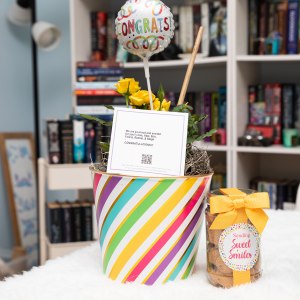
Image of a rainbow bucket with yellow roses, a congrats balloon and a sweet smiles jar of cookies.
Signing day gift from some of the CPs in question. Do you know who didn’t send me a gift? Anyone else. Not family, friends, partner. No one except them. Because they get it.

Mentors

Contrary to popular belief, you do not need a mentor. In fact, some might say trying to achieve one is just adding another gatekeeper in an endless stream of them. Considering the odds of being chosen by my Pitch Wars mentor were something like less than 3% and I spent five years trying to get into Pitch Wars and a couple trying to get into RevPit and at least one trying to get into AMM, I can’t entirely disagree.

They’re cool to have IF you do end up with one, though.

I was really fortunate to end up with the world’s greatest mentor. Not everyone is so lucky. There are arguments about this topic for both sides I could go on about for days, but that isn’t the point of this post.

What was really interesting about Pitch Wars was seeing all the different mentees with their mentors and how they all communicated and what worked and what didn’t and how totally different that could be. And how hard it could be to summarize on a blog, too, which is what the mentors attempted to do, and which I think many of the mentees did not read, because they cared more about getting in with ANYONE than getting in with the RIGHT someone. Sound familiar? Yeah, it happens with agents, too. A thing I will talk about in a future blog already mostly written.

So for me, I really wanted a close relationship with my mentor. I had spent a LONG time being rejected not only in publishing but in, well, life. I desperately needed someone to believe in me. Not only in my stories, but in me, as a human. I needed someone to believe I was capable of doing this. Even if it meant rolling her eyes and smiling through my dramatics while I raged that I could not, in fact, do this. Then waiting until I was finished, asking politely if I was actually finished before telling me that I could do this for the following reasons.

I also really needed someone who understood my neurodiversity and my trauma. That I process things differently. Who understood I’m not going to do Save the Cat or beat sheets and that would have to be okay. Who knew I needed some semblance of rules in the chaos that is publishing, even if the rule was there are no rules. Who would be able to be flexible where I was not. Rochelle was all these things and more. I was very lucky. Did I mention that?

But not everyone needs all this hand holding and cheerleading and ya ya. Some of my peers did very well with a much more business-like, professional relationship with their mentors that did not involve frantic 1 a.m. text messages about doom spiraling. Some fit right in the middle somewhere. Others had communication breakdowns because they could not find a meeting of the minds at all.

This is when you refer back to your community.

Cartoon image of various characters working on cell phones, tablets, digital displays, etc.

Where You Are is Not Who You Are

Let me tell you about how Pitch Wars teaches this lesson to the Not Darlings really fucking fast. This exact time last year I was essentially equal in credentials to my Pitch Wars peers. Of course some of us had heftier resumes than others. Some had won other mentorship contests. Some had been published with indie presses or in short story anthologies. Some (like me) had creative writing degrees, or MFAs. Some (not like me) had a list with 50 requests on it ready to go. But we all had shiny manuscripts polished over a period of the most intense revision months of our lives, a submission packet to make any querying author drool, and we had “2021 Pitch Wars novel/mentee” to tag onto our books (and our names). Out of thousands, we were the 115.

We thought that meant something. And maybe it’s the weirdness of this querying climate, or maybe it’s that Pitch Wars shut down the same day we entered the trenches, or maybe it did mean something but not enough for some of us. But on February 15th that starting gun fired and some of us shot forward and others of us stumbled, fell, startled, pressing our hands to our ears, shell shocked. Some of us barreled forward but quickly ran out of steam. Our paths started to diverge. Fast.

Within hours, LITERAL HOURS, calls were getting announced. From there, the deluge of distancing became frantic. Full requests poured in, some phones seemed to be ringing off the hooks. Question lists were assembled. Drama. Subtweeting. Agents with teeth. Mentees in the spotlight. We rallied for our peers because that’s what you do for your community, even when your own heart is bleeding. Even when your own inbox is empty. It was a good distraction.

Agent announcements. Talks of auctions. Editors with teeth. And still for so many of us, empty inboxes. Full requests from the showcase gone untended while the shinier mentees glowed. It was hard not to wonder what was different. Not to blame ourselves. We were all the same except… we weren’t. Not anymore.

Despair came fast, too. And in that despair sat uncomfortable feelings about our friends. Our peers. Our community. People we’d bonded with so tightly during this experience so few could relate to. Guilt. Blame. Shame. Resentment. Toward ourselves more than anything, really. Many of us started to turn away. And this is where things get a little tricky.

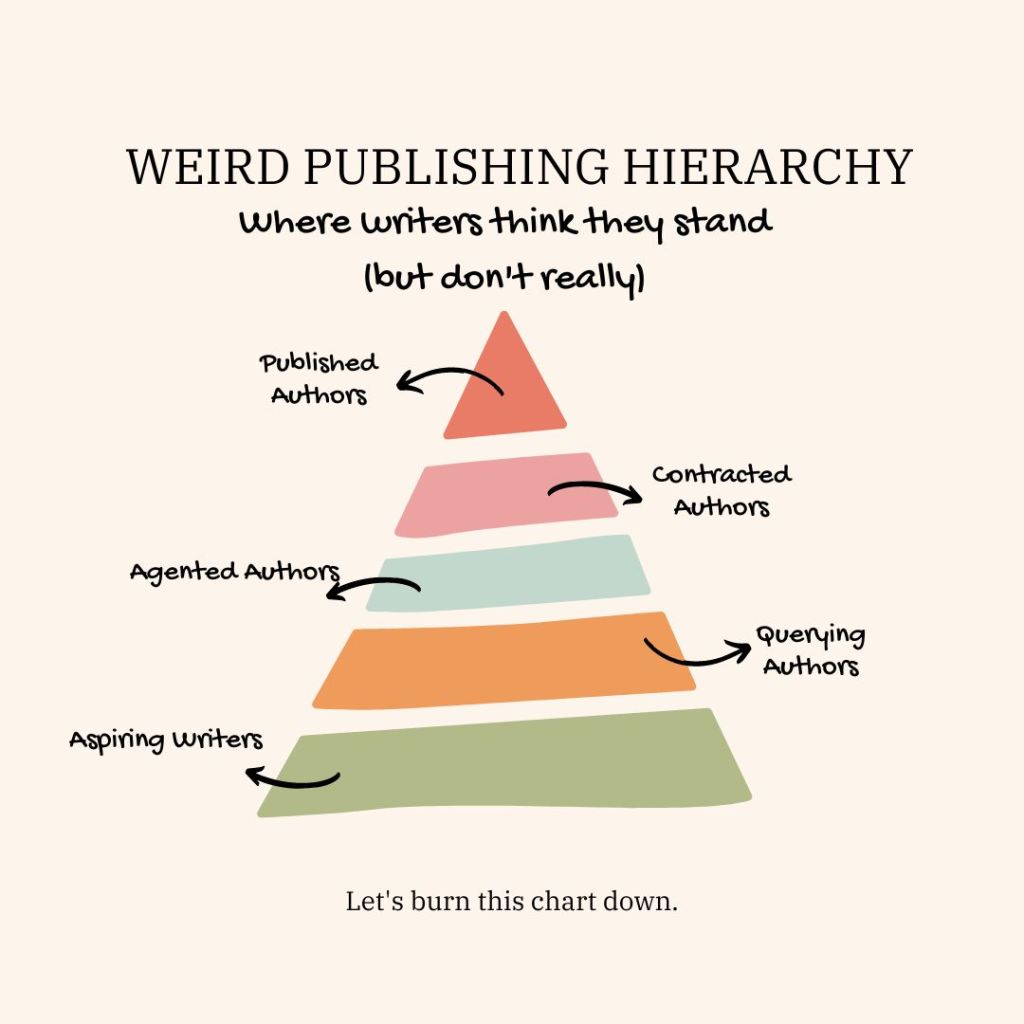
Because this is not uncommon in the entirety of the writing community, not just the Pitch Wars community. You will see if you hang out here enough there is this concept that there exists a hierarchy between authors. A chart is needed. Hold.

Chart: Title "Weird Publishing Hierarchy" which depicts levels. From bottom to top: Aspiring Writers; Querying Authors; Agented Authors; Contracted Authors; Published Authors. Subtext: Let's burn this chart down.
If this chart makes you uncomfortable, good. Me too. Let’s do something about it.

If you’ve been around long enough, you’ll have had the weird experience of watching your friends level up through this chart. You’ll have also likely seen some drama around people leveling up through this chart and leaving their friends behind. There is nowhere this phenomenon happens faster than in Pitch Wars. And if you’re on the inside of it, you get to watch this weird hierarchy play out in rapid fire fashion as some folks level up and others do not. Right now, at this very moment, my Pitch Wars peers are basically at all levels of this chart. The first book from my class comes out soon. Many book deals have been announced. Even more agent announcements. Still more of my classmates are querying new books, still looking for their agents. Some have veered off the traditional path all together, choosing indie presses or self-publishing. Some, like me almost, stepped back from writing all together.

But the thing I noticed while watching this all happen was that it’s not always as simple as “level up, leave behind.” There is so much more nuance behind it. I, for one, in my grief, tried to leave my core group of Pitch Wars friends… a couple of times. I felt like I was dragging them down, holding them back, being too depressing, dampening their joy. I felt like I was too lame for them with their fancy Big Five book deals and big shot agents. They, thankfully, dragged me back.

Now that I have an agent myself (weird), I also notice there’s a bit of a dynamic put on authors at perceived “higher” levels from those “beneath” that makes this all the stranger. My opinion seems to automatically matter more because I have an agent, which honestly, y’all it shouldn’t. It’s luck. You will never see me giving away a query critique because my query stats are objectively terrible. I still can’t write a synopsis. Don’t misunderstand, I learned a lot from Pitch Wars, and I continue to learn about my craft every day from writers everywhere on this pyramid. I will speak on what I believe I know enough about to speak on, but my advice is no more valuable than anyone else’s and in many cases, my un-agented CPs know just as much if not more than I do about loads of craft things.

All this long winded thing to say: We’re all writers. We all have valuable advice to bring to the table, and none of that is earned by any milestone along the way. It’s earned the way all knowledge is earned: by study. So don’t let where you are on this pyramid thing define who you are as a writer, and don’t let it change the way YOU act around other writers (you can’t change how they act around you, obviously, but one side of this can be controlled at least). If you feel your friends leaving you behind, ask yourself, truly, are they? Or are you?

TL;DR Don’t push your friends away because you think you’re not worthy of them anymore because they got a Fancy Book Deal or a high profile agent. If they’re your real friends, they are not going to give a shit. They’re still going to crack jokes with you about opening pickle jars and ask you for cat pics. Because besides all being writers, you are first and foremost all friends.

Picture of a gray and white cat sitting in front of a bowl of pickles.
Apropos of absolutely nothing, I JUST SO HAPPEN to have a picture of my cat Hope with pickles.

So, to my Pitch Wars 2021 Class, happy one year post-showcase. I am so proud of each and every one of you. And I can’t wait to see what the next year brings.

Xoxo,

Aimee

How to Write (and not Write) Bi Characters

Author’s Note: This blog might have some spicy takes in it but please note it is not a blog-sized subtweet of any particular book, genre, series, or author. I genuinely want to try and explain some things for my fellow writers so what I’m seeing so much of I can see less of, because it’s… not great. Also, remember this is not a be-all, end-all, that no marginalized person can speak for the whole, we are not a monolith, and every experience is different, especially where intersecting identities exist. Please don’t use this blog as anything more than a tool and one perspective. Please also don’t think to use it as a way to try to analyze anyone’s sexuality (i.e. you did one of the things so you must not be bi and are writing outside your lane). Don’t do this, because you don’t know. This is for writers to improve their own representations, not dissect others’ in a way to potentially hurt them. Many authors are not actively out for safety reasons, and they should not be forced out to “prove” anything.


Dear fellow authors,

Bisexual characters are not a quick and easy worldbuilding nod to the LGBTQ community at large. Please stop using them as such.

Yep. I just went there.

If you’re bisexual, you might be nodding. I hope you’re nodding. If you’re not, you might be wondering what the hell I’m talking about. Let me elaborate on this somewhat spicy take.

I have noticed recently what seems to be an uptick of what I assume are well-intentioned authors attempting to diversify their worlds by building in bisexual characters. It seems like they might think bisexual characters are easier to write than other LGBTQ characters, but they’re not. To be fair, I don’t actually know why they’re doing it. I can’t get in their heads anymore than they can get in mine, but the way I’ve seen these characters written that seems to be the most likely situation.

If you’re still lost, let me just dive in to what I’m seeing that makes my head swivel and my back tense and how to make it better, shall we?

Image of a blackboard with a chalk drawing of a boy in shorts and a tee-shirt carrying books at the bottom of a set of steps, each on reading a different word. Ascending order: Start, fair, good, very good, excellent success.
To offset some of the spicy I provide motivational images. Time to whip characters and your worldbuilding from surface level nods to allyship to an actual world that accepts bisexuals. Image by Gerd Altmann from Pixabay

Bisexuals Don’t Forget They’re Bisexual

Example:

Character A (cis female presenting as hetero) says to Character B (cis male presenting as hetero and an obvious love interest) “If only I could find the prince I’m looking for.” Her eyes darted to the side, and after a beat she added, “Or princess.”

This kind of thing seems to find its way into a lot of books these days. And I think it’s well-intentioned. I think the authors writing this are intending to say to the LGBTQ community, “I am an ally and I recognize you’re here. May I present you with this character?” But the problem is that this character is not bisexual. How do I know?

Well, I wrote Character A! Ha! Jokes aside, this type of character is really just a hetero girl the author added some extra words for one time and then forgot. This kind of dialogue reads to a bisexual (or at least to this bisexual) as an insert character for the author who has forgotten the character is supposed to be bisexual and quickly adds it in. As a bisexual woman, let me tell you about how I never forget I’m bisexual despite many people in my family wishing I would. The other part of my sexuality is not really an afterthought to be casually tossed in then not mentioned for the next 400 pages.

Could it be written to imply the character is embarrassed or nervous to admit her sexuality? Absolutely, but it almost is never done in a way that suggests that because it’s like a drag and drop. Whoop, I’m bisexual in this sentence and that’s that. If your intent is to indicate some kind of embarrassment, that really should be explored more for the representation to be more than surface level. I really would recommend you get a second read from a beta or CP or sensitivity reader on any exploration of that, because as someone who has spent most of my life closeted, that embarrassment and shame is real but it is… there’s a lot going on that you can do wrong. I don’t even write it (yet).

If it’s the more common thing I think it is, and the author is trying to indicate the character is bisexual then never talk about it again, I have some news. Don’t do that. Bisexuals don’t stop being bisexual when they meet the love interest (regardless of gender). They also aren’t going to forget it. You don’t have to bang the reader over the head with a bisexual mallet or anything, references can be subtle, something as simple as the character taking notice of something attractive in the opposite gender, maybe. An off-handed comment here or there. But please spare us from the casual, “Hey, remember on page 10 when I hinted I was maybe into girls then never looked twice at another girl for the entire book except to view them as competition between me and the boy?” I just… am not going to buy that as a real bisexual character.

Cartoon image of a blue elephant holding a blue picket sign that says "Don't forget"
Don’t forget that we don’t forget. Unless we have ADHD and forget everything. KIDDING, those of us who have ADHD still don’t forget our sexuality but fun side note I’m going to briefly touch on intersectional identities later. Stay tuned. Is this blog long? Ask yourself, did I write it? Then you should know the answer already. Image by Gerd Altmann from Pixabay

We aren’t half hetero and half lesbian/gay. Bisexuality is a unique experience

Example:

Character A (cis girl explicitly stated to be bisexual and described as having a previous girlfriend) meets Character B (cis boy presenting as hetero who is the love interest). Character A, upon meeting Character B, never looks at another girl, or mentions, discusses, her bisexuality ever again.

This one is a little more spicy, I know. Especially framed this way, which is exactly why I put it this way. So let me first say that you as a human and your characters in fiction who are bisexual are always bisexual regardless of the relationship you and they are presently in. How you identify your sexuality is between you and whoever you want to know, and the same is true for your characters. In real life, I am a cisgender, bisexual woman in a monogamous relationship with a cishet man. This does not make me less bisexual.

However, if you are not a bisexual author and you are writing the narrative in the example above or something akin to it, you might not be digging deep enough. First of all, bisexuality is a spectrum. Second of all, as a bisexual woman, I am not part lesbian and part straight. When I’m with my male partner, I am not hetero, just like when I was with females I was not a lesbian. Being with one gender or the other doesn’t “turn off” some other switch in my brain. I am still attracted to women when I’m with a man, and I’m still attracted to men when I’m with a woman. I don’t ever stop noticing either.

Sometimes I think hetero authors might try to write bisexual characters as their “token” queer characters because they think “Well, I can empathize with half of this person, at least.” Which I appreciate the attempt at empathy, truly. But that isn’t how it works. It is pretty obvious to those who actually are bisexual that’s what you’re trying to do, though. Like you tried to reduce a person’s unique experience to a binary, sever it, cut out the portion you don’t understand (while paying cheap lip service to it), then focus on the portion you do.

Again, appreciate the effort to try and be inclusive, but… don’t do this. That’s not how this works. Bisexuality runs through the entirety of my life the same as everything else about me that makes me who I am. Loving my boyfriend and being devoted to him didn’t “cure” me of being attracted to women anymore than it “cured” me of my trauma or anxiety or anything else. And yes, I mean “cure” in a roll my eyes sort of way, not a real sort of way. Obviously I do not believe I or anyone else needs to be “cured” of their sexuality.

Cartoon images of many different faces on squares in the colors of the bisexual flag (Pink to purple to blue)
There are so many ways to be bisexual but none of them are by being gay or a lesbian. Image by wage212 from Pixabay

Bisexuality Isn’t Being “Open Minded”

Example:

Character A (cis male presenting as hetero) is forced into an arrangement whereby he must marry for political reasons. While there is no evidence in the text to indicate he is bisexual, he still welcomes male suitors into his court, but he never actually goes on dates with any of them, and they are hardly mentioned except to remind readers every once in awhile they’re there (and they’re men!)

This one. Oh man, this one. Okay, I know this might seem nice and logical in 2023 when we all want to be open-minded and inclusive and that’s great. And a political marriage has nothing to do with attraction or love anyway, right? So what does it matter? Well, it matters because this kind of worldbuilding implies that bisexuality is in some way a choice. Or that it can be. Which is really harmful because there are a lot of people (even in the queer community itself) who still don’t believe bisexuality is “real.” Who still are operating on the binary. One or the other. Anything else is a cry for attention or “edgy” or trying to be I dunno, “woke” or some shit. Like being bisexual is super cool and trendy, and we definitely never get persecuted by friends, family, coworkers for it. Like we definitely wanted to make a choice that makes people feel awkward around us sometimes and scares away potential partners and makes others think we’re into sexual shit we’re not. Like… oop, doing it again gonna stop.

So when we as writers world build what essentially constitutes a “choice” to be bisexual, it further solidifies the idea in people’s minds that this is some liberal nonsense that should be snuffed out and erased. And that’s… well, it’s hard.

Real talk, as someone who has experienced the shit end of this kind of harassment, who has repeatedly been told her sexuality isn’t real, or is a phase, or is “trauma-induced,” or that it’s some kind of attention-seeking behavior, I can tell you it really sucks. It makes you question yourself, your reality, your own experiences. I’ve spent a large chunk of my life closeted, feeling like I had no right to write bisexual characters, to call myself bisexual, to speak on subjects like this because of exactly this kind of thinking baked into books I love.

So here’s the thing, I can’t speak for the entirety of the queer community, but if you’re trying to world build inclusively, there are ways to do it without… this. I would rather have a hetero character courting exclusively women than a poorly crafted hetero man pretending to be open-minded enough to “choose” to be bi for political reasons. In my opinion, that’s just giving a weapon to some ignorant asshole to hurt the community you’re trying to be an ally to.

Photo of a red-painted sign against a large tree trunk. Sign reads "Eat, Drink and Be Married"
+ Be Authentically Queer (or not, no rep is better than bad rep, I said what I said). Photo by Ben Rosett on Unsplash

Avoid Common Bisexual Stereotypes

Final thing then I will stop, I swear. But, like all marginalizations, there are some common stereotypes that you should avoid if you’re trying to write an authentic bisexual character. This list isn’t exhaustive by any means, but it does contain the ones I personally see in fiction (and TV) most often:

  1. Bisexuals are cheaters. This is by far and away the most common stereotype about bisexuals you will hear bisexuals yell about. Rightfully so. The common thinking is something like because bisexual people are attracted to more genders they have more temptation. Or something. Do bisexual people cheat sometimes? Yes. Do they cheat because they’re bisexual? No. They cheat because people cheat and bisexual people are, in fact, people. Surprise! If you’re not bisexual, probably don’t write bisexual cheating, though. Like just leave that nuance to those who have had to deal with the bullshit. We got it.
  2. Bisexuals are promiscuous. Sort of related to the above, but there’s a stereotype that bisexuals will basically sleep with anyone or anything because I don’t know, they can? Which is wild, because if you’ve tried to date within the last 5-7 years you’ll know it is harder than it seems to find someone who will even swipe right on you. Subcategory, bisexuals don’t want to have auto-threesomes. Sorry. Many of us are just regular old homebody types who have enough trouble managing the one partner. There are definitely bisexual folks out there in healthy, loving polyamorous relationships, but I absolutely would not recommend tackling this unless that is your lived experience. There isn’t much in print, and it needs to be approached with nuance from several different angles that are not “sex sells.”
  3. The Evil Bisexual. For some reason I see a lot of bisexual villains. If you’re going to write a bisexual villain, please make sure you have some bisexual goodies to make up for the badies.
  4. The One Exception. Liking all women and one goofy dude who happens to be the love interest? Just… I mean does it happen? Sure. But it’s not the most common bisexual experience, and it seems overrepresented and sort of plays into that whole idea of bisexuality being a phase or a one-off weird thing on your way to hetero or lesbian. And that’s… not how it is.
  5. Not including intersectional experiences. This one is tricky, I know, but it’s absolutely crucial not to forget when crafting characters that there are intersections of identities at play everywhere. Not all bisexuals are white women. Trans and nonbinary people are not excluded from the bisexual experience. Know that there can be bisexual people who are ace or aro. I’m not going to speak to these experiences because they are not mine, but they exist and they should be recognized.
  6. Not using the word “Bisexual.” A lot of bisexuals like to see the word actually written and not used as some kind of dirty word or with shame or judgment. I… do not use the word bisexual in my fantasy writing; however, I do not use the word with intention. It’s part of my own worldbuilding which is queer normative and usually label free (and second world fantasy, not using the word bisexual would make absolutely no sense in a book set in Philadelphia in 2022).
  7. Bisexual Erasure. In case you’re thinking, “Wow, this all sounds like a lot, maybe I just won’t have bisexual characters in my book at all” I have news. Bisexual erasure is also really common (possibly because it IS difficult to accurately represent this sort of nuanced perspective), and is one of the things the bisexual community has really worked to bring awareness to in recent years. Good news is I think it’s working! People are starting to include bisexual characters in their works. Now, we just need a little more leveling up from the superficial to the fully rounded.

And here is perhaps my spiciest take of all. In my opinion, moderation is key. You don’t have to tackle it all at once. You don’t have to include in your novel a bisexual of every variation, or understand every nuanced identity intersection. That would be a lot for one book and your book should be about more than like… an encyclopedia of bis. Plus, there are other people and experiences to show and think of. The world is big and different and no one who is reasonable is expecting you to fit the entirety of the human experience into one novel. Pick and choose what you think you can write most authentically, and go for it. Don’t surface level that shit so you can check as many boxes as possible. There are a lot of us writing our own stories that deep dive into our identities. All we need from you is empathy when you write characters like us. Quality over quantity.

Questions?

I really need to work on wordcount on these blogs. But if after ALL THAT you’re still curious about writing an authentic bisexual character, please feel free to email me at aimee@aimee-davis.com and I will do my best to try and get back to you with what information I can!

Happy writing!

Xoxo,

Aimee

Opening up the Shelf: Adult SFF

Author’s Note: Today, I am going to talk about my #PitchWars book ALL HER WISHES specifically, but only as a way to address some swirling thoughts I’ve had about adult fantasy in general. For those who don’t know, my 2021 #PitchWars book ALL HER WISHES is a dual-POV, adult fairytale retelling told from the POVs of a selfish fairy godmother who hates her job but is trying to be good at it in order to save her best friend’s Destiny, and the villain (who happens to be the MC’s ex) who is trying to sabotage all that for, well, vengeance, obviously. It is an enemies-to-lovers, second chance love story set within a fractured fairytale world.

When I submitted to Pitch Wars in 2021, I entered All Her Wishes as a Romance (with a capital R). At the time, I had no idea what it actually was. What I did know was I’d never read anything quite like it in Adult Fantasy, though plenty of things like it exist within Young Adult Fantasy. I figured it would never “make it” if I endeavored to set it on a Fantasy shelf beside Tolkien and George R.R. Martin and All the Characters Who Stab. There are no swords, no graphic violence, no wars, no epic quests. There’s no need for a map (I can’t read them and neither can my main character), no invented languages or species, no explanations of geography or the genealogy of my characters going back 700 generations.

I didn’t love the idea of submitting it as a Romance, because somehow, it felt like cheating. But I had sent a few queries prior to Pitch Wars and the only feedback I’d received was “Sounds adorable! I’ve checked with some people, and no one knows who or how to market it.” So, somehow it seemed like because Wishes didn’t have all the above things meant it was “lacking” and therefore not Fantasy and maybe? a? Romance? Which, also felt gross. Because Romance, for the record, is not lacking in shit. Seriously, stop saying, believing, perpetuating any stereotype that Romance is anything but the badass queen of the publishing castle. Facts: Romance is the highest grossing genre in publishing (at $1.44 billion in revenue last year, take that to the bank and suck it). Romance authors are kings and queens of their art, and they deserve so much credit for what they do. The fact they don’t get it is a whole other blog post for another day. Also, Wishes’ love story does not make it less of a Fantasy.

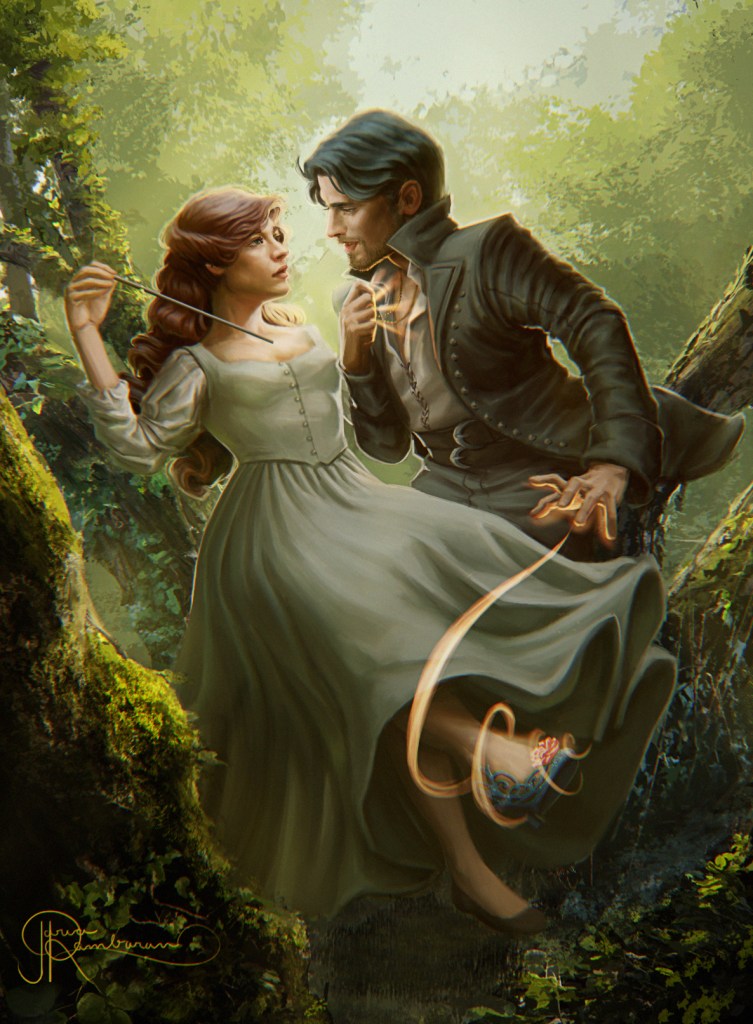
A white woman with auburn hair in a green gown leans back against a tree, pointing her wand downward while a white man with dark hair wearing a dark jacket leans toward her, holding his hand to her foot.
Am I going to take this opportunity to drop this beautiful artwork for the book despite the fact it is everywhere on this website? Absolutely. Image © Jaria Rambaran  

Good news, my mentor also didn’t love that I’d submitted it as a Romance. Primarily because it hit NONE of the Romance beats and to make it do so was going to be a Herculean task that might have destroyed the structure of the actual story. We spoke at great lengths about my feelings on whether it was primarily a Romance or a Fantasy, and though I said to her I didn’t have strong feelings either way and in private said to my friends I would make it whatever the hell she wanted if it got me into Pitch Wars, the more I started to think on it, the more I realized I did have strong feelings about where Wishes ended up on the shelf.

ALL HER WISHES is Fantasy, capital F. It’s a story about magic, about friendship, about villains and heroes and the mistakes they make and the prices they pay. There are princes and princesses, fairy godmothers and evil queens, multiverses, and magic systems. There is world building and palace intrigue, and yes, there’s a whole lot of kissing, and because it’s adult, sex too. There’s love, but when did Fantasy stop becoming Fantasy because there was love?

Would Neil Gaiman’s Stardust find itself on a Romance shelf because it’s primarily the story of a boy out to win the heart of a girl and in so doing falls in love with another? What about one of the most quintessential epic fantasies of all time, the Wheel of Time series where the main character, Rand Al’Thor, is involved in a polyamorous relationship with three women? Do we discount the romance in that series because there’s enough words around it to ignore it? What about a more recent example in Jay Kristoff’s Nevernight? Mia Corvere, that series’ main character is about as ensconced in romance as she is in blood. Or do these authors get a pass because they’re *AHEM* white men? It’s fine, y’all, they’re writing MANLY love stories. Which is totes fine. Manly man’s masculinity is not threatened as long as the love story is also written by a man, am I right? Okay, I should sit down before I refuse to get off this here soap box. WHOOPS.

Drawing of a white girl in a blue dress with a purple bow standing on a soap box washing on a wash board over a large basin of water.
Oh look, it’s me getting back into the time period I’m expected to be in. I kid, I kid.

As I worked on my revisions of Wishes throughout Pitch Wars, these thoughts continued to poke at my brain. Where did my book go on the shelf, and why was I so afraid to say with these others?

Afraid.

Yep. There it was. I was afraid. Because there exists in Adult SFF a sort of elitism not unlike what I remember from my undergraduate days at UNC spent arguing Chekhov and Hemingway and preparing for an MFA at Iowa. Because obviously you go to Iowa. That is the only option for a Serious Writer. In Adult SFF there is a similar feel to this lit fic like discourse that’s more akin to: Obviously you write epic fantasy of a political nature, heavy on the world building, light on the romance, or you are not a Serious Fantasy Writer.

It feels a little… Gamergate to me, truth be told. And after I got done being afraid, I got irritated. If you couldn’t tell.

The thing is, I believe all genres should be for everyone, which means we have to tell lots of different kinds of stories within our genres to welcome lots of different kinds of people into not only our genres, but reading in general. That’s how we cultivate growth, and learning, and a body of literature that expands our experiences beyond what we know which is literally one of the main points of all reading but especially freaking fantasy!

So it’s time to open up the shelf to new stories that go beyond the old elitist thoughts of what Adult Fantasy should look like. Stories that include subgenres like urban fantasy, and contemporary fantasy, and yes, fairytale retellings, and stories from non-western mythos, and romantasy. And stories written from different perspectives than we’re used to seeing. Stories from women, and POC, and LGBTQ folks, and ND people, and disabled people. I want to see stories about Black grandmas riding dragons, 20-somethings in wheelchairs shooting flames from their spokes and owning their sexuality, and stories about brown women trying to juggle being the badass court sorceress while being pregnant and having a baby. It’s time for a new canon of fantasy that is relevant to the readers who fell in love with fantasy during the YA fantasy boom brought on 20 years ago.

Because guess what? We aren’t teenagers anymore, but we still like fantasy. And sure, some of us do like politically epic fantasy with sprawling worlds and all that other stuff (although I can bet you based on my anecdotal research a fair few more of them are reading R.F. Kuang than they are Robert Jordan these days). But loads of us want a fresh array of new stuff. Short stuff. Different stuff. Weird and wacky stuff. Stuff that is relevant to our lives and our world and yes, that’s important even if it’s a fantasy.

Book cover: The Remarkable Retirement of Edna Fisher by E.M. Anderson. A red cover with a dragon flying over a city skyline.
I would be remiss not to mention my agent sib has just such a book coming out soon. Which you can preorder HERE.

So here’s my plea to not only publishing but the readers who love my genre as much as I do: Support new voices in Adult SFF. Writers and readers alike. Don’t push them out because they’re different or you think the books they write or the books they like aren’t “serious” or otherwise “enough” of something for you. If they haven’t read all of the Lord of the Rings books, they can still love Fantasy. If they don’t know with perfect precision the specs of every species from a series they say they love, they can still love that series. If they don’t know which superhero fits into DC or Marvel, they should still be welcome. There should be no criteria to liking fantasy books other than, well, liking fantasy books.

Welcome them! Open up the shelf! You never know, they could be the author who writes your next favorite book!

Xoxo,

Aimee

Don’t Give Up… Too Soon

I know. I just wrote a How I Got My Agent post that was all about why it’s totally okay to quit. AND IT IS. To be clear. There is no right or wrong time to quit. Or to get back in the game. Or to leave it entirely. Or to try something new. Publishing is dynamic, and you can be, too. What you should not be is knee-jerk reactionary because you read some Bad Advice on Twitter™. Of which there appears to be a lot lately.

If you are new to querying, please go read my agent sib, E’s How I Got My Agent post first. There’s some Very Good Advice™ to be had there that we really don’t talk about enough. Like how pre-pandemic querying advice should be thrown out the window and some great tips on setting limits to help your mental health through this most arduous of journeys. My personal favorite being letting someone else have control of your query inbox. Which, by the way, if you don’t have a separate email JUST for querying, I do recommend setting one of those puppies up and giving yourself a specific ringtone for it that you can also just… turn off.

This post is sort of the reaction (not knee-jerk) to E’s post, which made me realize my own How I Got My Agent novella was great for those long-time queryers who were worn to pieces but maybe wasn’t considering the message I might be giving to writers new to the trenches. Fortunately, E to the rescue to rectify my oversight!

However, this post is also the reaction (knee-jerk, a bit, yes) to some new Bad Advice™ I’ve seen making the rounds on Twitter (again). Evergreen bad advice. Everyone’s favorite.

Evergreen tree to the left with opaque light shining down. Image by Pexels from Pixabay.

Luck is a real thing. It has nothing to do with you.

You could write an objectively fantastic book. It could hit all the right writerly things. It could have a great hook, a cool concept, a fantastic story arc, fast pacing, hit its beats with dynamite precision, and prose that makes the reader’s mouth pop open into a delighted little “O.” But let’s say for shits and giggles it’s a new adult portal fantasy about giant Donny Darko bunnies navigating their way through college who get sucked into a weird space/time dimension. Okay, clearly I don’t read a ton of sci-fi but DO YOU GET MY POINT? If the book is not hitting the right market at the right time, it can be the best fucking book anyone has ever read and no agent will request it because they can’t sell new adult right now, never mind portal fantasies that maybe are also sci-fi genre blending. This has NOTHING to do with you as a writer or your ideas or your book. Maybe in two years new adult will be a thing in traditional publishing. Or portal fantasy will be back. Or genre blending will be the next hot trend. But right now, that’s probably going to be a whole nope.

GIF of figure in bunny mask from Donnie Darko. Source: https://tenor.com/view/darko-donnie-gif-18843800

I don’t consider myself a very lucky person, but I obviously have been. Here are just SOME of the ways I have gotten lucky over the past couple decades of this wild publishing journey of mine:

  • At the very last moment a spot became available at a retreat in 2017 put on by MadCap Retreats and We Love Diverse Books and when I applied, I was able to snag it. There, I was able to make some amazing connections, many of whom are still my friends, CPs, and were influential in getting me where I am today
  • I got rejected from #PitchWars and #AMM and #RevPit a million times, yes, but I also made SO MANY friends and connections along the way
  • Two of the people I met at that conference in 2017 and one of the people I met during AMM helped me do BIG EDITS to the book that would FINALLY get me into #PitchWars
  • Being a #PitchWars mentee absolutely gave me a bigger platform than other querying writers
  • The #PitchWars showcase went very poorly for me, yes, but I again, made friends and CPs and supporters – AND one friend in particular who REFERRED ME to my now-agent (Gabriella you are amazing I owe you forever!)
  • My agent passed on my first book queried but was kind enough (and liked my writing enough) to request another book which is the one that ended up being The One
I sit in front of a monitor with my Pitchwars swag during another rewrite of the book that would eventually get me my agent.

A lot of things had to come together over a long period of years for me to get to that one single yes, and much of it involved luck and opportunity and yeah, hustle. I had to recognize the luck when it was happening and seize it, for sure. But to just pretend it was all me working my ass off and no just like… happenstance would be doing a disservice to other writers who are working THEIR asses off and no magic is happening.

Which is to say, if you’re working your ass off and nothing is happening, it doesn’t necessarily mean you’re doing anything wrong. You could just be having shitty luck. There’s no way to control luck, but you can keep trying. Or not. Up to you. But don’t give up because someone said you had [arbitrary number of rejections] so you must be Writing Bad. Nope. No. Wrong.

Privilege is also real. Don’t minimalize it.

Privilege comes in so many forms. Whiteness. Straightness. Able-bodied-ness. Economic privilege has huge power in publishing. Connections. Networking. Who you can rub shoulders with (or not). A lot of the same things that fall under the category of “luck” for me can also fall under privilege.

  • That retreat in 2017? It was lucky a spot opened up and that I got in. But if I hadn’t had the money to afford to go, all the luck in the world wouldn’t have made a damn bit of difference
  • During the #PitchWars revision period, I was in the middle of transitioning jobs, which was actually just lucky timing, but I was economically privileged enough to be able to take a full month off between the two jobs to focus ONLY on my revisions. Many of my peers did not have this advantage
  • Do I think my whiteness and overall appearance of straight-passing/non-disabled in a profile pic helps me? I would be stupid not to

That said, the things you can’t see about me in a smiling photo on Twitter or my gushing about some kittens have hurt me. Almost destroyed me. Almost smashed this glass slipper of a dream against the cobblestone. Migraines. Broken teeth. Nerve damage in my back. Disassociation. My sexuality and coming out and what that has cost. The exposure putting my touch aversion and trauma on full display brings that I never really calculated. How talking about my recovery from addiction has ostracized me in IRL circles. So much incalculable pain to chase this thing I might never really hold to tell these stories the world might not even want.

It takes someone special to understand the unique experiences of people digging deep from these wells. That has nothing to do with you. It’s a them problem. Not a you problem. That doesn’t mean it doesn’t hurt just as much, though. Your pain is valid and real, and I see you. But please do not let anyone drive you to quitting or changing your story or taking your identity out of it because of some un-nuanced hot take on Twitter. You are the only one who can tell your story. Finding someone to champion it, well, that’s the journey. If you want to take it.

Blue cake with a glass slipper on it with a bookmark that reads “You’re never too old for faerytales” next to a pink rose in a glass case.

Sometimes, it takes a few (dozen) books.

You can be writing good books now. Probably are! But if you love your writing and your craft, they’ll only get better. So, if you still love writing, and it isn’t taking a toll on your mental health, keep writing them! Don’t let anyone tell you you’re a one hit wonder. There’s always a chance to circle back on that other book that just wasn’t quite right for whatever reason. I know loads of people who have resurrected shelved books with their agents and gone on to sell them when the market was better for that book or their craft was better for that revision.

Also, if you need a personal example, a reminder that my agent passed on one of my books, requested another right away, and offered on it. So clearly it wasn’t “you suck as a writer” it was “this isn’t quite the right book for me right now what else you got?” And because I had been querying forever, there was in fact something else! Bonus to querying forever! So, for any new writers who are wondering, “Do agents really mean it when they say I hope you’ll consider me for your next project?” Yes! They do! A vast majority of my agented friends have agents who rejected previous projects.

Do not Self-Publish just because

Before I wrap this up, I do want to add this last part. Because hidden among some of the Bad Advice I’ve seen making the rounds on Twitter is some Good Advice. But it’s (of course) lacking some meat on its bones.

There are loads of reasons to choose to self-publish. You want the book in the world, have some money to spend (and know how much that will cost and how much you can afford), and don’t care how much money you’ll make as long as you can have something in your hands. You are a very savvy marketer who can write fast and have a great business plan and are ready to make a business of this whole self-publishing thing. You want a super expensive hobby and that’s cool if that’s all it ever is. The list goes on.

You should not self-publish because you’ve been querying for five months and have received twenty form rejections and fuck it. Self-publishing is a VERY big endeavor. It’s a whole business unto itself and you can incur tons of debt very quickly if you aren’t going in with your eyes wide open. Sadly, there are also a lot of folks who will prey off your desire to get your book into the world no matter the cost. Self-publishing should really be taken seriously and considered for a long time. Don’t allow rejections from traditional publishing to send you into debt if you’re not in a position to take it on. Instead, try some of the tips in my agent sib’s How I Got My Agent post to stave off (some) of the sads.

TL;DR I self-published two books in 2016 and 2017. I’m very proud of them, but I wish I had not done it. It cost me $10,000 that would have been better put to other uses. I made less than $1,000 on both books. This is a more common experience than the “I make six figures a month self-publishing and YOU CAN TOO*” stories you hear.

*All you have to do is buy my 7-book series on how to accomplish this and attend my $1,500 course on how to do it ‘right.’

Don’t let Bad Advice Get you Down

So all this very wordy post to say simply: Querying is hard. And shitty. It takes forever. And involves way too many things you have zero control over which is exactly why you see so many of these “Just do X” or “If you are getting X query response, then Y” posts. People are trying to help you (and probably themselves) regain some control over a process that is totally uncontrollable. I get it. I like rules too. And control. Boy, do I like control.

But I don’t like lies. And that’s what all that shit is, I’m afraid. Lies. There is no One Good Way to query. If there was, we’d all be doing it and getting our agents and taking publishing by storm. Or probably more realistically someone would be hoarding it and selling it to the highest bidders.

Either way, if you need to quit for you, absolutely do it. But don’t give up too soon. If people like E and me can tell you anything it’s that even when you think there isn’t, there’s a lot of story still left.

Xoxo,

Aimee

How I Didn’t Get My Agent

2023 Update: This post was originally posted in 2019. It was the last post on my website before I shut it down. Now that I reactivated it to tell my very own How I Got My Agent story, it seemed fitting I leave this here as well, as a reminder. This is not always (or often) an easy journey.

Trigger/Content Warning: This post is sad. It is coming from a really dark place and is my mental illness speaking through me. If you’re not in a good place for that kind of dark content, please tread no further, I would never want the expression my mental health to hurt someone else’s.


You know the posts about How I Got My Agent? A lot of your favorite authors have them on their website. Most of them are stories of victory over adversity. They’re about the pains of the querying trenches all being worth it. They’re about how there’s a light at the end of the tunnel. They’re really cool and often so inspiring.

This post isn’t that.

I’ve been crying for three days. I can’t stop. Every time I think I have it under control, it starts again. My throat burns, and I’m having trouble breathing my sinuses are so choked. I can’t sleep, can’t taste the food I eat. When I go to the gym, I end up sobbing so hard I can’t keep going. The other day after another unsuccessful workout, I curled into a ball on the yoga mat I was stretching on and fell asleep. Things aren’t good with me.

I’ve been rejected. Again. From Pitch Wars, again. For the third time. It’s a new manuscript but the same results. This book was a bright and shiny beacon I was so, so proud of. But I was proud of the last one, too. And it was rejected twice from Pitch Wars and received 27 form rejections or spots of silence after that. The last manuscript didn’t receive a single request from a single agent I submitted to. It seems like this one is headed down the same path.

After I was sure I wasn’t going to be getting into Pitch Wars, I braved the querying trenches once more. I want this so bad. And this manuscript, I assured myself, is different. It’s special. It’s so much of me that someone has to see it for what it is. I have worked so fucking hard.

Not hard enough. I received my first form rejection within 24 hours of sending the first query. Here we go again.

I laid under my desk at my day job where I work as a paralegal, surrounded by smart people I really like but who I’m so jealous of because they will always be more important and make more money than me because they have a piece of paper I don’t, and I wept. And when one of my coworkers found me, I blamed my period and ran to the bathroom to continue crying alone.

This isn’t my period. I haven’t gotten my period in three years. The doctors say it’s stress.  Stress I put on myself, or the world puts on me, I can’t be sure anymore. So no, this isn’t that. This is something else. This is the raw, ripe, stinging pain of rejection after rejection after rejection with no shining hope at the end of the tunnel. I am not good enough. I will never be good enough. I am what I am and what I am is not sufficient.

No one tells you about this part. No one records it. It’s not hopeful or pretty or tied neatly with an HEA and a bright red bow at the end. It’s bad for your look to look like no one wants you. But it’s the truth. And if I had a brand, which I don’t because you need to have a product to have a brand, it would be truth.

Here’s the truth. We aren’t all going to get agents and book deals. There are far more of us than there are of them. We aren’t all going to be able to live the dream and make enough money writing to quit our day jobs and pursue our passion. So we need to have contingent dreams. If I could give any young writer advice it would be that: Have another dream. Have something else to care about. Have something else to pay your bills and sate your passion. Search for it if you have to. Demand it of yourself, even if it doesn’t come naturally, even if you’re sure the only thing you’ll ever want is to be a writer. Find. Something. Else.

For me, something else is photography and fostering kittens. Sometimes, something else can almost be my day job. But whatever it is for you, don’t let writing become who you are. Let it be part of you, but not all of you. Save some of you for you.

And when you’re down, find a way to get back up, no matter how hard it is.

Take care of yourselves,

❤ Aimee

Do Audiobooks “Count”?

Woo! Something bookish (besides a book review) to talk about two weeks in a row! Look at me!

So let’s get right down to today’s topic. Do audiobooks count as books read?

Spoiler alert: Yes. They do. And to be honest, I’m not really sure why this is an issue I keep seeing come up, but I do, and it’s starting to get me a little feisty, so here’s my take on it all.

First off, “reading” a book basically means absorbing it, understanding it. When we’re tested on reading comprehension we’re not tested on can. you. read. each. of. these. individual. words. We’re tested on can you string these words into a sentence and understand them. You don’t actually have to physically read the words with your eyes to string them into a sentence and understand them. Simply put, reading is not a physical act you need sight to complete.

Which leads me to my second point which is: it is ableist as hell to tell someone that audiobooks don’t “count” as reading. What about blind folks? Do they have to get a book in Braille for it to count, per this silly rule? Do you know how few physical books there are that are produced in Braille? And how expensive they are? A copy of The Hobbit is $72.95. Want a more recent young adult book? A copy of Ash Princess is $97.95. Game of Thrones$239.95. Audiobooks are expensive, too, don’t get me wrong, but they’re more widely available, and there are many more library options.

It’s not only blind people who this nonsense excludes, either. “Not counting” audiobooks also hurts neurodiverse people. Audiobooks are often used as an alternative method of teaching for kids (and adults) whose brains aren’t neurotypical. Just because some people mix letters up doesn’t mean they’re not able to comprehend stories and information. It doesn’t mean they don’t count.

I think this is really why this issue fires me up, to be perfectly honest. Because by saying audiobooks don’t “count,” it feels like people are saying those for whom audiobooks are the only viable (or affordable or accessible) option don’t “count” when they in fact do. Very much. They’re just as much a part of the literary community as everyone else. I want them as part of my audience. I want everyone as part of my audience. I want that tent to be as wide and welcoming as possible. I don’t care how you absorb stories; I only care that you do.

Ableism is point one and the most important, but point two is time. Some people don’t have time to read as much as they’d like (or at all). Single parents, workaholic types, people having to hold multiple jobs, people doing school and work, those with long commutes, the people who might make up this category are endless. As you get older and take on more and more responsibilities, you have less and less free time. And what free time you have is precious. Maybe you’re trying to get that side hustle going. Maybe you need to spend more time with your partner or children. Maybe you’re just too damn tired from struggling that you can’t make the words turn into sentences at the end of a sixteen-hour day. Audiobooks give you back a little bit of free time because you can read and do other things. I listen to audiobooks on my long commute, at the gym, while I’m cooking dinner, taking the dog on a walk, cleaning my house, etc. All things that need to happen, all things that cut into the time I have to read a physical book. To have the luxury to have so much free time that you can choose not to “count” audiobooks is a privilege, plain and simple.

Final point on why audiobooks definitely count as books read: because not counting them is silly, really. I recently listened to Furyborn by Claire Legrand on audiobook. I wasn’t taken with the narrator, so I read the sequel, Kingsbane, in hardback. Shockingly, I didn’t have to go back and read Furyborn in hardback to understand Kingsbane. I simply picked up the book, opened the cover, and started to read. This is because I’d read it by listening to it. I mean, this is not that complicated.

So, at the end of the day, this is my word problem: According to Goodreads, Aimee has read 55 books this year. If 27 of them were audiobooks, how many books has Aimee read this year?

Answer: Aimee has read 55 books this year.

As always, be kind to yourself, and keep at those Goodreads goals, however you reach them!

❤ Aimee

Mamas Last Hug
Bookstagram photograph from @writingwaimee of audiobook version of Mama’s Last Hug by Frans de Waal surrounded by red butterflies.

All the Rules We Break

Author’s Note: I know I promised this blog yesterday, but it’s been hectic! But! Here it is, alive and well! It’s not edited well because I just flung it up in a rush, but I did the thing, which is great because this post is about YOU doing the thing!


For a good chunk of my writing career, I thought when people said, “Kill your darlings,” they meant that writers should kill their favorite characters. So I took that “advice” and ran with it. For awhile, I literally killed my favorite characters as a writing exercise, or a weird point of pride. Including at the end of romances, which um… did not go down well with romance readers (as it should not have, sorry, early readers at this life stage!)

I was younger then, and like a bright-eyed student thirsty for the knowledge of those older and therefore (I assumed) wiser than me, I took every bit of writing advice I could glean. When I had it, these gems, these treasures, these bits of knowledge that would surely make me Leigh Bardugo famous, I attempted to use them all.

As you might suspect (since I am not Leigh Bardugo famous), a lot of that advice has many interpretations and is quite subjective. A lot of it simply didn’t work for me. And if I’m honest, some if it made me really hate writing.

“Write what you know.” This is the oldest one in the book. Every writing student and aspiring author knows this one. “Write what you know” and “Show don’t tell” might be tattooed on the inside of my eyelids for how often they float through my mind.

I am not going to recreate what has already been done (both poorly and well) here. Google “Write what you know is wrong” and take everything you read with a grain of salt. Be especially careful about white dudes defending cultural appropriation for the sake of “art.” (Read: their Very Important™ writing). Not all of it is wrong, though. But “write what you know” can mean a lot of things. It doesn’t have to mean you can only write your memoir (although, if you have the urge to do that, do that, I need more memoirs to read!) “Write what you know” in the young adult spectrum might be more akin to, “Stay in your own lane” which I wrote about a few weeks ago. “Write what you know” could also mean that the most powerful writing you’ll do is when you’re writing about an experience that is intimately familiar to you. We all have unique experiences that only we can bring our perspective and voice to. But you also don’t have to do it all at once. “Write what you know” doesn’t have to be “Well, I’ve put every important thing on the page in this very first book and now I’m all dry and whatever will I do? I know nothing else!” Because I mean, that’s silly. We’re always experiencing and learning new things.

And now you’re probably wondering … wasn’t this post supposed to be about rule breaking? Why did you just spend 500 words defending The Rule? Well, partly it’s because when I was looking for a quote about writing what you know being flexible, I found all these articles about write what you know is wrong, and they espoused a lot of “cultural appropriation is okay for art,” and I got mad and had to come to The Rule’s defense. But it’s also partly because I wanted to make the point that all these “rules” are subjective. They can be used, and tossed aside, and bent, and broken, and rocketed into the sun strapped to a Tesla. As long as you have a book you’re proud of at the end, however long it takes you to get to that end, then you’ve done the thing!

Speaking of however long it takes, let me talk about one of the rules that isn’t that subjective and which I think is garbage (for me). Please keep in mind I mean in all of this for me. I always hesitate to give writing advice to anyone because everyone is so different. This advice is probably really helpful for some people. I have friends and professors and mentors who swear by it. But it doesn’t work for me, and I want to assure people here that if it doesn’t work for you, that is okay. You can still be a writer/author/creator without some a lot of this.

The advice goes thusly: “The art of writing is the art of applying the seat of the pants to the seat of the chair.” This quote is attributed to writer and activist Mary Heaton Vorse, but it has taken various forms across the years. Most of my writing professors used to advise taking at least one hour per day to write. To put your ass in the chair and get it done. To ground out words even if they sucked.

No shade to my professors, but as it turns out, academia makes a nice butt cushion. In my experience, 12-16 hour workdays don’t leave much time for the butt in chair exercise every day. My workdays start with household chores at 6:30 a.m. and don’t usually end until 8 p.m (on a good, 10 hours at work, workday). That doesn’t really leave much mental or physical energy for butt in chair time. I know people who get up even earlier to put their ass in a chair, and I admire that. But I have night terrors. If I go to bed at 11 p.m. and wake up at 6:30, with my nightmares, on a good night, I’ll be living on 5 hours of sleep. This is my life. Every day.

I’m not complaining, and I don’t want pity. It’s just my life, which is different than every other life. My life doesn’t have time for butt in chair exercises every day. That’s okay, though. As it turns out, I’ve been able to write 4 1/2 books in less than 4 years just writing when I can. Sneaking it in here and there when work is slow, taking days off solely to write, staying up late on days when I have the energy, putting a lot of time in on the weekends. But it’s not every day, and it isn’t consistent. Sometimes, I’ll go months without writing. I have to put food on my table and my primary job is what does that. No matter what though, I still get back to doing the thing.

And you can, too. You can do the thing. You don’t need every single “rule.” You can tell sometimes. Some stories need more telling than others. You don’t have to write every day. You can write stuff you don’t know (again, I mean like write about six-legged ponies, not cultural appropriation). You can write in tenses that aren’t active. You can throw jargon all over your damn page. You can write sentences so long even lawyers’ eyes will bug out at the sight of them. You can write how you want to write. It is your story and your voice and your art. There are really no “rules” to writing in the end. Only guidelines. Take what works for you and phooey on the rest.

old-1130743_1920

That said, what is your favorite writing “rule” (especially if it’s one you’ve come up with for yourself?)

< Always, Aimee